 Ozali dino nini? Kwizi
 Etumba ya badino
 Mbangu ya badino
 Masano mike ya badino
 Albumu ya bastika
 Bilisti TOP ya badino
 Kamwisa ngai!
Pengornis
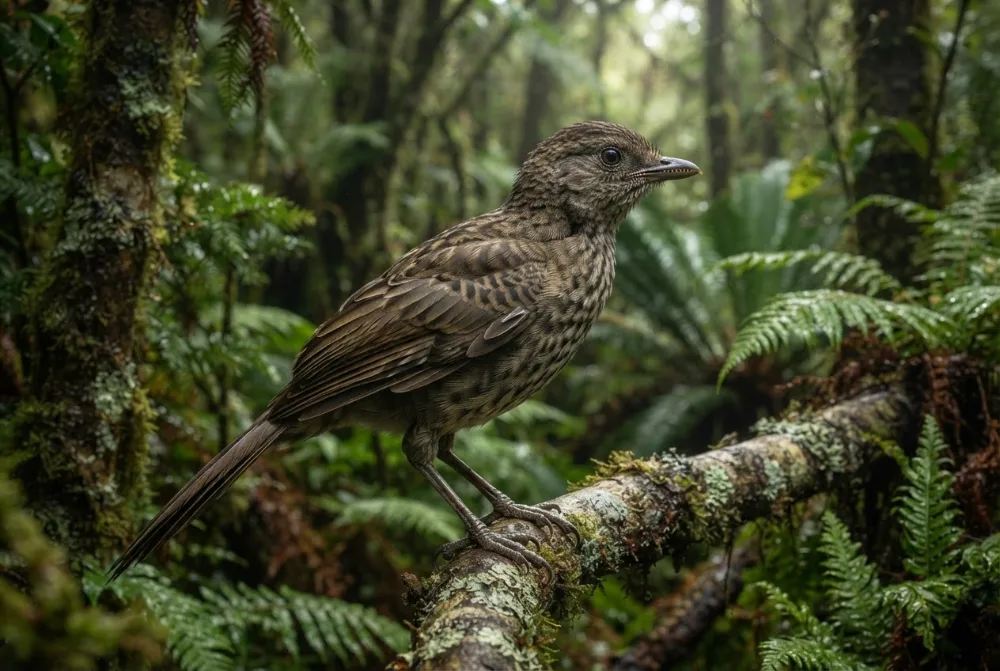
Pengornis was a bird that lived in the Early Cretaceous, about 120 million years ago. It was one of the biggest birds of its time, with a wingspan as wide as a small car. It had tiny teeth and ate meat.21
Azalaki na bomoi ntango nini?
Azalaki na mbangu boni?


Makambo ya kosepelisa
Pengornis is the largest known enantiornithine bird from the Early Cretaceous of northeast China.1
Its skull is one of the best preserved among all Mesozoic birds, showing details like tiny teeth and wear facets.2
Pengornis had a globose humeral head that stuck out further than its deltopectoral crest, a feature not seen in other enantiornithines.2
The name comes from 'Peng', a giant mythological bird in Chinese folklore, and 'ornis' meaning bird in Greek.1
Its teeth were small, conical, and not curved, similar to those of the early bird Archaeopteryx.2
Pengornis had a long tail with a pygostyle, a fused bone at the tip that helped control flight.2
Mituna oyo batunaka mingi na ntina na Pengornis
?How big was Pengornis?
Pengornis was a small bird with a wingspan of roughly 1 meter (3.3 feet). It is the largest known enantiornithine bird from the Early Cretaceous.13
?Did Pengornis have teeth?
Yes, Pengornis had tiny, conical teeth that were not curved, similar to those of the early bird Archaeopteryx. It had about 13 teeth in its lower jaw and used them to eat meat.13
?When did Pengornis live?
Pengornis lived during the Early Cretaceous period, about 120 million years ago.1
?What does the name Pengornis mean?
The name Pengornis comes from 'Peng', a giant mythological bird in Chinese folklore, and 'ornis', which means bird in Greek.1
Mpo na bayebi ya badino
- Nkombo ya siansi
- Pengornis
- Nkombo epesamaki na
- Zhou et al. 20084
- Lisanga
- Bandeke ya liboso
- Libota / klade
- Pengornithidae4
- Klasifikasio
- Theropoda > Avialae4
- Mbula ya mabanga
- mbula milio 121 kino 113 (Aptian)4
- Milongo ya mabanga
- Jiufotang4
- Bikolo
- Sina4
- Bafosile oyo ekomami
- 1 na The Paleobiology Database4
- Ntango bamonaki yango
- Pengornis was named in 2008 by Zhou, Clarke, and Zhang based on a nearly complete skeleton found in the Jiufotang Formation in Liaoning, China. The species name 'houi' honors the pioneering paleo-ornithologist Lianhai Hou.12
- Naino bazali kowelana
- Scientists debate whether Enantiornithes and Ornithurae (the group including modern birds) are truly separate groups. Pengornis has features of both, which blurs the line.12
Esika makambo euti
- Pengornis (en.wikipedia.org)
- Insight into diversity, body size and morphological evolution from the largest Early Cretaceous enantiornithine bird (pmc.ncbi.nlm.nih.gov)
- Insight into diversity, body size and morphological evolution from the largest Early Cretaceous enantiornithine bird - Zhou - 2008 - Journal of Anatomy - Wiley Online Library (onlinelibrary.wiley.com)
- Pengornis in The Paleobiology Database (CC BY 4.0): mbula, bisika, milongo ya mabanga, klasifikasio.
Likambo nyonso na lokasa oyo ezali na nimero oyo elakisi liziba na yango. Soki tosali libunga, limbisa biso, tozali bato balingaka badino, zulunalo ya siansi te. Yebisa biso na [email protected] mpe tokobongisa yango.
 Rex azali na nzala! Dino Wiki ezali mosala ya tata moko mpo na mwana na ye ya mobali oyo alingaka badino, ofele, piblisite te mpe batrakere te. Bato bakolo bakoki kopesa Rex biskwi mpo na kosalisa ete etikala na internet.Leisa Rex
 Archaeopteryx
 Hesperornis
 Ichthyornis
 Baptornis
 Jurapteryx
 Gobipteryx
 Stegosaurus
 Iguanodon
 Giganotosaurus
 Microraptor
 Deinonychus
 Baryonyx