 Ozali dino nini? Kwizi
 Etumba ya badino
 Mbangu ya badino
 Masano mike ya badino
 Albumu ya bastika
 Bilisti TOP ya badino
 Kamwisa ngai!
Platecarpus
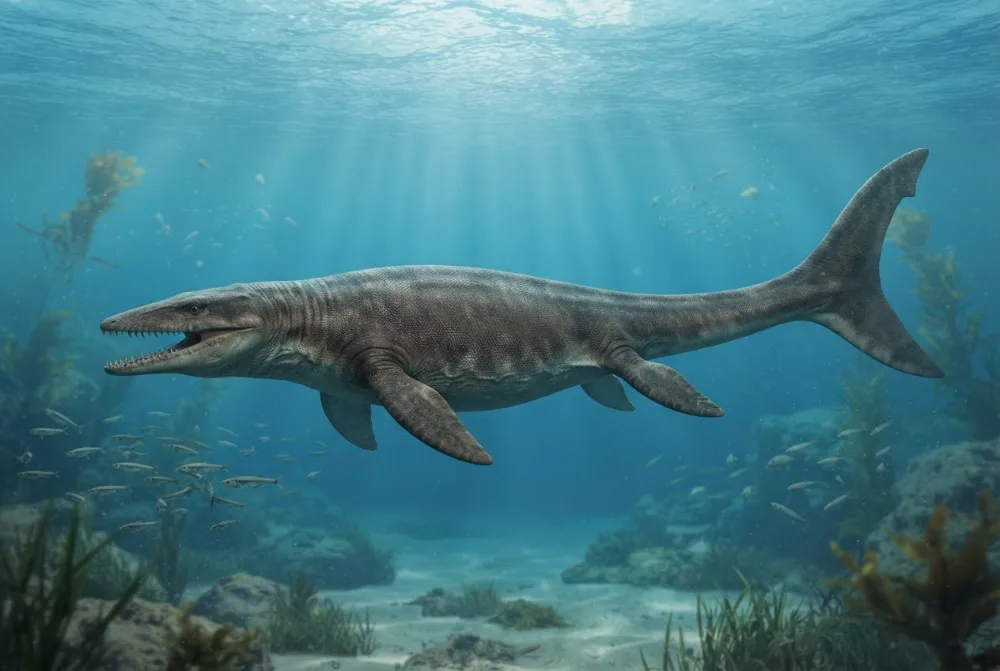
Platecarpus was a fast-swimming marine lizard that lived in the sea during the time of the dinosaurs. It had a long tail with a shark-like fin and ate fish and squid. Platecarpus was not a dinosaur, but a mosasaur, a kind of giant sea lizard.1
Azalaki na bomoi ntango nini?
Azalaki monene boni?
Azalaki molai boni?
 molai lokola bambwa 6 zolo kino mokila🍌molai lokola matoko 32 oyo balandani🏊akokaki kobeta mai bolai ya pisine monene (50 m) na sekonde 4,7
Platecarpus azalaki monene boni soki tokokanisi na YO?
Kaka matematiki na navigatere na yo. Eloko moko te ebombami to etindami esika moko.
Azalaki na mbangu boni?


Makambo ya kosepelisa
Platecarpus had a short skull and fewer teeth than any other mosasaur, with only about 10 teeth in each lower jaw bone.1
A well-preserved fossil shows skin impressions, pigments near the nostrils, and even the shape of the tail fluke, which was like a shark's tail.1
Platecarpus swam by moving its tail side to side, but its deep tail fin made it a powerful, fast swimmer, not like an eel.1
Fossilized stomach contents show that Platecarpus ate fish and did not digest its food completely, passing bones and scales quickly.1
A 2026 study of tooth chemistry suggests that Platecarpus was warm-blooded, like modern sharks and whales.1
Platecarpus fossils are very common in the Smoky Hill Chalk of Kansas, which was once the bottom of a shallow sea.1
Mituna oyo batunaka mingi na ntina na Platecarpus
?How big was Platecarpus?
About 5.7 metres (18.7 feet) long, based on a complete fossil. That is roughly the length of a small bus.1
?What did Platecarpus eat?
It ate medium-sized fish, and probably also squid and ammonites. Fossil stomach contents show it swallowed fish whole and digested them quickly.1
?When did Platecarpus live?
It lived about 84 to 81 million years ago, during the Late Cretaceous period. That was the time of the dinosaurs.1
?Is Platecarpus a dinosaur?
No, it is not a dinosaur. It is a mosasaur, a kind of giant marine lizard that lived in the sea.1
?Where have Platecarpus fossils been found?
Mostly in the United States, especially in Kansas. Fossils have also been found in Belgium, Australia, and Africa.1
Mobuki masapo
Lisapo: Many people think mosasaurs like Platecarpus swam like eels, wiggling their whole body.
Solo: Platecarpus had a crescent-shaped tail fluke and swam more like a shark, using its tail for powerful thrusts.1
Mpo na bayebi ya badino
- Nkombo ya siansi
- Platecarpus
- Nkombo epesamaki na
- Cope 18692
- Lisanga
- Bamozazore
- Libota / klade
- Mosasauridae2
- Klasifikasio
- Mosasauroidea2
- Mbula ya mabanga
- mbula milio 100 kino 66 (Cenomanian / Maastrichtian)2
- Milongo ya mabanga
- Pierre Shale, Niobrara, Molecap Greensand2
- Bikolo
- Amerika, Kanada, Suwede, Brezili, Ositrali, Rusi2
- Bafosile oyo ekomami
- 60 na The Paleobiology Database2
- Ntango bamonaki yango
- Platecarpus was named by the famous paleontologist Edward Drinker Cope in 1869, based on fossils found in Mississippi, USA.12
- Naino bazali kowelana
- Scientists still debate whether some fossils belong to Platecarpus or to other closely related mosasaurs, and some species have been moved to different genera.1
Esika makambo euti
- Platecarpus (en.wikipedia.org)
- Platecarpus in The Paleobiology Database (CC BY 4.0): mbula, bisika, milongo ya mabanga, klasifikasio.
Likambo nyonso na lokasa oyo ezali na nimero oyo elakisi liziba na yango. Soki tosali libunga, limbisa biso, tozali bato balingaka badino, zulunalo ya siansi te. Yebisa biso na [email protected] mpe tokobongisa yango.
 Rex azali na nzala! Dino Wiki ezali mosala ya tata moko mpo na mwana na ye ya mobali oyo alingaka badino, ofele, piblisite te mpe batrakere te. Bato bakolo bakoki kopesa Rex biskwi mpo na kosalisa ete etikala na internet.Leisa Rex
 Mosasaurus
 Prognathodon
 Tylosaurus
 Clidastes
 Globidens
 Halisaurus
 Tyrannosaurus
 Triceratops
 Velociraptor
 Spinosaurus
 Ankylosaurus
 Parasaurolophus