 Ozali dino nini? Kwizi
 Etumba ya badino
 Mbangu ya badino
 Masano mike ya badino
 Albumu ya bastika
 Bilisti TOP ya badino
 Kamwisa ngai!
Protopteryx
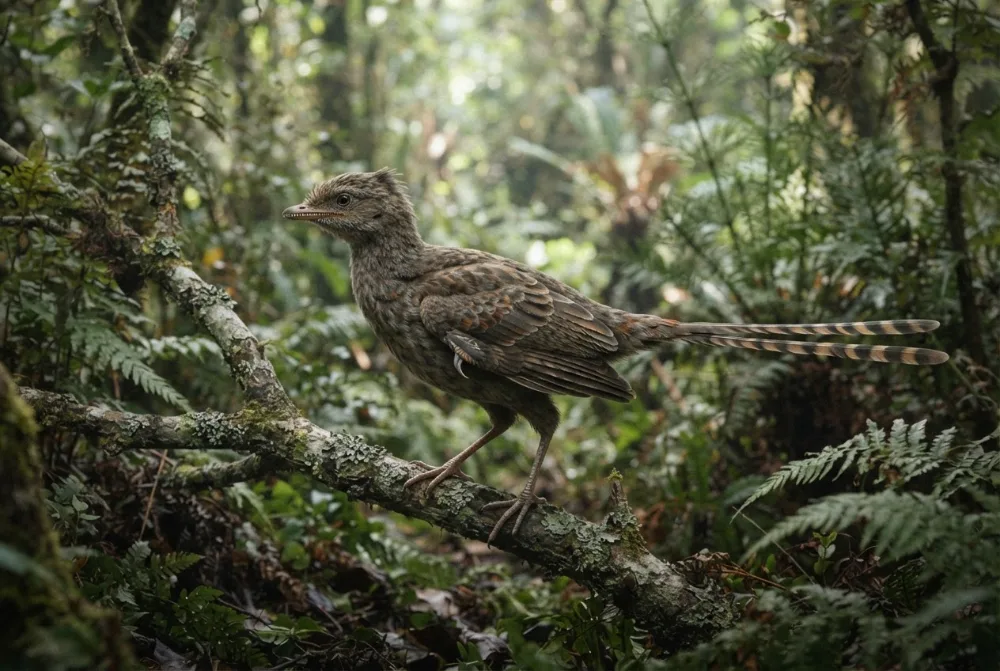
Protopteryx was a tiny early bird that lived about 131 million years ago in what is now China. It had two long, ribbon-like tail feathers that were different from any modern bird's feathers. This little bird could fly and probably ate small animals like insects.14
Azalaki na bomoi ntango nini?
Azalaki monene boni?
Azalaki molai boni?
Azalaki molai boni na likolo?
kokanisa
Azalaki kilo boni?
Protopteryx azalaki monene boni soki tokokanisi na YO?
Kaka matematiki na navigatere na yo. Eloko moko te ebombami to etindami esika moko.
Azalaki na mbangu boni?


Makambo ya kosepelisa
Protopteryx is one of the oldest and most primitive members of the group Enantiornithes, which were early birds that lived alongside dinosaurs.1
Its two central tail feathers were scalelike without barbs near the body, only having barbs at the tips. This is similar to the tail feathers of the modern red bird-of-paradise.12
Protopteryx was about the size of a modern starling, with a body length of only 10 centimetres (3.9 inches) not counting its long tail feathers.1
Its body was covered in three types of feathers: down feathers, flight feathers, and the long ribbon-like tail feathers.1
The down feathers of Protopteryx had flat, frayed tips instead of the hairlike barbs seen in modern birds.1
Protopteryx had a triosseal canal, a feature in the shoulder that helped with flight, and this is one of the earliest examples in birds.2
Mituna oyo batunaka mingi na ntina na Protopteryx
?How big was Protopteryx?
About 10 centimetres long, not counting its long tail feathers. It was roughly the size of a modern starling.1
?What did Protopteryx eat?
It probably ate small animals like insects. Its teeth are similar to those of Archaeopteryx, which suggests a similar diet.1
?Could Protopteryx fly?
Yes, it was adapted for flying. It had a triosseal canal in its shoulder and asymmetric wing feathers, just like modern flying birds.1
?Why did Protopteryx have long tail feathers?
The long, ribbon-like tail feathers were probably used for display, not for flying. They only had barbs at the tips, similar to the red bird-of-paradise today.1
Mpo na bayebi ya badino
- Nkombo ya siansi
- Protopteryx
- Nkombo epesamaki na
- Zhang and Zhou 20004
- Lisanga
- Bandeke ya liboso
- Libota / klade
- Enantiornithes4
- Klasifikasio
- Theropoda > Avialae4
- Mbula ya mabanga
- mbula milio 133 kino 121 (Hauterivian / Barremian)4
- Milongo ya mabanga
- Huajiying4
- Bikolo
- Sina4
- Bafosile oyo ekomami
- 2 na The Paleobiology Database4
- Ntango bamonaki yango
- Protopteryx was named by Chinese paleontologists Fucheng Zhang and Zhonghe Zhou in 2000 based on a fossil found in the Yixian Formation of Hebei Province, China.14
- Naino bazali kowelana
- Scientists are still debating whether the long, ribbon-like tail feathers of Protopteryx were used for display, thermoregulation, or sensing the environment.1
Esika makambo euti
- Protopteryx (en.wikipedia.org)
- A Primitive Enantiornithine Bird and the Origin of Feathers (science.org)
- Anatomy and Flight Performance of the Early Enantiornithine Bird Protopteryx fengningensis : Information from New Specimens of the Early Cretaceous Huajiying Formation of China (anatomypubs.onlinelibrary.wiley.com)
- Protopteryx in The Paleobiology Database (CC BY 4.0): mbula, bisika, milongo ya mabanga, klasifikasio.
Likambo nyonso na lokasa oyo ezali na nimero oyo elakisi liziba na yango. Soki tosali libunga, limbisa biso, tozali bato balingaka badino, zulunalo ya siansi te. Yebisa biso na [email protected] mpe tokobongisa yango.
 Rex azali na nzala! Dino Wiki ezali mosala ya tata moko mpo na mwana na ye ya mobali oyo alingaka badino, ofele, piblisite te mpe batrakere te. Bato bakolo bakoki kopesa Rex biskwi mpo na kosalisa ete etikala na internet.Leisa Rex
 Archaeopteryx
 Hesperornis
 Ichthyornis
 Baptornis
 Jurapteryx
 Gobipteryx
 Stegosaurus
 Iguanodon
 Giganotosaurus
 Microraptor
 Deinonychus
 Baryonyx