 Ozali dino nini? Kwizi
 Etumba ya badino
 Mbangu ya badino
 Masano mike ya badino
 Albumu ya bastika
 Bilisti TOP ya badino
 Kamwisa ngai!
Saurornithoides
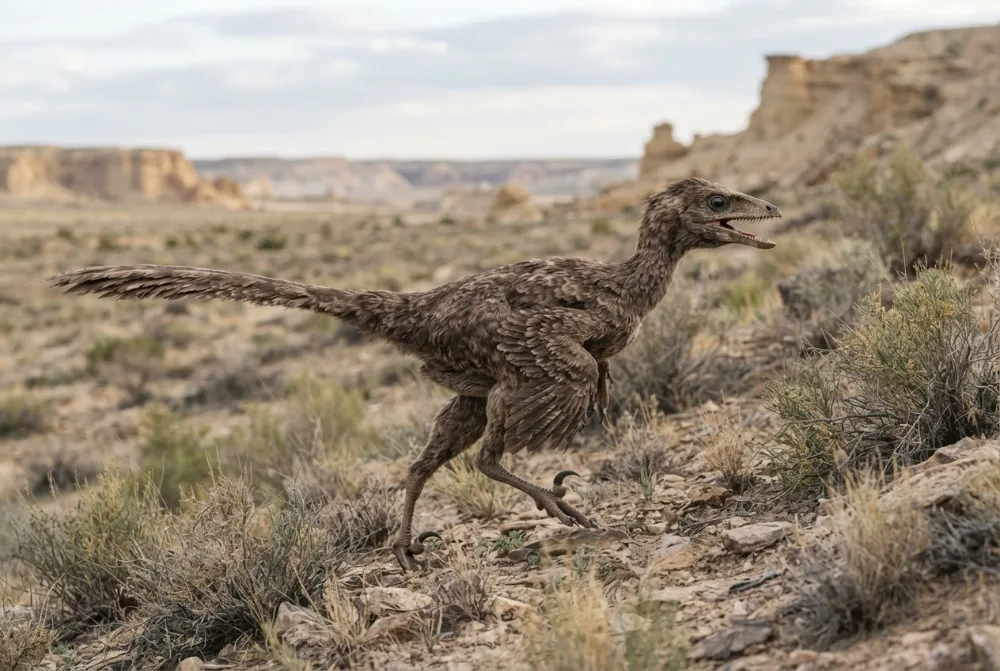
Saurornithoides was a small, fast, bird-like dinosaur that lived in the Late Cretaceous period. It had big eyes for seeing in the dark and a sharp claw on each foot to catch its prey. This smart hunter probably scoured the Gobi Desert for small mammals and reptiles.1
Azalaki na bomoi ntango nini?
Azalaki monene boni?
Azalaki molai boni?
Azalaki molai boni na likolo?
kokanisa
 molai lokola bapusu 5 ya ndako zolo kino mokila🍌molai lokola matoko 13 oyo balandani🏃akokaki kopota metele 100 na sekonde 8,2 (moto oyo aleki mbangu asalelaka 9,6)
Saurornithoides azalaki monene boni soki tokokanisi na YO?
Kaka matematiki na navigatere na yo. Eloko moko te ebombami to etindami esika moko.
Azalaki na mbangu boni?


Makambo ya kosepelisa
Saurornithoides had a large brain for its size, making it one of the smartest non-bird dinosaurs.1
Its eyes were huge and gave it excellent stereoscopic vision, which helped it judge distances when hunting at night.1
The first Saurornithoides fossil was found on July 9, 1923, by a Chinese employee of an American Museum of Natural History expedition named Chih.1
A baby Saurornithoides had very strong leg bones, suggesting that troodontid babies could walk soon after hatching and needed little parental care.1
It had a retractable sickle claw on the second toe of each foot, like its cousin Troodon.1
The name was originally going to be 'Ornithoides' (bird-like), but Henry Fairfield Osborn changed it to Saurornithoides when he formally described it in 1924.1
Mituna oyo batunaka mingi na ntina na Saurornithoides
?How big was Saurornithoides?
About 2 metres (6.6 feet) long. That is roughly the length of a large sofa.3
?What does the name Saurornithoides mean?
It means 'bird-like lizard' in Greek, because its skull looked like a bird's.3
?Was Saurornithoides related to Velociraptor?
Yes, it resembled Velociraptor. Both are theropod dinosaurs.1
?Where was Saurornithoides found?
In Mongolia, in the Gobi Desert. Its fossils come from the Djadochta Formation.1
?When did Saurornithoides live?
It lived during the Late Cretaceous period, about 85 to 80 million years ago.3
?How many species of Saurornithoides were there?
Only one valid species is known: Saurornithoides mongoliensis. Other named species have been moved to different dinosaurs or are no longer considered valid.1
Mpo na bayebi ya badino
- Nkombo ya siansi
- Saurornithoides
- Nkombo epesamaki na
- Osborn 19244
- Lisanga
- Baraptore
- Libota / klade
- Troodontidae4
- Klasifikasio
- Theropoda > Theropoda > Troodontidae > Compsognathidae4
- Mbula ya mabanga
- mbula milio 100 kino 66 (Cenomanian / Maastrichtian)4
- Milongo ya mabanga
- Djadokhta, Hell Creek, Bayan Mandahu4
- Bikolo
- Mongoli, Amerika, Sina, Uzbekistani4
- Bafosile oyo ekomami
- 8 na The Paleobiology Database4
- Ntango bamonaki yango
- Saurornithoides was named by Henry Fairfield Osborn in 1924 based on a skull and other bones found in Mongolia by a Chinese collector named Chih in 1923.1
- Naino bazali kowelana
- Scientists are not sure whether Saurornithoides is more closely related to North American troodontids like Troodon or to other Asian troodontids.2
Esika makambo euti
- Saurornithoides (en.wikipedia.org)
- A review of the Mongolian Cretaceous dinosaur Saurornithoides (Troodontidae, Theropoda). (American Museum novitates, no. 3654) (digitallibrary.amnh.org)
- Saurornithoides | Natural History Museum (nhm.ac.uk)
- Saurornithoides in The Paleobiology Database (CC BY 4.0): mbula, bisika, milongo ya mabanga, klasifikasio.
Likambo nyonso na lokasa oyo ezali na nimero oyo elakisi liziba na yango. Soki tosali libunga, limbisa biso, tozali bato balingaka badino, zulunalo ya siansi te. Yebisa biso na [email protected] mpe tokobongisa yango.
 Rex azali na nzala! Dino Wiki ezali mosala ya tata moko mpo na mwana na ye ya mobali oyo alingaka badino, ofele, piblisite te mpe batrakere te. Bato bakolo bakoki kopesa Rex biskwi mpo na kosalisa ete etikala na internet.Leisa Rex
 Velociraptor
 Microraptor
 Deinonychus
 Asiamericana
 Richardoestesia
 Saurornitholestes
 Tyrannosaurus
 Triceratops
 Spinosaurus
 Ankylosaurus
 Parasaurolophus
 Pteranodon