 Ozali dino nini? Kwizi
 Etumba ya badino
 Mbangu ya badino
 Masano mike ya badino
 Albumu ya bastika
 Bilisti TOP ya badino
 Kamwisa ngai!
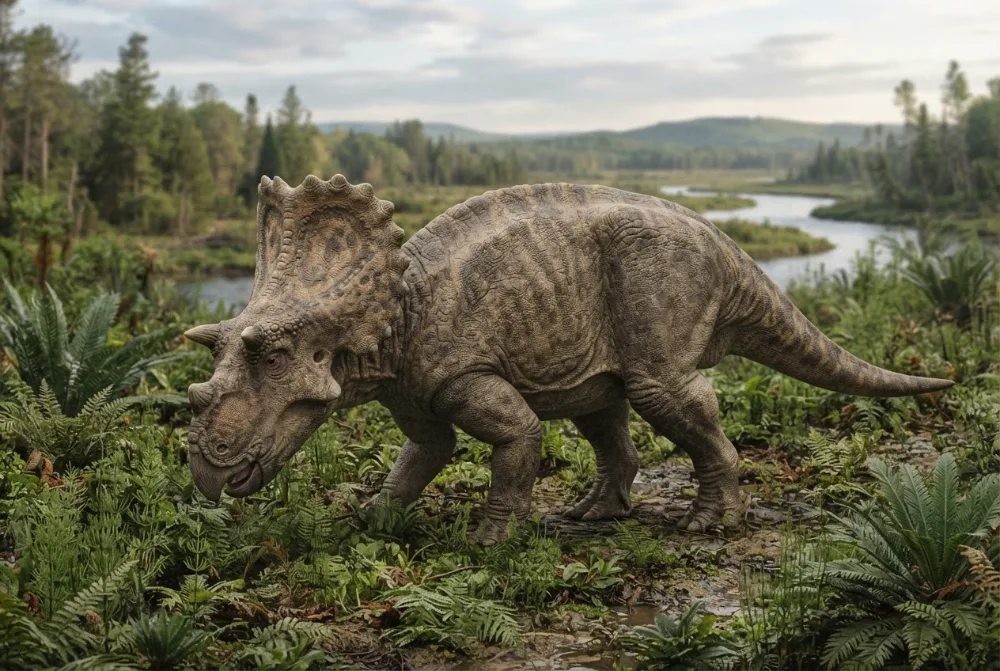
Vagaceratops
Vagaceratops was a plant-eating dinosaur with a big, square frill on its head. It had short brow horns that looked like bumps and a weird, wavy edge on its frill made of flat bones. It lived in what is now Canada and the USA about 76 million years ago.1
Azalaki na bomoi ntango nini?
Azalaki monene boni?
Azalaki molai boni?
Azalaki molai boni na likolo?
kokanisa
Azalaki kilo boni?
 molai lokola bambwa 4 zolo kino mokila🍌molai lokola matoko 25 oyo balandani🍉kilo lokola bapasteke 240🧸kilo lokola bana 63 ya eteyelo ya bana mike🎒kilo lokola bana 38 ya kelasi🐻❄️kilo lokola ba-urs ya pembe 2,5🏃akokaki kopota metele 100 na sekonde 9,5 (moto oyo aleki mbangu asalelaka 9,6)
Vagaceratops azalaki monene boni soki tokokanisi na YO?
Kaka matematiki na navigatere na yo. Eloko moko te ebombami to etindami esika moko.
Azalaki na mbangu boni?


Makambo ya kosepelisa
Vagaceratops had ten epoccipitals, which are small bones around its frill. Eight of them were flat and curved forward, making a jagged edge.1
Its frill was wider than it was long, which is unusual for chasmosaurine dinosaurs.1
Vagaceratops was first thought to be a species of Chasmosaurus, called Chasmosaurus irvinensis, before being given its own name in 2010.1
Scientists are not sure if Vagaceratops is more closely related to Kosmoceratops from Utah or to Chasmosaurus.1
The name Vagaceratops means 'wandering horned face' because it is closely related to Kosmoceratops, which lived far away in Utah.1
Vagaceratops lived during the Late Cretaceous period, about 76.2 million years ago.1
Mituna oyo batunaka mingi na ntina na Vagaceratops
?How big was Vagaceratops?
Vagaceratops was a medium sized ceratopsian, reaching about 4.5 metres (15 feet) in length and weighing about 1.2 tonnes (1.3 short tons).1
?What did Vagaceratops eat?
Vagaceratops was a plant-eating dinosaur. It had a parrot-like beak for cropping plants.1
?Why is it called Vagaceratops?
The name means 'wandering horned face' because it is closely related to Kosmoceratops, which lived far away in Utah.1
?Is Vagaceratops the same as Chasmosaurus?
Scientists disagree. Some think Vagaceratops is its own genus, while others think it is a species of Chasmosaurus called Chasmosaurus irvinensis.1
Mobuki masapo
Lisapo: Vagaceratops had long, sharp horns on its brow like Triceratops.
Solo: Vagaceratops had very short brow horns that were reduced to low bumps, not long spikes.1
Mpo na bayebi ya badino
- Nkombo ya siansi
- Vagaceratops
- Nkombo epesamaki na
- Sampson 20102
- Lisanga
- Badino na maseke
- Libota / klade
- Ceratopsidae2
- Klasifikasio
- Ornithischia > Ceratopsia > Ceratopsidae2
- Mbula ya mabanga
- mbula milio 84 kino 72 (Campanian)2
- Milongo ya mabanga
- Dinosaur Park, Oldman, Judith River2
- Bikolo
- Kanada, Amerika2
- Bafosile oyo ekomami
- 7 na The Paleobiology Database2
- Bayebi ye mpe na nkombo
- Mercuriceratops (bankombo ya kala oyo sikoyo batangaka lokola nyama moko)2
- Ntango bamonaki yango
- Vagaceratops was named by paleontologist Scott D. Sampson and colleagues in 2010. The fossils were originally described in 2001 as a species of Chasmosaurus, but later moved to a new genus.1
- Naino bazali kowelana
- Scientists still debate whether Vagaceratops should be its own genus or just a species of Chasmosaurus.1
Esika makambo euti
- Vagaceratops (en.wikipedia.org)
- Vagaceratops in The Paleobiology Database (CC BY 4.0): mbula, bisika, milongo ya mabanga, klasifikasio.
Likambo nyonso na lokasa oyo ezali na nimero oyo elakisi liziba na yango. Soki tosali libunga, limbisa biso, tozali bato balingaka badino, zulunalo ya siansi te. Yebisa biso na [email protected] mpe tokobongisa yango.
 Rex azali na nzala! Dino Wiki ezali mosala ya tata moko mpo na mwana na ye ya mobali oyo alingaka badino, ofele, piblisite te mpe batrakere te. Bato bakolo bakoki kopesa Rex biskwi mpo na kosalisa ete etikala na internet.Leisa Rex
 Triceratops
 Protoceratops
 Ojoceratops
 Tatankaceratops
 Psittacosaurus
 Centrosaurus
 Tyrannosaurus
 Velociraptor
 Spinosaurus
 Ankylosaurus
 Parasaurolophus
 Pteranodon