 Kwizi ya Ndiwe dino uti?
 Nkhondo ya madino
 Mpikisano wa madino
 Masewera ang'onoang'ono a madino
 Chimbale cha zomata
 Mindandanda ya TOP ya madino
 Ndidabwitse!
Achelousaurus
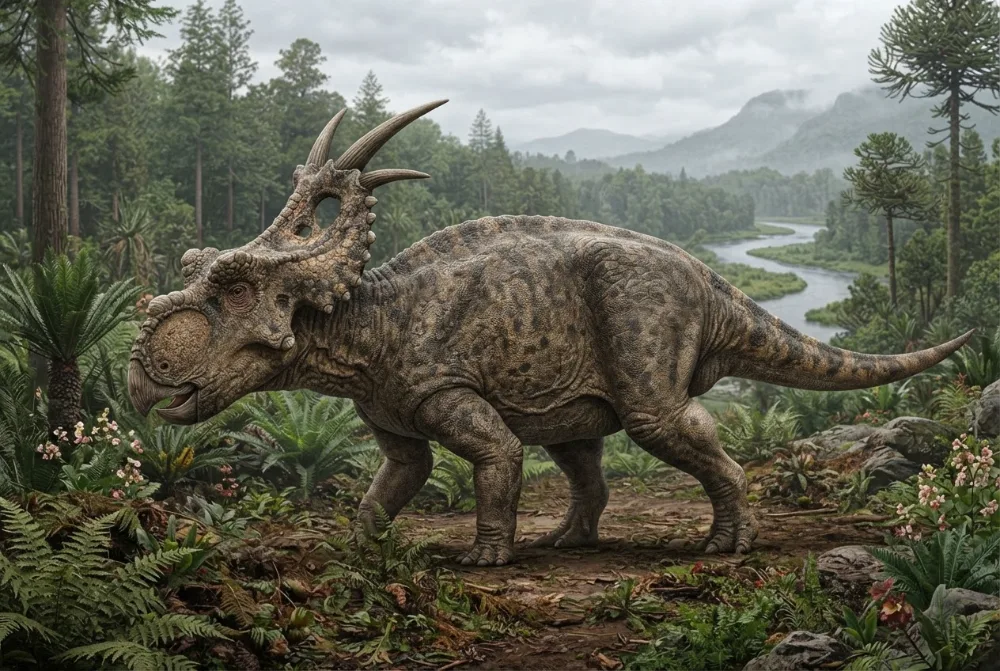
Achelousaurus was a horned dinosaur that lived in North America about 77 to 74 million years ago. It had a big bony frill on its head and two long spikes pointing out from the back of its skull. Instead of sharp horns above its eyes, it had rough, bumpy bosses like a bison.1
Ankakhala liti?
Anali wamkulu bwanji?
Anali wautali bwanji?
Msinkhu wake unali wautali bwanji?
kuyerekeza
Ankalemera bwanji?

 wautali ngati agalu 6 otsatizana mphuno ndi mchira🍌wautali ngati nthochi 33 zotsatizanawolemera ngati agalu 150🍉wolemera ngati mavwende 600🎒wolemera ngati makalasi athunthu a ana a sukulu 4🐻❄️wolemera ngati zimbalangondo zoyera 7🏃akanatha kuthamanga mamita 100 m'masekondi 12 (munthu waliwiro kwambiri amafunika 9.6)
Achelousaurus anali wamkulu bwanji poyerekeza ndi IWEYO?
Ndi masamu chabe mu msakatuli wako. Palibe chimene chimasungidwa kapena kutumizidwa kwina kulikonse.
Anali ndi liwiro lotani?


Mfundo zosangalatsa
Achelousaurus is named after the Greek river god Achelous, who could change shape. This name was chosen because the dinosaur has features that seem to be halfway between two other horned dinosaurs, Einiosaurus and Pachyrhinosaurus.1
Adult Achelousaurus had rough, bumpy bosses on their snout and above their eyes instead of the long horns seen in many other horned dinosaurs. These bosses were covered in a thick layer of keratin, the same stuff our fingernails are made of.1
Its skull was about 1.62 metres (5.3 feet) long, which is as long as a tall adult human is tall.1
Achelousaurus lived on an island continent called Laramidia, which was the western part of North America during the Late Cretaceous. The climate was warm and seasonal, with a long dry season.1
The first fossils of Achelousaurus were discovered in 1987 by a team led by famous paleontologist Jack Horner, after he lost access to another fossil site.1
Scientists think Achelousaurus may have used its head bosses for fighting, like bison do today, butting heads with rivals.1
Achelousaurus had a dental battery with 25 to 28 tooth positions in each upper jaw bone. New teeth grew below old ones, so it always had fresh teeth for chewing tough plants.1
Mafunso ofunsidwa kwambiri okhudza Achelousaurus
?How big was Achelousaurus?
About 6 metres (20 feet) long and weighed around 3 tonnes (3.3 short tons). Its skull alone was 1.62 metres (5.3 feet) long.13
?What did Achelousaurus eat?
It was a herbivore, eating tough plants. It had a dental battery with hundreds of teeth that were replaced as they wore down.1
?Did Achelousaurus have horns?
Instead of sharp horns above its eyes, adult Achelousaurus had rough, bumpy bosses covered in keratin. It did have two long spikes on the back of its frill.13
?When did Achelousaurus live?
It lived during the Late Cretaceous Period, about 77 to 74 million years ago.1
?Where was Achelousaurus found?
Fossils have been found in Montana, USA, in the Two Medicine Formation. It lived on the island continent of Laramidia.13
?Is Achelousaurus a dinosaur?
Yes, it is a centrosaurine ceratopsid dinosaur, a type of horned dinosaur.1
?Why is it called Achelousaurus?
It is named after Achelous, a Greek river god who could change shape, because this dinosaur has features that seem halfway between two other horned dinosaurs.14
?Could Achelousaurus fight with its head?
Scientists think the rough bosses on its head might have been used for butting fights, like bison do today, as well as for display.1
Wothetsa nthano zabodza
Nthano: Achelousaurus is often thought to be a direct ancestor of Pachyrhinosaurus.
Zoona: Scientists debate this. Some think Achelousaurus and Pachyrhinosaurus are close cousins in a group called Pachyrhinosaurini, not a direct ancestor-descendant pair.1
Kwa akatswiri a madino
- Dzina la sayansi
- Achelousaurus
- Anapatsidwa dzina ndi
- Sampson 19945
- Gulu
- Madino a nyanga
- Banja / kladi
- Ceratopsidae5
- Magawidwe a sayansi
- Ornithischia > Ceratopsia > Ceratopsidae5
- Zaka za miyala
- zaka 84 mpaka 72 miliyoni (Campanian)5
- Mapangidwe a miyala
- Two Medicine5
- Mayiko
- Amereka5
- Zolemba za mafosili
- 2 mu The Paleobiology Database5
- Kupezeka
- Achelousaurus was named by Scott D. Sampson in 1994. The first fossils were found in Montana in 1987 by a team led by Jack Horner. The species name horneri honors Horner.1
- Akukambiranabe
- Scientists are still unsure exactly what the bosses on the head looked like in life, because the keratin covering has not been preserved.1
Kumene mfundo zimachokera
- Achelousaurus (en.wikipedia.org)
- Achelousaurus | Natural History Museum (nhm.ac.uk)
- Achelousaurus horneri | AMNH (amnh.org)
- Achelousaurus (britannica.com)
- Achelousaurus in The Paleobiology Database (CC BY 4.0): zaka, malo, mapangidwe a miyala, magawidwe a sayansi.
Mfundo iliyonse patsamba lino ili ndi nambala yosonyeza kumene yachokera. Ngati talakwitsa kanthu, pepa, ndife okonda madino, osati magazini ya sayansi. Tiuze pa [email protected] ndipo tikonza.
 Rex ali ndi njala! Dino Wiki ndi ntchito ya bambo kwa mwana wawo wamwamuna wokonda madainoso, yaulere popanda zotsatsa ndi zokazonda. Akuluakulu angadyetse Rex zokhwasula-khwasula kuti tsambali lipitirize kupezeka pa intaneti.Dyetsa Rex
 Triceratops
 Protoceratops
 Ojoceratops
 Tatankaceratops
 Psittacosaurus
 Centrosaurus
 Tyrannosaurus
 Velociraptor
 Spinosaurus
 Ankylosaurus
 Parasaurolophus
 Pteranodon