 Kwizi ya Ndiwe dino uti?
 Nkhondo ya madino
 Mpikisano wa madino
 Masewera ang'onoang'ono a madino
 Chimbale cha zomata
 Mindandanda ya TOP ya madino
 Ndidabwitse!
Ankakhala liti?

Anali wamkulu bwanji?
Anali wautali bwanji?
Msinkhu wake unali wautali bwanji?
Ankalemera bwanji?
 wautali ngati agalu 3 otsatizana mphuno ndi mchira🍌wautali ngati nthochi 17 zotsatizana
 wolemera ngati amphaka a pakhomo 11🍉wolemera ngati mavwende 9🧸wolemera ngati ana a sukulu ya mkaka 2.5🎒wolemera ngati ana a sukulu 1.5🏃akanatha kuthamanga mamita 100 m'masekondi 7.5 (munthu waliwiro kwambiri amafunika 9.6)
Aniksosaurus anali wamkulu bwanji poyerekeza ndi IWEYO?
Ndi masamu chabe mu msakatuli wako. Palibe chimene chimasungidwa kapena kutumizidwa kwina kulikonse.
Anali ndi liwiro lotani?


Mfundo zosangalatsa
Aniksosaurus means 'spring lizard' because it was discovered on September 21, 1995, the first day of spring in the Southern Hemisphere.1
Its shin bone (tibia) was about 13% longer than its thigh bone (femur), which helped it run fast.1
Fossils of at least four Aniksosaurus individuals were found together, suggesting they may have lived in groups.1
The type specimen includes a right hind leg with the foot still attached, found in green sandstone.1
Aniksosaurus lived about 96 to 91 million years ago during the Late Cretaceous period.1
Scientists think the individuals found were juveniles or sub-adults, about three years old when they died.1
Mafunso ofunsidwa kwambiri okhudza Aniksosaurus
?How big was Aniksosaurus?
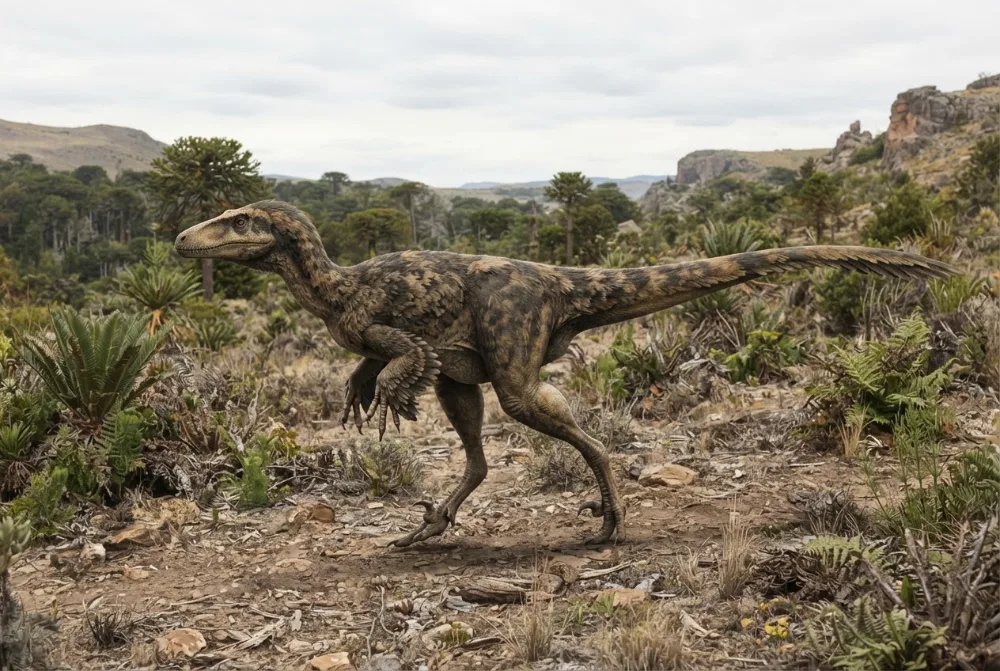
Aniksosaurus was about 2 to 3 metres long and weighed between 35 and 65 kilograms. It stood about 70 centimetres tall at the hip.1
?Did Aniksosaurus live in groups?
Yes, scientists think Aniksosaurus may have lived in groups. Fossils of at least five individuals were found together, and studies suggest they were gregarious, especially as sub-adults.1
?What did Aniksosaurus eat?
Aniksosaurus was a meat-eating dinosaur (a theropod). It likely hunted small animals, though its exact diet is not known from fossils.1
?How fast could Aniksosaurus run?
Aniksosaurus had a shin bone 13% longer than its thigh bone, which is a sign of good running ability. Scientists think it was a fast runner, but no exact speed is known.1
Kwa akatswiri a madino
- Dzina la sayansi
- Aniksosaurus
- Anapatsidwa dzina ndi
- Martínez and Novas 20062
- Gulu
- Madino odya nyama
- Banja / kladi
- Compsognathidae2
- Magawidwe a sayansi
- Theropoda > Compsognathidae2
- Zaka za miyala
- zaka 100 mpaka 90 miliyoni (Cenomanian / Turonian)2
- Mapangidwe a miyala
- Bajo Barreal2
- Mayiko
- Argentina2
- Zolemba za mafosili
- 1 mu The Paleobiology Database2
- Kupezeka
- Aniksosaurus was named by Rubén Dario Martínez and Fernando Emilio Novas in 2006. The first fossils were found in 1995 in the Bajo Barreal Formation of Patagonia, Argentina.1
- Akukambiranabe
- Scientists are not sure exactly where Aniksosaurus fits in the dinosaur family tree. Some think it is a compsognathid, others a maniraptoromorph or a megaraptoran.1
Kumene mfundo zimachokera
- Aniksosaurus (en.wikipedia.org)
- Aniksosaurus in The Paleobiology Database (CC BY 4.0): zaka, malo, mapangidwe a miyala, magawidwe a sayansi.
Mfundo iliyonse patsamba lino ili ndi nambala yosonyeza kumene yachokera. Ngati talakwitsa kanthu, pepa, ndife okonda madino, osati magazini ya sayansi. Tiuze pa [email protected] ndipo tikonza.
 Rex ali ndi njala! Dino Wiki ndi ntchito ya bambo kwa mwana wawo wamwamuna wokonda madainoso, yaulere popanda zotsatsa ndi zokazonda. Akuluakulu angadyetse Rex zokhwasula-khwasula kuti tsambali lipitirize kupezeka pa intaneti.Dyetsa Rex
 Allosaurus
 Carnotaurus
 Dilophosaurus
 Giganotosaurus
 Compsognathus
 Paronychodon
 Tyrannosaurus
 Triceratops
 Velociraptor
 Spinosaurus
 Ankylosaurus
 Parasaurolophus