 Kwizi ya Ndiwe dino uti?
 Nkhondo ya madino
 Mpikisano wa madino
 Masewera ang'onoang'ono a madino
 Chimbale cha zomata
 Mindandanda ya TOP ya madino
 Ndidabwitse!
Antarctopelta
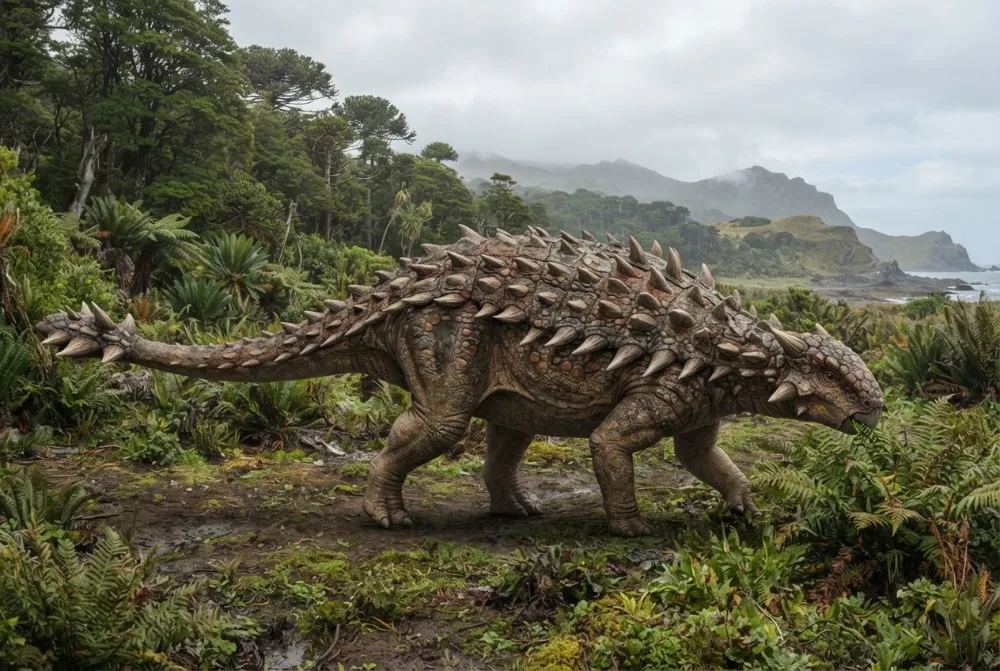
Antarctopelta was an armoured dinosaur that lived in Antarctica during the Late Cretaceous. It was covered in bony plates and spikes, and its tail ended in a weapon made of fused spikes that looked like an Aztec club. It was a slow-moving plant-eater that used its armour for protection.1
Ankakhala liti?
Anali wamkulu bwanji?
Anali wautali bwanji?
Msinkhu wake unali wautali bwanji?
kuyerekeza
Ankalemera bwanji?
 wautali ngati agalu 6 otsatizana mphuno ndi mchira🍌wautali ngati nthochi 33 zotsatizana🍉wolemera ngati mavwende 70🧸wolemera ngati ana a sukulu ya mkaka 18🎒wolemera ngati ana a sukulu 11🏃akanatha kuthamanga mamita 100 m'masekondi 16 (munthu waliwiro kwambiri amafunika 9.6)
Antarctopelta anali wamkulu bwanji poyerekeza ndi IWEYO?
Ndi masamu chabe mu msakatuli wako. Palibe chimene chimasungidwa kapena kutumizidwa kwina kulikonse.
Anali ndi liwiro lotani?


Mfundo zosangalatsa
Antarctopelta was the first dinosaur fossil ever named from Antarctica, even though it was discovered before another Antarctic dinosaur called Cryolophosaurus.1
Its tail had a special weapon called a macuahuitl, made of flat, spiky bones fused together. It looked like an Aztec club and was used for defence.1
Scientists found six different types of armour plates on Antarctopelta, including large flat ones and tall keeled spikes.1
Antarctopelta lived in a warm, ice-free Antarctica with dense forests of conifers, cycads, and ginkgos. It still had to survive long dark winters.1
The only known skeleton was discovered in 1986 by Argentine geologists Eduardo Olivero and Robert Scasso, but it took ten years to dig out because of frozen ground and bad weather.1
Antarctopelta shared its home with the small plant-eater Trinisaura, as well as marine reptiles like mosasaurs and plesiosaurs.1
Mafunso ofunsidwa kwambiri okhudza Antarctopelta
?How big was Antarctopelta?
About 4 meters (13 feet) long from snout to tail tip. One scientist estimated it could have been up to 6 meters (20 feet) long and weighed 350 kilograms (770 pounds).1
?What did Antarctopelta eat?
It was a plant-eater. Its jaws had small, leaf-shaped teeth for chewing plants.1
?Did Antarctopelta have feathers?
No. It was an armoured dinosaur covered in bony plates and spikes, not feathers.1
?When did Antarctopelta live?
It lived during the late Campanian stage of the Late Cretaceous period, about 73.4 million years ago.1
?Was Antarctopelta a dinosaur?
Yes, it was a type of armoured dinosaur called an ankylosaur.1
?Could Antarctopelta swim?
Scientists are not sure, but its body was stocky and built for walking on land, not swimming. Its fossils were found with a shark tooth, suggesting it may have floated out to sea after death.1
Wothetsa nthano zabodza
Nthano: Some people think Antarctopelta had a tail club like a typical ankylosaur.
Zoona: Antarctopelta actually had a macuahuitl, a flat fan of spikes at the end of its tail, not a round club.1
Kwa akatswiri a madino
- Dzina la sayansi
- Antarctopelta
- Anapatsidwa dzina ndi
- Salgado and Gasparini 20062
- Gulu
- Madino a zishango
- Banja / kladi
- Parankylosauria2
- Magawidwe a sayansi
- Ornithischia > Ankylosauria > Thyreophora2
- Zaka za miyala
- zaka 84 mpaka 72 miliyoni (Campanian)2
- Mapangidwe a miyala
- Snow Hill Island2
- Mayiko
- Antakitika2
- Zolemba za mafosili
- 1 mu The Paleobiology Database2
- Kupezeka
- Antarctopelta was discovered in January 1986 by Argentine geologists Eduardo Olivero and Robert Scasso on James Ross Island, Antarctica. It was named in 2006 by paleontologists Leonardo Salgado and Zulma Gasparini, who called it Antarctopelta oliveroi after Olivero.1
- Akukambiranabe
- Scientists are still debating whether Antarctopelta was more closely related to nodosaurids or ankylosaurids, because it has features of both groups.1
Kumene mfundo zimachokera
- Antarctopelta (en.wikipedia.org)
- Antarctopelta in The Paleobiology Database (CC BY 4.0): zaka, malo, mapangidwe a miyala, magawidwe a sayansi.
Mfundo iliyonse patsamba lino ili ndi nambala yosonyeza kumene yachokera. Ngati talakwitsa kanthu, pepa, ndife okonda madino, osati magazini ya sayansi. Tiuze pa [email protected] ndipo tikonza.
 Rex ali ndi njala! Dino Wiki ndi ntchito ya bambo kwa mwana wawo wamwamuna wokonda madainoso, yaulere popanda zotsatsa ndi zokazonda. Akuluakulu angadyetse Rex zokhwasula-khwasula kuti tsambali lipitirize kupezeka pa intaneti.Dyetsa Rex
 Ankylosaurus
 Sauropelta
 Pinacosaurus
 Scutellosaurus
 Struthiosaurus
 Euoplocephalus
 Tyrannosaurus
 Triceratops
 Velociraptor
 Spinosaurus
 Parasaurolophus
 Pteranodon