 Kwizi ya Ndiwe dino uti?
 Nkhondo ya madino
 Mpikisano wa madino
 Masewera ang'onoang'ono a madino
 Chimbale cha zomata
 Mindandanda ya TOP ya madino
 Ndidabwitse!
Ankakhala liti?

Anali wamkulu bwanji?
Anali wautali bwanji?
Msinkhu wake unali wautali bwanji?
Ankalemera bwanji?
 wautali ngati agalu 6 otsatizana mphuno ndi mchira🍌wautali ngati nthochi 33 zotsatizana🍉wolemera ngati mavwende 260🧸wolemera ngati ana a sukulu ya mkaka 68🎒wolemera ngati ana a sukulu 41🐻❄️wolemera ngati zimbalangondo zoyera 3🏃akanatha kuthamanga mamita 100 m'masekondi 9.7 (munthu waliwiro kwambiri amafunika 9.6)
Arrhinoceratops anali wamkulu bwanji poyerekeza ndi IWEYO?
Ndi masamu chabe mu msakatuli wako. Palibe chimene chimasungidwa kapena kutumizidwa kwina kulikonse.
Anali ndi liwiro lotani?


Mfundo zosangalatsa
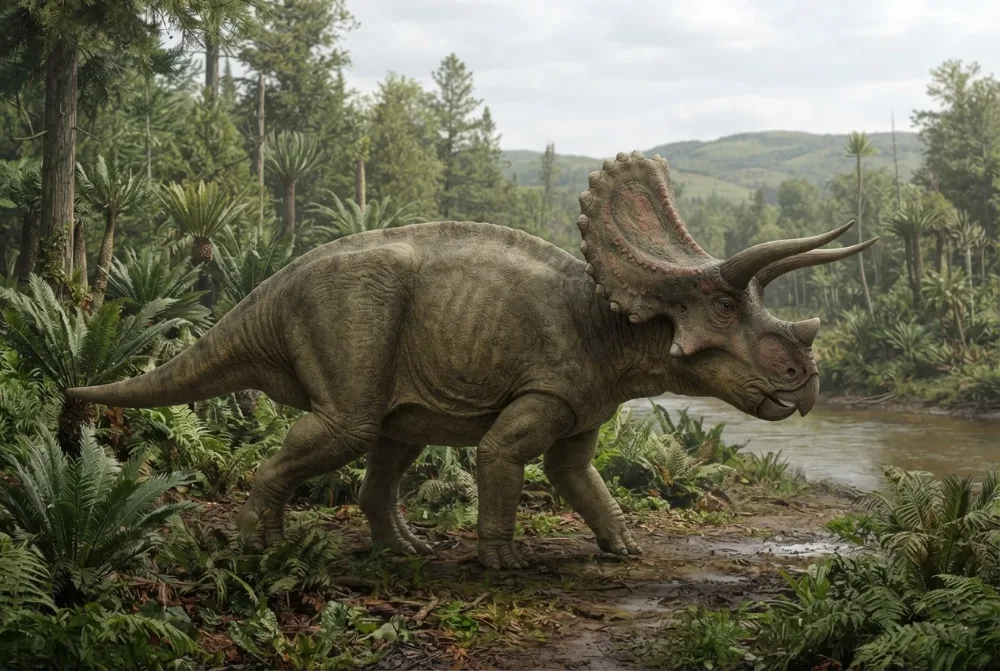
Arrhinoceratops lived a few million years before its famous relative Triceratops.1
The name 'Arrhinoceratops' means 'no nose-horn face', but scientists later realized it actually did have a nose horn, just a short one.1
Only one complete skull of Arrhinoceratops has been found, so scientists do not know much about the rest of its body.12
Its skull had a broad, square frill with two oval openings and a scalloped rear edge.1
The frill of Arrhinoceratops was decorated with about nine bony bumps called osteoderms along the sides.1
Arrhinoceratops lived in a wet coastal environment with warm summers and cool winters, and may have been hunted by the tyrannosaur Albertosaurus.1
The first Arrhinoceratops skull was found by a University of Toronto expedition in 1923 along the Red Deer River in Alberta.1
Mafunso ofunsidwa kwambiri okhudza Arrhinoceratops
?How big was Arrhinoceratops?
Estimates vary. Some popular science books estimate it was about 6 metres (20 ft) long, while Gregory S. Paul estimated 4.5 metres (15 ft) and 1.3 tonnes (2,900 lb).12
?What did Arrhinoceratops eat?
Arrhinoceratops was a herbivore. It likely ate ferns, cycads and conifers, using its sharp beak to bite off leaves or needles.1
?When did Arrhinoceratops live?
It lived during the Late Cretaceous, about 72 to 67 million years ago, a few million years before Triceratops.21
?Where was Arrhinoceratops found?
Its remains have been found in Canada, specifically along the Red Deer River in Alberta.12
?Did Arrhinoceratops have a nose horn?
Yes, it did have a nose horn, but it was short and blunt. The name 'no nose-horn face' was based on a misunderstanding.1
Wothetsa nthano zabodza
Nthano: Arrhinoceratops had no nose horn at all.
Zoona: It actually had a short, blunt nose horn, like many other horned dinosaurs.1
Kwa akatswiri a madino
- Dzina la sayansi
- Arrhinoceratops
- Anapatsidwa dzina ndi
- Parks 19254
- Gulu
- Madino a nyanga
- Banja / kladi
- Ceratopsidae4
- Magawidwe a sayansi
- Ornithischia > Ceratopsia > Ceratopsidae4
- Zaka za miyala
- zaka 84 mpaka 66 miliyoni (Campanian / Maastrichtian)4
- Mapangidwe a miyala
- Horseshoe Canyon4
- Mayiko
- Kanada4
- Zolemba za mafosili
- 3 mu The Paleobiology Database4
- Kupezeka
- William Arthur Parks named Arrhinoceratops in 1925 based on a skull found in Alberta, Canada, by a University of Toronto expedition in 1923.14
- Akukambiranabe
- Scientists are not sure exactly how Arrhinoceratops is related to other horned dinosaurs like Torosaurus and Anchiceratops.1
Kumene mfundo zimachokera
- Arrhinoceratops (en.wikipedia.org)
- Arrhinoceratops | Natural History Museum (nhm.ac.uk)
- Arrhinoceratops | Part of the Ceratopsian Family of Dinosaurs (dinosaurmadness.com)
- Arrhinoceratops in The Paleobiology Database (CC BY 4.0): zaka, malo, mapangidwe a miyala, magawidwe a sayansi.
Mfundo iliyonse patsamba lino ili ndi nambala yosonyeza kumene yachokera. Ngati talakwitsa kanthu, pepa, ndife okonda madino, osati magazini ya sayansi. Tiuze pa [email protected] ndipo tikonza.
 Rex ali ndi njala! Dino Wiki ndi ntchito ya bambo kwa mwana wawo wamwamuna wokonda madainoso, yaulere popanda zotsatsa ndi zokazonda. Akuluakulu angadyetse Rex zokhwasula-khwasula kuti tsambali lipitirize kupezeka pa intaneti.Dyetsa Rex
 Triceratops
 Protoceratops
 Ojoceratops
 Tatankaceratops
 Psittacosaurus
 Centrosaurus
 Tyrannosaurus
 Velociraptor
 Spinosaurus
 Ankylosaurus
 Parasaurolophus
 Pteranodon