 Kwizi ya Ndiwe dino uti?
 Nkhondo ya madino
 Mpikisano wa madino
 Masewera ang'onoang'ono a madino
 Chimbale cha zomata
 Mindandanda ya TOP ya madino
 Ndidabwitse!
Caupedactylus
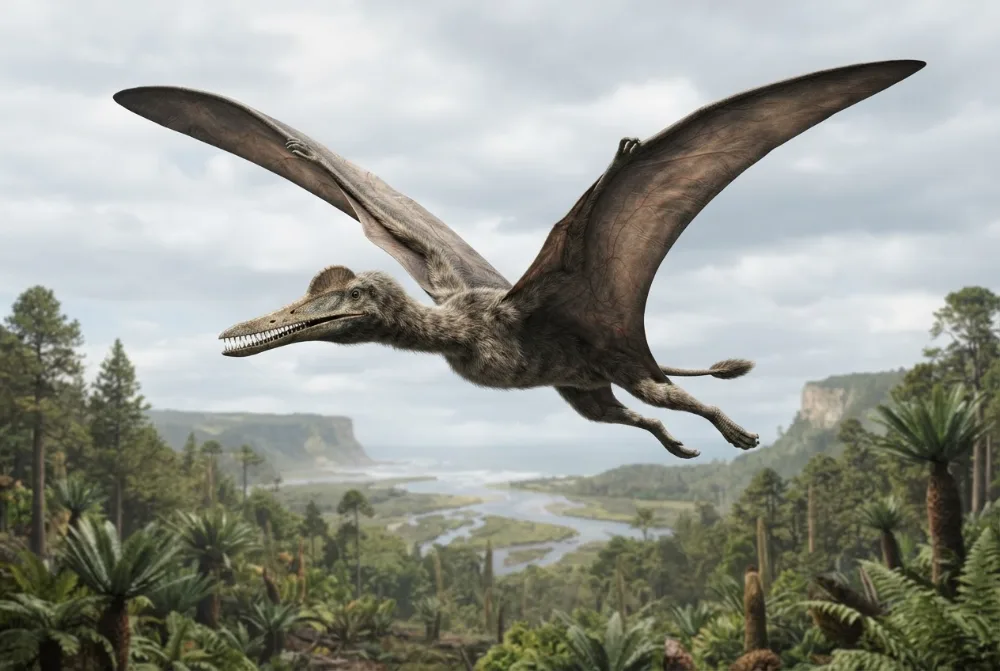
Caupedactylus was a flying reptile with a big, thin crest on its head. It had no teeth and used its beak to eat fruit. It lived about 110 million years ago in what is now Brazil.13
Ankakhala liti?
Anali wamkulu bwanji?
Mapiko ake anali otambalala bwanji?
 mapiko otambalala ngati njinga 2 pamzere⚽akanatha kuuluka kudutsa bwalo lonse la mpira m'masekondi 6.5
Caupedactylus anali wamkulu bwanji poyerekeza ndi IWEYO?
Ndi masamu chabe mu msakatuli wako. Palibe chimene chimasungidwa kapena kutumizidwa kwina kulikonse.
Anali ndi liwiro lotani?


Mfundo zosangalatsa
Caupedactylus had a wingspan of about 3.3 metres (11 feet), making it the largest known tapejarine pterosaur.1
Its skull was about 46 centimetres long and had a large, rounded crest that was only half a millimetre thick at the top.1
The tip of its snout curved downward, and its upper jaw had a slightly concave lower edge.1
The crest on its snout had grooves that may have held blood vessels, possibly helping with temperature control.2
Its lower jaw had a thick, slightly convex surface at the rear, and when closed it fit tightly against the upper jaw with no gap.1
The holotype specimen (MN 4726-V) is an adult, which is rare for pterosaurs from this formation.1
Mafunso ofunsidwa kwambiri okhudza Caupedactylus
?What did Caupedactylus eat?
It ate fruit. Its beak had no teeth, and the Paleobiology Database lists it as a volant frugivore, meaning a flying fruit-eater.3
?How big was Caupedactylus?
Its wingspan was about 3.3 metres, making it the largest known tapejarine pterosaur. Its skull was about 46 centimetres long.1
?When did Caupedactylus live?
It lived about 110 million years ago, during the Early Cretaceous period (Albian stage).1
?Where was Caupedactylus found?
Its fossils were found in the Romualdo Formation of the Araripe Basin in northeastern Brazil.1
Kwa akatswiri a madino
- Dzina la sayansi
- Caupedactylus
- Anapatsidwa dzina ndi
- Kellner 20133
- Gulu
- Zokwawa zouluka
- Banja / kladi
- Tapejaridae3
- Magawidwe a sayansi
- Pterosauria > Pterodactyloidea3
- Zaka za miyala
- zaka 120 mpaka 113 miliyoni (Aptian)3
- Mapangidwe a miyala
- Crato3
- Mayiko
- Brazil3
- Zolemba za mafosili
- 1 mu The Paleobiology Database3
- Kupezeka
- Caupedactylus was named and described by Alexander Kellner in 2013 based on a partial skeleton found in the Romualdo Formation of Brazil.13
- Akukambiranabe
- Scientists are still debating whether the bones in the front of the palate are part of the palatine bones or the maxillae.1
Kumene mfundo zimachokera
- Caupedactylus (en.wikipedia.org)
- A new unusual tapejarid (Pterosauria, Pterodactyloidea) from the Early Cretaceous Romualdo Formation, Araripe Basin, Brazil (cambridge.org)
- Caupedactylus in The Paleobiology Database (CC BY 4.0): zaka, malo, mapangidwe a miyala, magawidwe a sayansi.
Mfundo iliyonse patsamba lino ili ndi nambala yosonyeza kumene yachokera. Ngati talakwitsa kanthu, pepa, ndife okonda madino, osati magazini ya sayansi. Tiuze pa [email protected] ndipo tikonza.
 Rex ali ndi njala! Dino Wiki ndi ntchito ya bambo kwa mwana wawo wamwamuna wokonda madainoso, yaulere popanda zotsatsa ndi zokazonda. Akuluakulu angadyetse Rex zokhwasula-khwasula kuti tsambali lipitirize kupezeka pa intaneti.Dyetsa Rex
 Pteranodon
 Quetzalcoatlus
 Dorygnathus
 Rhamphorhynchus
 Anhanguera
 Pterodactylus
 Stegosaurus
 Iguanodon
 Archaeopteryx
 Giganotosaurus
 Microraptor
 Deinonychus