 Kwizi ya Ndiwe dino uti?
 Nkhondo ya madino
 Mpikisano wa madino
 Masewera ang'onoang'ono a madino
 Chimbale cha zomata
 Mindandanda ya TOP ya madino
 Ndidabwitse!
Ankakhala liti?

Anali wamkulu bwanji?
Anali wautali bwanji?
Msinkhu wake unali wautali bwanji?
kuyerekeza
Ankalemera bwanji?
 wautali ngati amphaka a pakhomo 3 otsatizana mphuno ndi mchira🍌wautali ngati nthochi 8 zotsatizanawolemera pafupifupi ngati mphaka wa pakhomo🍌wolemera ngati nthochi 17🏃akanatha kuthamanga mamita 100 m'masekondi 16 (munthu waliwiro kwambiri amafunika 9.6)
Daurosaurus anali wamkulu bwanji poyerekeza ndi IWEYO?
Ndi masamu chabe mu msakatuli wako. Palibe chimene chimasungidwa kapena kutumizidwa kwina kulikonse.
Anali ndi liwiro lotani?


Mfundo zosangalatsa
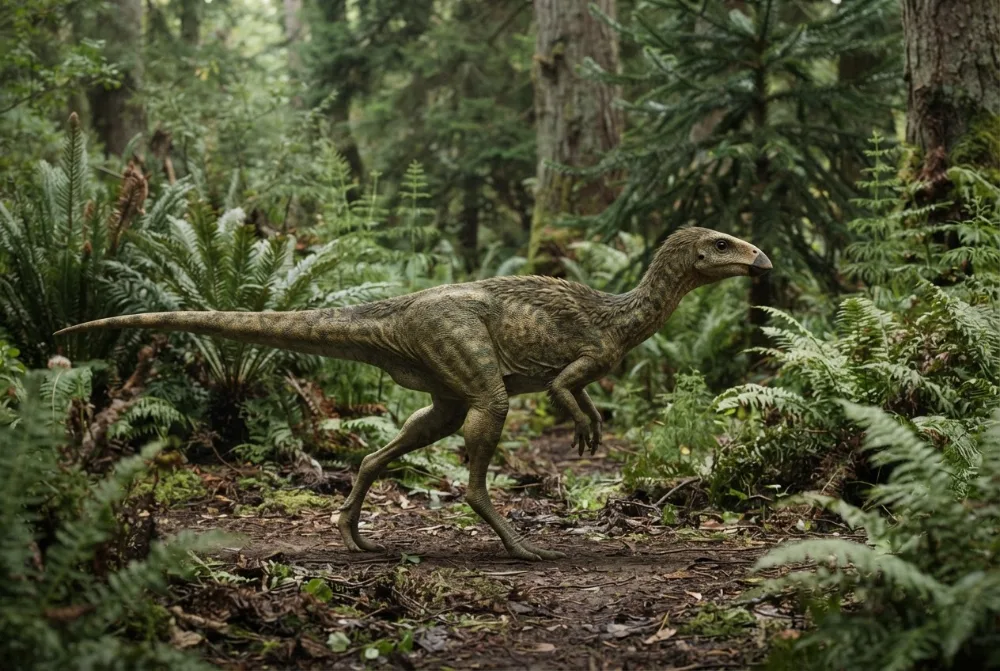
Daurosaurus is known from a partial skeleton that includes preserved soft parts, which is very rare for dinosaurs.1
It had skin scales that split into bristles, a feature that scientists think may be an early step toward feathers.2
The fossil site was once a lake, and the dinosaur lived in a landscape with lakes and changing plant life.2
Scientists think Daurosaurus may have lived in groups, because the fossil record suggests it was gregarious.1
The age of the rocks where Daurosaurus was found was first thought to be Late Jurassic, but later studies showed it is actually Middle Jurassic, about 168 to 165 million years old.2
Daurosaurus is one of several small plant-eating dinosaurs found at the same site, along with Kulindapteryx and Kulindadromeus.2
Mafunso ofunsidwa kwambiri okhudza Daurosaurus
?How big was Daurosaurus?
Daurosaurus was a small dinosaur. Its adult length is estimated at 1 metre, so it was quite small.4
?What did Daurosaurus eat?
Daurosaurus was a herbivore, meaning it ate plants. It had a beak for cropping plant material.4
?Did Daurosaurus have feathers?
Daurosaurus had skin scales that split into bristles, which scientists think may be an early step toward feathers. This is similar to the feather-like structures found on its relative Kulindadromeus.34
?When did Daurosaurus live?
Daurosaurus lived during the Late Bathonian stage of the Middle Jurassic, about 168 to 165 million years ago.4
?Where was Daurosaurus found?
Daurosaurus was found in the Ukureyskaya Formation in Zabaykal'ye, Russia. Its fossil was discovered at a site called Kulinda.4
?Did Daurosaurus live in groups?
Yes, the fossil record suggests Daurosaurus was gregarious, meaning it likely lived in groups.4
Wothetsa nthano zabodza
Nthano: Some people think all dinosaurs with bristles or filaments were birds or ancestors of birds.
Zoona: Daurosaurus was a plant-eating dinosaur, not a bird, but its bristle-like scales show that such features appeared in many dinosaur groups, not just bird relatives.2
Kwa akatswiri a madino
- Dzina la sayansi
- Daurosaurus
- Anapatsidwa dzina ndi
- Alifanov and Saveliev 20144
- Gulu
- Odya zomera a milomo
- Banja / kladi
- Hypsilophodontidae4
- Magawidwe a sayansi
- Ornithischia > Ornithopoda4
- Zaka za miyala
- zaka 168 mpaka 165 miliyoni (Bathonian)4
- Mapangidwe a miyala
- Ukureyskaya4
- Mayiko
- Rasha4
- Zolemba za mafosili
- 1 mu The Paleobiology Database4
- Kupezeka
- Daurosaurus was named by Russian scientists Vladimir Alifanov and Sergei Saveliev in 2014, based on a partial skeleton found at the Kulinda site in Transbaikalia, Russia.12
- Akukambiranabe
- Scientists debate whether Daurosaurus is a valid species, because some researchers think the name is doubtful (a nomen dubium) due to incomplete remains.1
Kumene mfundo zimachokera
- PBDB Taxon (paleobiodb.org)
- Two new ornithischian dinosaurs (Hypsilophodontia, Ornithopoda) from the Late Jurassic of Russia (researchgate.net)
- Kulindadromeus (Wikipedia) (Wikipedia)
- Daurosaurus in The Paleobiology Database (CC BY 4.0): zaka, malo, mapangidwe a miyala, magawidwe a sayansi.
Mfundo iliyonse patsamba lino ili ndi nambala yosonyeza kumene yachokera. Ngati talakwitsa kanthu, pepa, ndife okonda madino, osati magazini ya sayansi. Tiuze pa [email protected] ndipo tikonza.
 Rex ali ndi njala! Dino Wiki ndi ntchito ya bambo kwa mwana wawo wamwamuna wokonda madainoso, yaulere popanda zotsatsa ndi zokazonda. Akuluakulu angadyetse Rex zokhwasula-khwasula kuti tsambali lipitirize kupezeka pa intaneti.Dyetsa Rex
 Iguanodon
 Tenontosaurus
 Thescelosaurus
 Zalmoxes
 Camptosaurus
 Rhabdodon
 Ichthyosaurus
 Khudiakovia
 Ophthalmosaurus
 Pterodactylus
 Peloneustes
 Rhamphocephalus