 Kwizi ya Ndiwe dino uti?
 Nkhondo ya madino
 Mpikisano wa madino
 Masewera ang'onoang'ono a madino
 Chimbale cha zomata
 Mindandanda ya TOP ya madino
 Ndidabwitse!
Ankakhala liti?

Anali wamkulu bwanji?
Anali wautali bwanji?
Msinkhu wake unali wautali bwanji?
Ankalemera bwanji?
 wautali ngati agalu 7 otsatizana mphuno ndi mchira🍌wautali ngati nthochi 39 zotsatizana🍉wolemera ngati mavwende 180🧸wolemera ngati ana a sukulu ya mkaka 47🎒wolemera ngati ana a sukulu 28🐻❄️wolemera ngati zimbalangondo zoyera 2🏃akanatha kuthamanga mamita 100 m'masekondi 11 (munthu waliwiro kwambiri amafunika 9.6)
Tenontosaurus anali wamkulu bwanji poyerekeza ndi IWEYO?
Ndi masamu chabe mu msakatuli wako. Palibe chimene chimasungidwa kapena kutumizidwa kwina kulikonse.
Anali ndi liwiro lotani?


Mfundo zosangalatsa
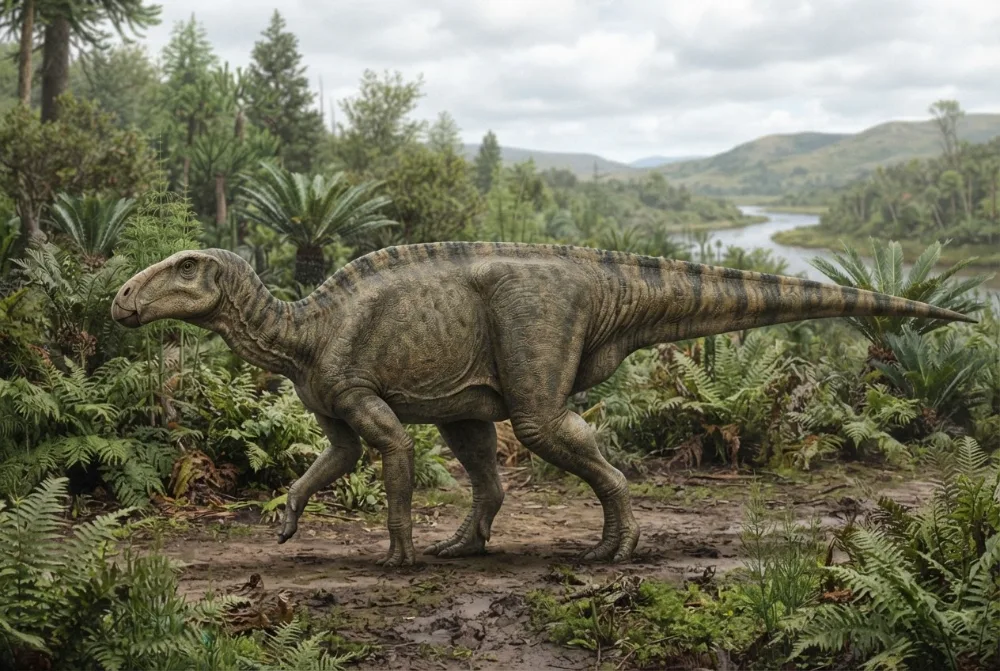
Tenontosaurus had an unusually long and broad tail, stiffened by a network of bony tendons, which is why it is called 'sinew lizard'.1
An adult Tenontosaurus could reach a browsing height of about 3 meters (10 feet) if it stood on its hind legs, but it usually walked on all fours.1
Its beak was U-shaped and thick, and its lower jaw had a special bone called a predentary that helped form the lower beak.1
Tenontosaurus lived alongside the predator Deinonychus, and fossils of both are common in the same rocks.1
The first Tenontosaurus fossil was found in 1903 in Montana, but it was not named until 1970.1
There are two species: Tenontosaurus tilletti and Tenontosaurus dossi. T. dossi is known from only a few specimens in Texas.1
Mafunso ofunsidwa kwambiri okhudza Tenontosaurus
?How big was Tenontosaurus?
About 6 to 8 metres long and around 1,000 kilograms, though estimates vary by species and study.12
?What did Tenontosaurus eat?
It was a plant-eater. It used its U-shaped beak and chopping teeth to eat leaves, wood, fruit, and low-growing ferns and shrubs.12
?Did Tenontosaurus walk on two legs or four?
It usually walked on all four legs, but could stand on its hind legs to reach higher plants, up to about 3 metres.12
?Was Tenontosaurus bigger than Deinonychus?
Yes, adult Tenontosaurus were much larger than adult Deinonychus. Deinonychus probably hunted young or sick Tenontosaurus.1
?When did Tenontosaurus live?
It lived during the Early Cretaceous period, about 115 to 108 million years ago, in western North America.12
?Why did Tenontosaurus have a long tail?
Its tail was unusually long and broad, stiffened by bony tendons. This helped support the tail, but scientists aren't sure of its exact purpose.1
Wothetsa nthano zabodza
Nthano: Some people think Tenontosaurus was a slow, clumsy dinosaur.
Zoona: Scientists think it was a common and successful herbivore, and its stiff tail may have helped it balance.1
Kwa akatswiri a madino
- Dzina la sayansi
- Tenontosaurus
- Anapatsidwa dzina ndi
- Ostrom 19704
- Gulu
- Odya zomera a milomo
- Banja / kladi
- Tenontosauridae4
- Magawidwe a sayansi
- Ornithischia > Ornithopoda > Iguanodontia4
- Zaka za miyala
- zaka 121 mpaka 94 miliyoni (Aptian / Cenomanian)4
- Mapangidwe a miyala
- Cloverly, Antlers, Cedar Mountain4
- Mayiko
- Amereka4
- Zolemba za mafosili
- 83 mu The Paleobiology Database4
- Kupezeka
- The first fossil was found in 1903 by an American Museum of Natural History expedition in Montana. John Ostrom named it Tenontosaurus tilletti in 1970 after studying many specimens.1
- Akukambiranabe
- Scientists still debate exactly how Tenontosaurus moved, whether it was mostly quadrupedal or could run on two legs.1
Kumene mfundo zimachokera
- Tenontosaurus (en.wikipedia.org)
- Tenontosaurus | Natural History Museum (nhm.ac.uk)
- All about Tenontosaurus (animalia.bio)
- Tenontosaurus in The Paleobiology Database (CC BY 4.0): zaka, malo, mapangidwe a miyala, magawidwe a sayansi.
Mfundo iliyonse patsamba lino ili ndi nambala yosonyeza kumene yachokera. Ngati talakwitsa kanthu, pepa, ndife okonda madino, osati magazini ya sayansi. Tiuze pa [email protected] ndipo tikonza.
 Rex ali ndi njala! Dino Wiki ndi ntchito ya bambo kwa mwana wawo wamwamuna wokonda madainoso, yaulere popanda zotsatsa ndi zokazonda. Akuluakulu angadyetse Rex zokhwasula-khwasula kuti tsambali lipitirize kupezeka pa intaneti.Dyetsa Rex
 Iguanodon
 Thescelosaurus
 Zalmoxes
 Camptosaurus
 Rhabdodon
 Nanosaurus
 Stegosaurus
 Archaeopteryx
 Giganotosaurus
 Microraptor
 Deinonychus
 Baryonyx