 Kwizi ya Ndiwe dino uti?
 Nkhondo ya madino
 Mpikisano wa madino
 Masewera ang'onoang'ono a madino
 Chimbale cha zomata
 Mindandanda ya TOP ya madino
 Ndidabwitse!
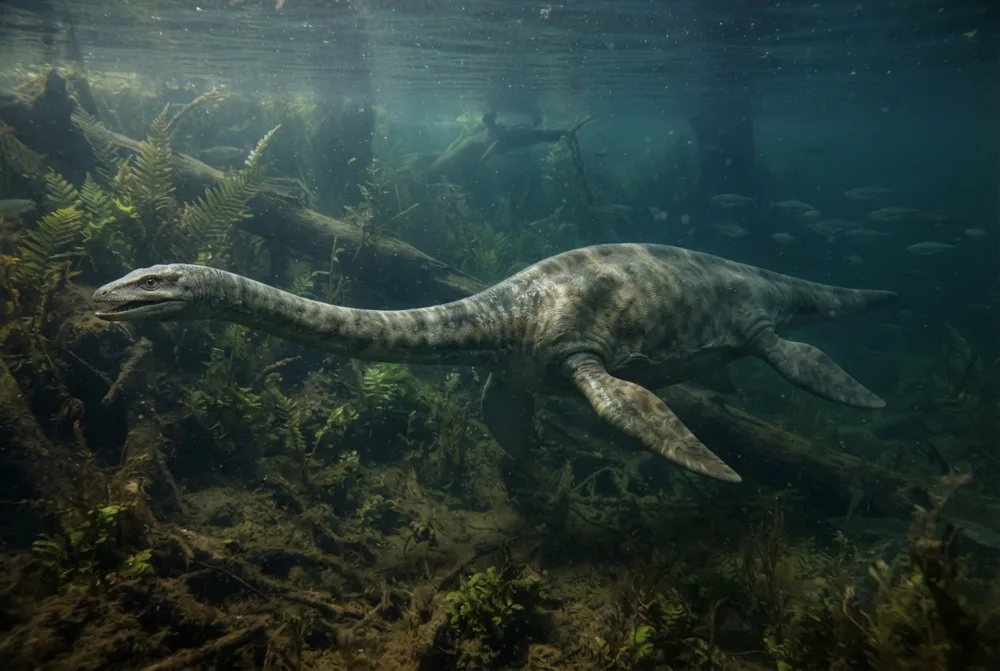
Fluvionectes
Fluvionectes was a long-necked marine reptile that swam in rivers and estuaries, not the open ocean. It was a type of plesiosaur called an elasmosaur, and it hunted fish and other prey in the water.1
Ankakhala liti?
Anali wamkulu bwanji?
Anali wautali bwanji?
Ankalemera bwanji?
 wautali ngati agalu 7 otsatizana mphuno ndi mchira🍌wautali ngati nthochi 39 zotsatizana🍉wolemera ngati mavwende 78🧸wolemera ngati ana a sukulu ya mkaka 21🎒wolemera ngati ana a sukulu 12🏊akanatha kusambira utali wa dziwe lalikulu losambira (50 m) m'masekondi 6.2
Fluvionectes anali wamkulu bwanji poyerekeza ndi IWEYO?
Ndi masamu chabe mu msakatuli wako. Palibe chimene chimasungidwa kapena kutumizidwa kwina kulikonse.
Anali ndi liwiro lotani?


Mfundo zosangalatsa
Fluvionectes is one of the few plesiosaurs found in non-marine rocks, meaning it lived in rivers and estuaries, not the open ocean.1
The holotype skeleton was found disarticulated, scattered over an area of about 2.5 square metres, with only two rib bones still connected.1
Fluvionectes had 22 dorsal vertebrae, which is a unique feature that helps scientists identify it as a new species.1
The name Fluvionectes comes from Latin and Greek words meaning 'river swimmer', because it lived in rivers.1
The species name sloanae honours Donna Sloan, who discovered the holotype and worked as a scientific illustrator at the Royal Tyrrell Museum.1
Fluvionectes was smaller than many other elasmosaurids that lived in the ocean, which might be because it lived in rivers.1
Mafunso ofunsidwa kwambiri okhudza Fluvionectes
?How big was Fluvionectes?
About 5 to 5.2 metres (16 to 17 ft) long for the holotype, and the largest known specimen may have reached 7 metres (23 ft).23
?What did Fluvionectes eat?
It hunted fish and other vertebrates in the water, using its slender tooth and powerful flippers to catch prey.4
?Where did Fluvionectes live?
It lived in rivers and estuaries (brackish water) in what is now Alberta, Canada, not in the open ocean like most other elasmosaurs.23
?Is Fluvionectes a dinosaur?
No, it is a plesiosaur, a type of marine reptile that lived in the water during the time of dinosaurs.2
Wothetsa nthano zabodza
Nthano: Some people think all plesiosaurs lived only in the ocean.
Zoona: Fluvionectes shows that some plesiosaurs lived in rivers and estuaries, not just the open sea.1
Kwa akatswiri a madino
- Dzina la sayansi
- Fluvionectes
- Anapatsidwa dzina ndi
- Campbell et al. 20215
- Gulu
- Maplesiosauri
- Banja / kladi
- Elasmosauridae5
- Magawidwe a sayansi
- Plesiosauria > Elasmosauridae > Sauropterygia5
- Zaka za miyala
- zaka 84 mpaka 72 miliyoni (Campanian)5
- Mapangidwe a miyala
- Dinosaur Park5
- Mayiko
- Kanada5
- Zolemba za mafosili
- 6 mu The Paleobiology Database5
- Kupezeka
- The holotype was discovered by Donna Sloan in the Dinosaur Park Formation in Alberta, Canada. It was named by Campbell and colleagues in 2021.1
- Akukambiranabe
- Scientists are still debating why Fluvionectes was smaller than ocean-living elasmosaurids, and whether it spent its whole life in rivers or moved between fresh and salt water.1
Kumene mfundo zimachokera
- PeerJ A new elasmosaurid (Sauropterygia: Plesiosauria) from the non-marine to paralic Dinosaur Park Formation of southern Alberta, Canada (peerj.com)
- Fluvionectes (en.wikipedia.org)
- A new elasmosaurid (Sauropterygia: Plesiosauria) from the non-marine to paralic Dinosaur Park Formation of southern Alberta, Canada (pmc.ncbi.nlm.nih.gov)
- New Late Cretaceous Marine Reptile publication by M. Ryan and J. Campbell | Department of Earth Sciences (earthsci.carleton.ca)
- Fluvionectes in The Paleobiology Database (CC BY 4.0): zaka, malo, mapangidwe a miyala, magawidwe a sayansi.
Mfundo iliyonse patsamba lino ili ndi nambala yosonyeza kumene yachokera. Ngati talakwitsa kanthu, pepa, ndife okonda madino, osati magazini ya sayansi. Tiuze pa [email protected] ndipo tikonza.
 Rex ali ndi njala! Dino Wiki ndi ntchito ya bambo kwa mwana wawo wamwamuna wokonda madainoso, yaulere popanda zotsatsa ndi zokazonda. Akuluakulu angadyetse Rex zokhwasula-khwasula kuti tsambali lipitirize kupezeka pa intaneti.Dyetsa Rex
 Elasmosaurus
 Pliosaurus
 Plesiosaurus
 Cimoliasaurus
 Colymbosaurus
 Trinacromerum
 Tyrannosaurus
 Triceratops
 Velociraptor
 Spinosaurus
 Ankylosaurus
 Parasaurolophus