 Kwizi ya Ndiwe dino uti?
 Nkhondo ya madino
 Mpikisano wa madino
 Masewera ang'onoang'ono a madino
 Chimbale cha zomata
 Mindandanda ya TOP ya madino
 Ndidabwitse!
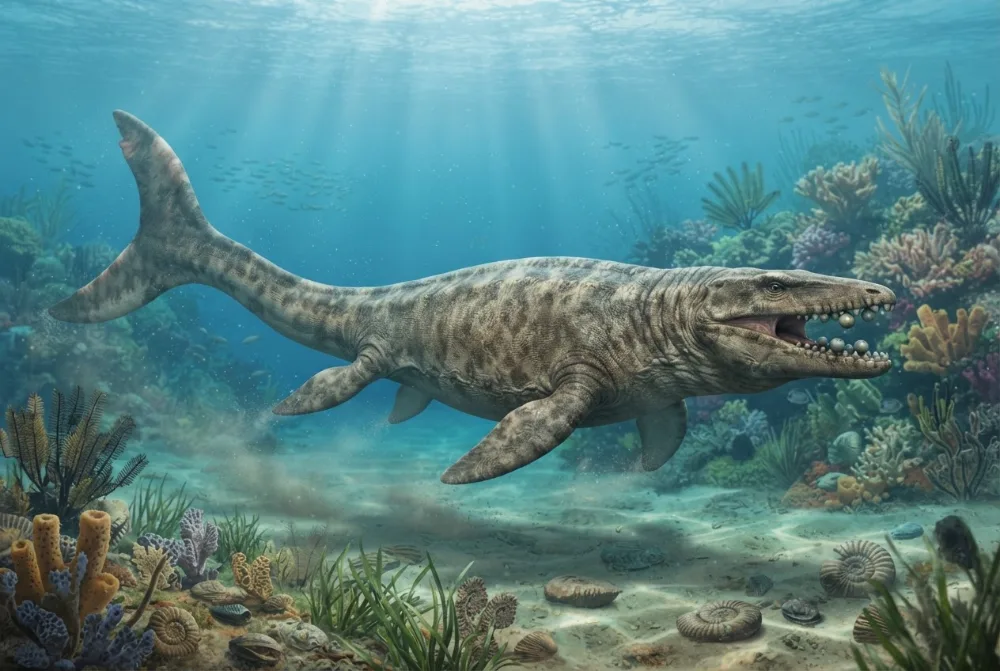
Globidens
Globidens was a marine lizard that lived in the warm, shallow seas of the Late Cretaceous. It had strange, round teeth like little balls, perfect for crushing the hard shells of its prey. Unlike many other sea reptiles, Globidens was a shell-crushing specialist!1
Ankakhala liti?
Anali wamkulu bwanji?
Anali wautali bwanji?
 wautali ngati agalu 6 otsatizana mphuno ndi mchira🍌wautali ngati nthochi 33 zotsatizana🏊akanatha kusambira utali wa dziwe lalikulu losambira (50 m) m'masekondi 4.7
Globidens anali wamkulu bwanji poyerekeza ndi IWEYO?
Ndi masamu chabe mu msakatuli wako. Palibe chimene chimasungidwa kapena kutumizidwa kwina kulikonse.
Anali ndi liwiro lotani?


Mfundo zosangalatsa
Globidens had round, globe-shaped teeth that were different from the sharp teeth of most other mosasaurs.1
Scientists found stomach contents inside a Globidens fossil from South Dakota, showing it ate clams called inoceramids.1
Globidens lived about 84 to 66 million years ago, during the Late Cretaceous period.3
The first Globidens fossil was a partial skull and a neck bone found in Alabama, USA, and named in 1912 by Charles W. Gilmore.1
Globidens had a strong, robust skull and a powerful bite to crush the shells of its prey.1
Mafunso ofunsidwa kwambiri okhudza Globidens
?How big was Globidens?
Globidens was a medium-sized mosasaur, measuring about 5 to 6 metres (16 to 20 feet) long.1
?What did Globidens eat?
Globidens ate hard-shelled prey like turtles, ammonites, nautili, and bivalves. Stomach contents from a fossil found in South Dakota showed it ate clams called inoceramids.12
?Why did Globidens have round teeth?
Globidens had round, globe-shaped teeth that were perfect for crushing tough shells. Unlike most mosasaurs with sharp teeth for grabbing slippery prey, Globidens was a shell-crushing specialist.1
?Was Globidens a dinosaur?
No, Globidens was not a dinosaur. It was a marine lizard, a type of mosasaur that lived in the sea during the Late Cretaceous.1
?When did Globidens live?
Globidens lived during the Late Cretaceous period, about 84 to 66 million years ago.1
?Where have Globidens fossils been found?
Globidens fossils have been found in Angola, Brazil, Colombia, Morocco, Syria, and the United States.1
Kwa akatswiri a madino
- Dzina la sayansi
- Globidens
- Anapatsidwa dzina ndi
- Gilmore 19123
- Gulu
- Mamosasauri
- Banja / kladi
- Mosasauridae3
- Magawidwe a sayansi
- Mosasauroidea3
- Zaka za miyala
- zaka 90 mpaka 66 miliyoni (Coniacian / Maastrichtian)3
- Mapangidwe a miyala
- Pierre Shale, Wolfe City/Sprinkle, Phosphates3
- Mayiko
- Amereka, Moroko, Siriya, Yorodani, Iguputo, Angola3
- Zolemba za mafosili
- 32 mu The Paleobiology Database3
- Kupezeka
- Globidens was first described in 1912 by Charles W. Gilmore, based on an incomplete skull and a neck bone from Alabama, USA. The name means 'globe tooth' because of its round teeth.1
- Akukambiranabe
- Scientists are still debating exactly how many species of Globidens existed, as some fossils have been moved to other groups like Prognathodon.1
Kumene mfundo zimachokera
- Globidens (en.wikipedia.org)
- Stomach contents of Globidens, a shell-crushing mosasaur (Squamata), from the Late Cretaceous Pierre Shale Group, Big Bend area of the Missouri River, central South Dakota (exa.ai)
- Globidens in The Paleobiology Database (CC BY 4.0): zaka, malo, mapangidwe a miyala, magawidwe a sayansi.
Mfundo iliyonse patsamba lino ili ndi nambala yosonyeza kumene yachokera. Ngati talakwitsa kanthu, pepa, ndife okonda madino, osati magazini ya sayansi. Tiuze pa [email protected] ndipo tikonza.
 Rex ali ndi njala! Dino Wiki ndi ntchito ya bambo kwa mwana wawo wamwamuna wokonda madainoso, yaulere popanda zotsatsa ndi zokazonda. Akuluakulu angadyetse Rex zokhwasula-khwasula kuti tsambali lipitirize kupezeka pa intaneti.Dyetsa Rex
 Mosasaurus
 Prognathodon
 Tylosaurus
 Platecarpus
 Clidastes
 Halisaurus
 Tyrannosaurus
 Triceratops
 Velociraptor
 Spinosaurus
 Ankylosaurus
 Parasaurolophus