 Kwizi ya Ndiwe dino uti?
 Nkhondo ya madino
 Mpikisano wa madino
 Masewera ang'onoang'ono a madino
 Chimbale cha zomata
 Mindandanda ya TOP ya madino
 Ndidabwitse!
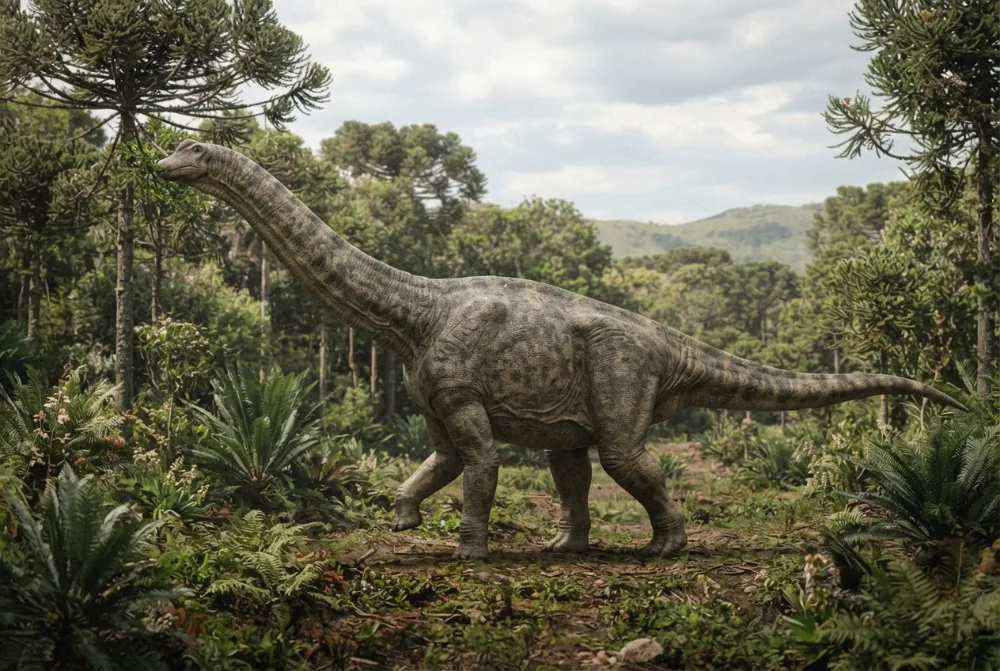
Gondwanatitan
Gondwanatitan was a long-necked plant-eater that stomped around Brazil near the end of the Age of Dinosaurs. It was small for a sauropod, about as long as a school bus, and probably used its tall neck to munch leaves from high trees.1
Ankakhala liti?
Anali wamkulu bwanji?
Anali wautali bwanji?
Msinkhu wake unali wautali bwanji?
kuyerekeza
Ankalemera bwanji?
 wautali ngati agalu 7 otsatizana mphuno ndi mchira🍌wautali ngati nthochi 39 zotsatizana🍉wolemera ngati mavwende 200🧸wolemera ngati ana a sukulu ya mkaka 53🎒wolemera ngati ana a sukulu 31🐻❄️wolemera ngati zimbalangondo zoyera 2🏃akanatha kuthamanga mamita 100 m'masekondi 12 (munthu waliwiro kwambiri amafunika 9.6)
Gondwanatitan anali wamkulu bwanji poyerekeza ndi IWEYO?
Ndi masamu chabe mu msakatuli wako. Palibe chimene chimasungidwa kapena kutumizidwa kwina kulikonse.
Anali ndi liwiro lotani?


Mfundo zosangalatsa
Gondwanatitan's middle tail bones are shaped like hearts, which helps scientists tell it apart from its close relative Aeolosaurus.1
Its limb bones were slender and graceful, not as heavy as those of many other sauropods.1
The shallow depressions on its vertebrae are similar to those seen in Saltasaurus, Alamosaurus, and Malawisaurus.1
The neural spines on its middle tail vertebrae point forward, a feature also seen in Cedarosaurus and Venenosaurus.1
In 2001, some scientists thought Gondwanatitan was the same as Aeolosaurus, but most now treat it as a separate genus.1
The type specimen was found on a farm in 1983, but it took until 1997 before scientists started preparing the bones.1
Mafunso ofunsidwa kwambiri okhudza Gondwanatitan
?How big was Gondwanatitan?
It was about 7 to 8 metres long and weighed around 1 tonne. That is small for a sauropod, about as long as a school bus.12
?What did Gondwanatitan eat?
It was a herbivore, eating tough shoots and leaves from the tops of trees. Its tall neck helped it reach high branches.13
?When did Gondwanatitan live?
It lived during the Late Cretaceous Period, about 70 million years ago.1
Wothetsa nthano zabodza
Nthano: Gondwanatitan was a giant like other sauropods.
Zoona: Actually, Gondwanatitan was a fairly small sauropod, only about 7 meters long and weighing about 1 tonne.1
Kwa akatswiri a madino
- Dzina la sayansi
- Gondwanatitan
- Anapatsidwa dzina ndi
- Kellner and Azevedo 19993
- Gulu
- Makosi atali
- Banja / kladi
- Aeolosaurini3
- Magawidwe a sayansi
- Sauropodomorpha > Sauropoda > Titanosauria > Macronaria3
- Zaka za miyala
- zaka 84 mpaka 66 miliyoni (Campanian / Maastrichtian)3
- Mapangidwe a miyala
- Adamantina, Cambambe3
- Mayiko
- Brazil3
- Zolemba za mafosili
- 2 mu The Paleobiology Database3
- Kupezeka
- The type specimen was discovered in 1983 on a farm in São Paulo, Brazil, and was formally named Gondwanatitan faustoi by Kellner and de Azevedo in 1999.13
- Akukambiranabe
- Scientists still debate whether Gondwanatitan is really a separate genus from Aeolosaurus, since some bones look very similar.1
Kumene mfundo zimachokera
- Gondwanatitan (en.wikipedia.org)
- Gondwanatitan (prehistoric-wildlife.com)
- Gondwanatitan in The Paleobiology Database (CC BY 4.0): zaka, malo, mapangidwe a miyala, magawidwe a sayansi.
Mfundo iliyonse patsamba lino ili ndi nambala yosonyeza kumene yachokera. Ngati talakwitsa kanthu, pepa, ndife okonda madino, osati magazini ya sayansi. Tiuze pa [email protected] ndipo tikonza.
 Rex ali ndi njala! Dino Wiki ndi ntchito ya bambo kwa mwana wawo wamwamuna wokonda madainoso, yaulere popanda zotsatsa ndi zokazonda. Akuluakulu angadyetse Rex zokhwasula-khwasula kuti tsambali lipitirize kupezeka pa intaneti.Dyetsa Rex
 Brachiosaurus
 Diplodocus
 Brontosaurus
 Argentinosaurus
 Camarasaurus
 Morosaurus
 Tyrannosaurus
 Triceratops
 Velociraptor
 Spinosaurus
 Ankylosaurus
 Parasaurolophus