 Kwizi ya Ndiwe dino uti?
 Nkhondo ya madino
 Mpikisano wa madino
 Masewera ang'onoang'ono a madino
 Chimbale cha zomata
 Mindandanda ya TOP ya madino
 Ndidabwitse!
Ankakhala liti?

Anali wamkulu bwanji?
Anali wautali bwanji?
Ankalemera bwanji?
 wautali ngati amphaka a pakhomo 4 otsatizana mphuno ndi mchira🍌wautali ngati nthochi 11 zotsatizana🍌wolemera ngati nthochi 76🏃akanatha kuthamanga mamita 100 m'masekondi 16 (munthu waliwiro kwambiri amafunika 9.6)
Graciliceratops anali wamkulu bwanji poyerekeza ndi IWEYO?
Ndi masamu chabe mu msakatuli wako. Palibe chimene chimasungidwa kapena kutumizidwa kwina kulikonse.
Anali ndi liwiro lotani?


Mfundo zosangalatsa
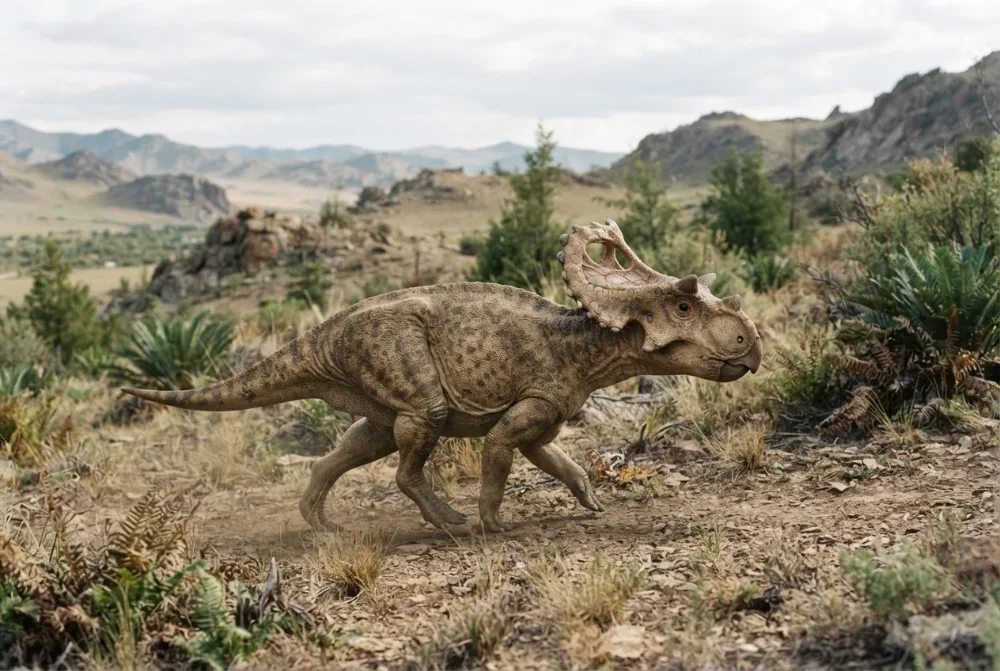
Graciliceratops had a very slender, fragile frill with large holes in it, held up by thin struts of bone.2
The only fossil found is a young animal, because its sacral vertebrae were not yet fused together.2
Its shin bone (tibia) was longer than its thigh bone (femur), which helped it run fast.2
Graciliceratops lived alongside the large dromaeosaurid Achillobator and the tyrannosauroid Khankhuuluu.2
It was a basal neoceratopsian, an early relative of later horned dinosaurs like Protoceratops.2
Mafunso ofunsidwa kwambiri okhudza Graciliceratops
?How big was Graciliceratops?
The only known fossil is a young animal about 60 cm long and weighing 2.27 to 9.1 kg. Scientists think a full-grown adult would have been around 2 m long, about the size of a small pony.21
?What did Graciliceratops eat?
It was an herbivore, eating plants. Fossil fruits found in the same area show that flowering plants grew there, so it probably ate those.21
Kwa akatswiri a madino
- Dzina la sayansi
- Graciliceratops
- Anapatsidwa dzina ndi
- Sereno 20003
- Gulu
- Madino a nyanga
- Banja / kladi
- Neoceratopsia3
- Magawidwe a sayansi
- Ornithischia > Ceratopsia3
- Zaka za miyala
- zaka 100 mpaka 84 miliyoni (Cenomanian / Santonian)3
- Mapangidwe a miyala
- Baynshire3
- Mayiko
- Mongoliya3
- Zolemba za mafosili
- 1 mu The Paleobiology Database3
- Kupezeka
- The first fossil was found in 1971 by a Polish-Mongolian expedition. It was originally called Microceratops, but Paul Sereno gave it the new name Graciliceratops in 2000.21
- Akukambiranabe
- Scientists are not sure exactly how big a fully grown Graciliceratops was, because the only known skeleton is from a juvenile.2
Kumene mfundo zimachokera
- Graciliceratops | Natural History Museum (nhm.ac.uk)
- Graciliceratops (en.wikipedia.org)
- Graciliceratops in The Paleobiology Database (CC BY 4.0): zaka, malo, mapangidwe a miyala, magawidwe a sayansi.
Mfundo iliyonse patsamba lino ili ndi nambala yosonyeza kumene yachokera. Ngati talakwitsa kanthu, pepa, ndife okonda madino, osati magazini ya sayansi. Tiuze pa [email protected] ndipo tikonza.
 Rex ali ndi njala! Dino Wiki ndi ntchito ya bambo kwa mwana wawo wamwamuna wokonda madainoso, yaulere popanda zotsatsa ndi zokazonda. Akuluakulu angadyetse Rex zokhwasula-khwasula kuti tsambali lipitirize kupezeka pa intaneti.Dyetsa Rex
 Triceratops
 Protoceratops
 Ojoceratops
 Tatankaceratops
 Psittacosaurus
 Centrosaurus
 Tyrannosaurus
 Velociraptor
 Spinosaurus
 Ankylosaurus
 Parasaurolophus
 Pteranodon