 Kwizi ya Ndiwe dino uti?
 Nkhondo ya madino
 Mpikisano wa madino
 Masewera ang'onoang'ono a madino
 Chimbale cha zomata
 Mindandanda ya TOP ya madino
 Ndidabwitse!
Ankakhala liti?

Anali wamkulu bwanji?
Anali wautali bwanji?
Msinkhu wake unali wautali bwanji?
kuyerekeza
Ankalemera bwanji?

 wautali ngati agalu 8 otsatizana mphuno ndi mchira🍌wautali ngati nthochi 44 zotsatizanawolemera ngati agalu 150🍉wolemera ngati mavwende 600🎒wolemera ngati makalasi athunthu a ana a sukulu 4🐻❄️wolemera ngati zimbalangondo zoyera 7🏃akanatha kuthamanga mamita 100 m'masekondi 14 (munthu waliwiro kwambiri amafunika 9.6)
Gryposaurus anali wamkulu bwanji poyerekeza ndi IWEYO?
Ndi masamu chabe mu msakatuli wako. Palibe chimene chimasungidwa kapena kutumizidwa kwina kulikonse.
Anali ndi liwiro lotani?


Mfundo zosangalatsa
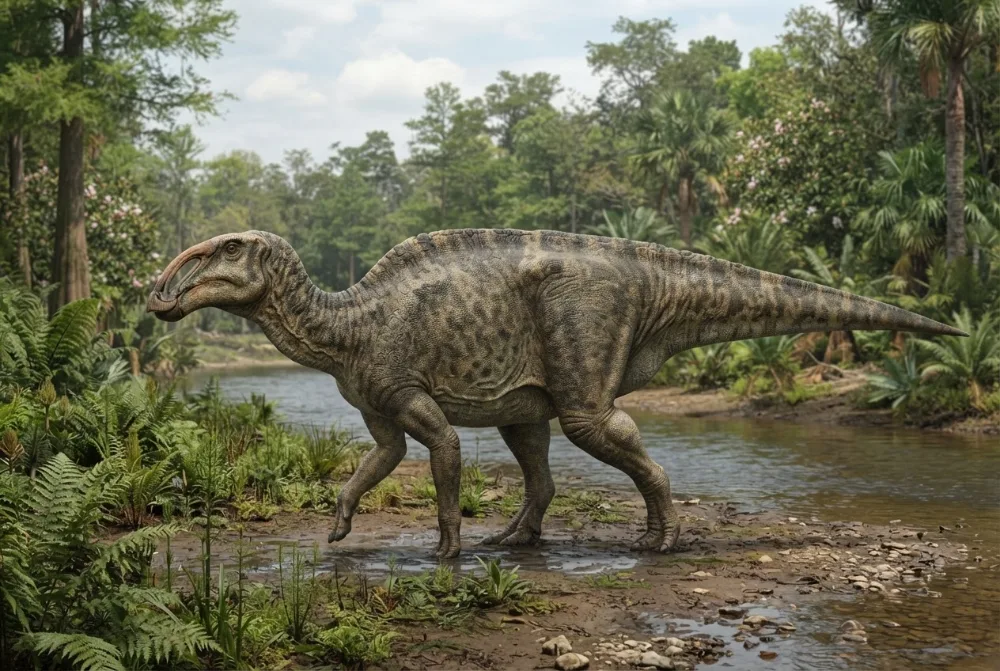
Gryposaurus had a narrow, arching hump on its nose that looked like a Roman nose, which might have been used to tell species apart or to fight others of the same kind.1
Some Gryposaurus fossils even include skin impressions that show it had pyramid-shaped scales running along the middle of its back.1
Its teeth were packed into batteries of hundreds, and only a few were in use at a time, constantly being replaced like a conveyor belt.1
Gryposaurus probably lived near rivers, and it disappeared from the Dinosaur Park Formation before another duckbill called Prosaurolophus showed up.1
The species G. monumentensis was named one of the top 10 new species of 2008 by the International Institute for Species Exploration.1
Gryposaurus could reach food from the ground up to about 4 metres (13 feet) high, using its beak and cheek-like organs to hold plants.1
Mafunso ofunsidwa kwambiri okhudza Gryposaurus
?How big was Gryposaurus?
Gryposaurus was about 8 meters (26 feet) long. One nearly complete skeleton measured about 8.2 meters (27 feet) long.1
?What did Gryposaurus eat?
Gryposaurus was a herbivore that ate plants. It had hundreds of teeth in dental batteries and could feed from the ground up to about 4 meters (13 feet) high.1
?Did Gryposaurus have a crest?
Gryposaurus had a narrow, arching hump on its nose, often described as a 'Roman nose.' It might have been used for species recognition or combat.1
?Could Gryposaurus swim?
Gryposaurus probably lived near rivers and may have preferred river settings. It could walk on two legs or all fours, but there is no direct evidence it swam.1
?When did Gryposaurus live?
Gryposaurus lived about 80 to 75 million years ago, during the Late Cretaceous. A possible species from Texas may have lived until 66 million years ago.1
?Was Gryposaurus a dinosaur?
Yes, Gryposaurus was a duck-billed dinosaur, a type of hadrosaurid. It was a plant-eating dinosaur that lived in North America.1
Kwa akatswiri a madino
- Dzina la sayansi
- Gryposaurus
- Anapatsidwa dzina ndi
- Lambe 19142
- Gulu
- Milomo ya bakha
- Banja / kladi
- Hadrosauridae2
- Magawidwe a sayansi
- Ornithischia > Ornithopoda > Iguanodontia > Hadrosauridae2
- Zaka za miyala
- zaka 84 mpaka 66 miliyoni (Campanian / Maastrichtian)2
- Mapangidwe a miyala
- Dinosaur Park, Kaiparowits, Two Medicine2
- Mayiko
- Kanada, Amereka2
- Zolemba za mafosili
- 22 mu The Paleobiology Database2
- Kupezeka
- Gryposaurus was named by Lawrence Lambe in 1914, based on a skull and partial skeleton collected by George F. Sternberg in 1913 from the Dinosaur Park Formation in Alberta, Canada.12
- Akukambiranabe
- Scientists still debate whether Gryposaurus and Kritosaurus are the same dinosaur, because their skulls are very similar.1
Kumene mfundo zimachokera
- Gryposaurus (en.wikipedia.org)
- Gryposaurus in The Paleobiology Database (CC BY 4.0): zaka, malo, mapangidwe a miyala, magawidwe a sayansi.
Mfundo iliyonse patsamba lino ili ndi nambala yosonyeza kumene yachokera. Ngati talakwitsa kanthu, pepa, ndife okonda madino, osati magazini ya sayansi. Tiuze pa [email protected] ndipo tikonza.
 Rex ali ndi njala! Dino Wiki ndi ntchito ya bambo kwa mwana wawo wamwamuna wokonda madainoso, yaulere popanda zotsatsa ndi zokazonda. Akuluakulu angadyetse Rex zokhwasula-khwasula kuti tsambali lipitirize kupezeka pa intaneti.Dyetsa Rex
 Parasaurolophus
 Edmontosaurus
 Saurolophus
 Hypacrosaurus
 Corythosaurus
 Kritosaurus
 Tyrannosaurus
 Triceratops
 Velociraptor
 Spinosaurus
 Ankylosaurus
 Pteranodon