 Kwizi ya Ndiwe dino uti?
 Nkhondo ya madino
 Mpikisano wa madino
 Masewera ang'onoang'ono a madino
 Chimbale cha zomata
 Mindandanda ya TOP ya madino
 Ndidabwitse!
Hamipterus
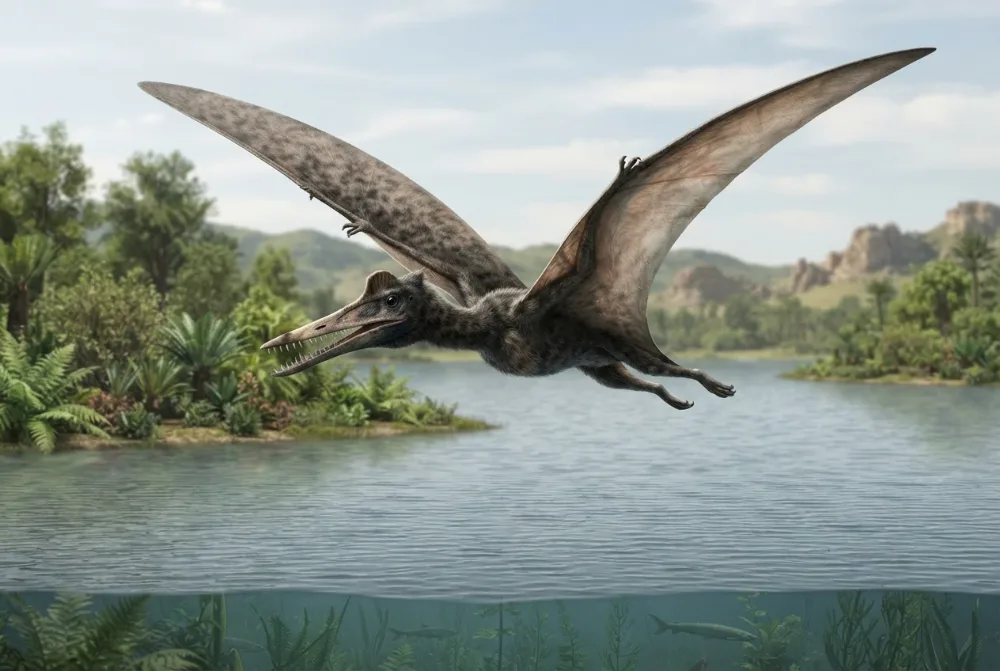
Hamipterus was a flying reptile with a wingspan as wide as a car! It lived in a big lake area in China and ate fish. Hundreds of Hamipterus fossils were found together, including eggs and soft parts like skin.12
Ankakhala liti?
Anali wamkulu bwanji?
Mapiko ake anali otambalala bwanji?
 mapiko otambalala ngati njinga 2 pamzere⚽akanatha kuuluka kudutsa bwalo lonse la mpira m'masekondi 6.4
Hamipterus anali wamkulu bwanji poyerekeza ndi IWEYO?
Ndi masamu chabe mu msakatuli wako. Palibe chimene chimasungidwa kapena kutumizidwa kwina kulikonse.
Anali ndi liwiro lotani?


Mfundo zosangalatsa
Hamipterus fossils were found in huge numbers, probably from a nesting colony that was buried by a storm. Over 40 individuals were collected, and there may have been hundreds.1
Unlike most pterosaurs, Hamipterus bones are three-dimensional and not squashed flat. Scientists even found the horny sheaths that covered its head crests.1
Five uncrushed eggs were found with the Hamipterus fossils. That is very rare for pterosaurs.1
Hamipterus had a hook-shaped bony process on the tip of its lower jaw, which scientists think helped it grab slippery fish.3
Male and female Hamipterus looked different. The paratype skull is thought to be from a male, while the holotype is probably a female.1
The tooth enamel of Hamipterus was very thin, only covering about half of each tooth crown.1
Mafunso ofunsidwa kwambiri okhudza Hamipterus
?How big was Hamipterus?
Hamipterus had a wingspan of 1.5 to 3.5 metres, which is about as wide as a small car.1
?Did Hamipterus have feathers?
No, Hamipterus was a pterosaur, a flying reptile, not a dinosaur. Pterosaurs did not have feathers; they had a fur-like covering called pycnofibers.1
?What did Hamipterus eat?
Hamipterus ate fish. It had a hook-shaped bony process on the tip of its lower jaw that helped it grab slippery fish.1
Kwa akatswiri a madino
- Dzina la sayansi
- Hamipterus
- Anapatsidwa dzina ndi
- Wang et al. 20144
- Gulu
- Zokwawa zouluka
- Banja / kladi
- Pteranodontoidea4
- Magawidwe a sayansi
- Pterosauria > Pterodactyloidea4
- Zaka za miyala
- zaka 137 mpaka 133 miliyoni (Valanginian)4
- Mapangidwe a miyala
- Shengjinkou4
- Mayiko
- China4
- Zolemba za mafosili
- 4 mu The Paleobiology Database4
- Kupezeka
- Hamipterus was named in 2014 by Wang Xiaolin and a team of scientists. The fossils were found in the Hami region of Xinjiang, China, starting in 2006.1
- Akukambiranabe
- Scientists are not sure exactly where Hamipterus fits in the pterosaur family tree. It may be close to Istiodactylus, Ludodactylus, or the Anhangueridae.1
Kumene mfundo zimachokera
- Hamipterus (en.wikipedia.org)
- The first dinosaurs from the Early Cretaceous Hami Pterosaur Fauna, China (pmc.ncbi.nlm.nih.gov)
- PBDB Taxon (paleobiodb.org)
- Hamipterus in The Paleobiology Database (CC BY 4.0): zaka, malo, mapangidwe a miyala, magawidwe a sayansi.
Mfundo iliyonse patsamba lino ili ndi nambala yosonyeza kumene yachokera. Ngati talakwitsa kanthu, pepa, ndife okonda madino, osati magazini ya sayansi. Tiuze pa [email protected] ndipo tikonza.
 Rex ali ndi njala! Dino Wiki ndi ntchito ya bambo kwa mwana wawo wamwamuna wokonda madainoso, yaulere popanda zotsatsa ndi zokazonda. Akuluakulu angadyetse Rex zokhwasula-khwasula kuti tsambali lipitirize kupezeka pa intaneti.Dyetsa Rex
 Pteranodon
 Quetzalcoatlus
 Dorygnathus
 Rhamphorhynchus
 Anhanguera
 Pterodactylus
 Stegosaurus
 Iguanodon
 Archaeopteryx
 Giganotosaurus
 Microraptor
 Deinonychus