 Kwizi ya Ndiwe dino uti?
 Nkhondo ya madino
 Mpikisano wa madino
 Masewera ang'onoang'ono a madino
 Chimbale cha zomata
 Mindandanda ya TOP ya madino
 Ndidabwitse!
Ischioceratops
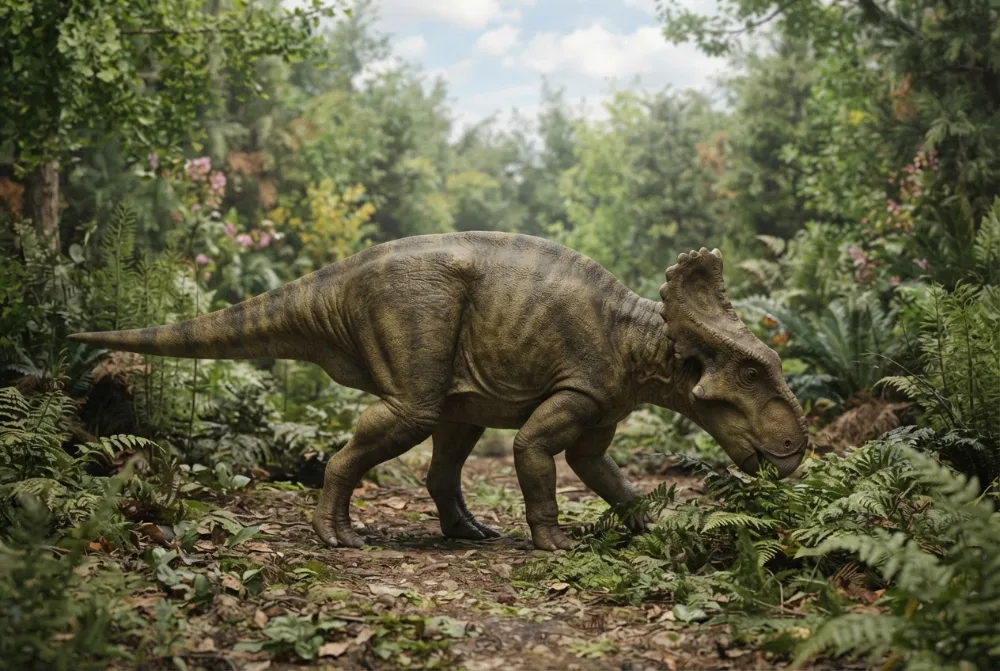
Ischioceratops was a small, plant-eating dinosaur that lived in what is now China. It had a short frill on its head and no horns, unlike its bigger cousin Triceratops. Its most unusual feature was a hip bone shaped like a bow and arrow.1
Ankakhala liti?
Anali wamkulu bwanji?
Anali wautali bwanji?
Msinkhu wake unali wautali bwanji?
kuyerekeza
 wautali ngati amphaka a pakhomo 4 otsatizana mphuno ndi mchira🍌wautali ngati nthochi 11 zotsatizana🏃akanatha kuthamanga mamita 100 m'masekondi 9.7 (munthu waliwiro kwambiri amafunika 9.6)
Ischioceratops anali wamkulu bwanji poyerekeza ndi IWEYO?
Ndi masamu chabe mu msakatuli wako. Palibe chimene chimasungidwa kapena kutumizidwa kwina kulikonse.
Anali ndi liwiro lotani?


Mfundo zosangalatsa
Ischioceratops is known only from a partial skeleton that includes the pelvis, tail bones, and parts of the legs. No skull has been found yet.1
Its ischium (a hip bone) is unlike any other dinosaur's. It flares out in the middle like a recurve bow and has a hole called a fenestra, ending in an axehead-shaped tip.1
Ischioceratops lived during the Campanian stage of the Late Cretaceous, about 83 to 72 million years ago.2
It was a leptoceratopsid, a group of small, hornless, frilled dinosaurs that walked on four legs. Leptoceratopsids are close relatives of the larger horned dinosaurs like Triceratops.1
The fossil was found in the same bonebed as many hadrosaur (duck-billed dinosaur) bones and a tyrannosaur, suggesting a rich ecosystem.1
Ischioceratops had nine sacral vertebrae (hip vertebrae), more than any other known leptoceratopsid.1
Kwa akatswiri a madino
- Dzina la sayansi
- Ischioceratops
- Anapatsidwa dzina ndi
- He et al. 20154
- Gulu
- Madino a nyanga
- Banja / kladi
- Leptoceratopsidae4
- Magawidwe a sayansi
- Ornithischia > Ceratopsia4
- Zaka za miyala
- zaka 84 mpaka 72 miliyoni (Campanian)4
- Mapangidwe a miyala
- Hongtuya4
- Mayiko
- China4
- Zolemba za mafosili
- 1 mu The Paleobiology Database4
- Kupezeka
- Ischioceratops was named in 2015 by a team of scientists including He Y., Makovicky P.J., and others. The only specimen was dug up from the Kugou locality in Zhucheng, China, and is stored at the Zhucheng Dinosaur Museum.12
- Akukambiranabe
- Scientists are not sure what the strange shape of its ischium was used for. It might have been for muscle attachment or display, but no one knows for certain.1
Kumene mfundo zimachokera
- A New Leptoceratopsid (Ornithischia, Ceratopsia) with a Unique Ischium from the Upper Cretaceous of Shandong Province, China | PLOS One (journals.plos.org)
- PBDB Taxon (paleobiodb.org)
- Ischioceratops (en.wikipedia.org)
- Ischioceratops in The Paleobiology Database (CC BY 4.0): zaka, malo, mapangidwe a miyala, magawidwe a sayansi.
Mfundo iliyonse patsamba lino ili ndi nambala yosonyeza kumene yachokera. Ngati talakwitsa kanthu, pepa, ndife okonda madino, osati magazini ya sayansi. Tiuze pa [email protected] ndipo tikonza.
 Rex ali ndi njala! Dino Wiki ndi ntchito ya bambo kwa mwana wawo wamwamuna wokonda madainoso, yaulere popanda zotsatsa ndi zokazonda. Akuluakulu angadyetse Rex zokhwasula-khwasula kuti tsambali lipitirize kupezeka pa intaneti.Dyetsa Rex
 Triceratops
 Protoceratops
 Ojoceratops
 Tatankaceratops
 Psittacosaurus
 Centrosaurus
 Tyrannosaurus
 Velociraptor
 Spinosaurus
 Ankylosaurus
 Parasaurolophus
 Pteranodon