 Kwizi ya Ndiwe dino uti?
 Nkhondo ya madino
 Mpikisano wa madino
 Masewera ang'onoang'ono a madino
 Chimbale cha zomata
 Mindandanda ya TOP ya madino
 Ndidabwitse!
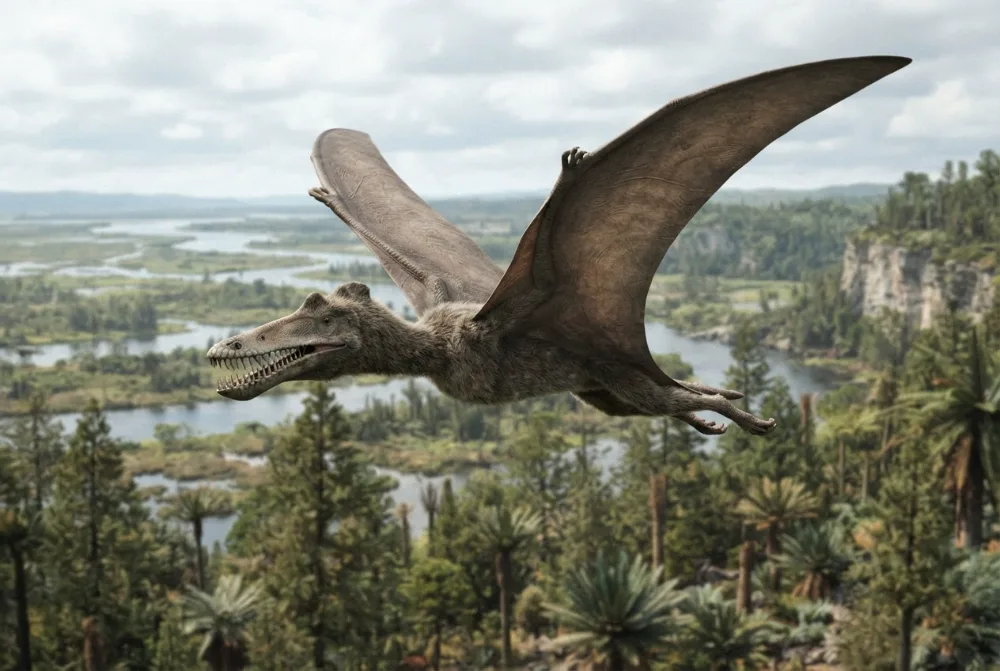
Istiodactylus
Istiodactylus was a flying reptile with a wide, blunt snout full of sharp, interlocking teeth. It lived about 120 million years ago and probably used its teeth like a cookie cutter to slice meat from big dead animals.12
Ankakhala liti?
Anali wamkulu bwanji?
Mapiko ake anali otambalala bwanji?
 mapiko otambalala ngati njinga 3 pamzere⚽akanatha kuuluka kudutsa bwalo lonse la mpira m'masekondi 5.5
Istiodactylus anali wamkulu bwanji poyerekeza ndi IWEYO?
Ndi masamu chabe mu msakatuli wako. Palibe chimene chimasungidwa kapena kutumizidwa kwina kulikonse.
Anali ndi liwiro lotani?


Mfundo zosangalatsa
Its skull was about 45 centimetres (18 inches) long and had a semicircle of 48 closely spaced, triangular teeth that interlocked to form a razor-edged outline.1
The lower jaw had a tooth-like projection that fit into the upper teeth, helping it bite cleanly.1
Some of its back vertebrae were fused into a structure called a notarium, which helped support its large wings.1
Its hindlimbs were very short, while its forelimbs and wing-finger were huge, making it a soaring specialist.1
For much of the 20th century, it was the only pterosaur known from three-dimensionally preserved fossils, giving scientists a rare look at pterosaur anatomy.12
Its teeth were unlike the long, curved fish-grabbing teeth of other pterosaurs, so scientists think it did not catch fish but instead scavenged.2
It lived in river and coastal environments in southern England, where the climate was warm, about 20 to 25 °C (68 to 77 °F).1
Mafunso ofunsidwa kwambiri okhudza Istiodactylus
?How big was Istiodactylus?
Its wingspan was about 4.3 to 5 metres. Its skull was about 45 centimetres long.12
?What did Istiodactylus eat?
It was a scavenger. It used its sharp, interlocking teeth like a cookie cutter to slice meat from dead animals.12
?Was Istiodactylus a dinosaur?
No, it was a pterosaur, a flying reptile that lived at the same time as dinosaurs but is not a dinosaur.1
?Could Istiodactylus fly?
Yes, it was a flying reptile with large wings. It may have been a soaring specialist, gliding long distances to find food.1
Wothetsa nthano zabodza
Nthano: Some people think Istiodactylus was a dinosaur because it lived with dinosaurs and had sharp teeth.
Zoona: Istiodactylus was a pterosaur, a flying reptile, not a dinosaur. Pterosaurs are a separate group of reptiles.1
Kwa akatswiri a madino
- Dzina la sayansi
- Istiodactylus
- Anapatsidwa dzina ndi
- Howse et al. 20013
- Gulu
- Zokwawa zouluka
- Banja / kladi
- Ornithocheiroidea3
- Magawidwe a sayansi
- Pterosauria > Pterodactyloidea3
- Zaka za miyala
- zaka 126 mpaka 120 miliyoni (Barremian / Aptian)3
- Mapangidwe a miyala
- Wessex, Vectis, Yixian3
- Mayiko
- United Kingdom, China3
- Zolemba za mafosili
- 6 mu The Paleobiology Database3
- Kupezeka
- The first fossil was found on the Isle of Wight in 1887, and in 1901 it was named Ornithodesmus latidens. In 2001, scientists moved it to its own genus, Istiodactylus.1
- Akukambiranabe
- Scientists debate whether the Chinese species Istiodactylus sinensis really belongs to this genus or to a different one, and whether it is the same as another pterosaur called Longchengpterus.1
Kumene mfundo zimachokera
- Istiodactylus (en.wikipedia.org)
- New Insights into the Skull of Istiodactylus latidens (Ornithocheiroidea, Pterodactyloidea) | PLOS One (journals.plos.org)
- Istiodactylus in The Paleobiology Database (CC BY 4.0): zaka, malo, mapangidwe a miyala, magawidwe a sayansi.
Mfundo iliyonse patsamba lino ili ndi nambala yosonyeza kumene yachokera. Ngati talakwitsa kanthu, pepa, ndife okonda madino, osati magazini ya sayansi. Tiuze pa [email protected] ndipo tikonza.
 Rex ali ndi njala! Dino Wiki ndi ntchito ya bambo kwa mwana wawo wamwamuna wokonda madainoso, yaulere popanda zotsatsa ndi zokazonda. Akuluakulu angadyetse Rex zokhwasula-khwasula kuti tsambali lipitirize kupezeka pa intaneti.Dyetsa Rex
 Pteranodon
 Quetzalcoatlus
 Dorygnathus
 Rhamphorhynchus
 Anhanguera
 Pterodactylus
 Stegosaurus
 Iguanodon
 Archaeopteryx
 Giganotosaurus
 Microraptor
 Deinonychus