 Kwizi ya Ndiwe dino uti?
 Nkhondo ya madino
 Mpikisano wa madino
 Masewera ang'onoang'ono a madino
 Chimbale cha zomata
 Mindandanda ya TOP ya madino
 Ndidabwitse!
Ankakhala liti?

Anali wamkulu bwanji?
Anali wautali bwanji?
Msinkhu wake unali wautali bwanji?
kuyerekeza
Ankalemera bwanji?
 wautali ngati agalu 5 otsatizana mphuno ndi mchira🍌wautali ngati nthochi 28 zotsatizana🍉wolemera ngati mavwende 130🧸wolemera ngati ana a sukulu ya mkaka 34🎒wolemera ngati ana a sukulu 20🏃akanatha kuthamanga mamita 100 m'masekondi 8.4 (munthu waliwiro kwambiri amafunika 9.6)
Juratyrant anali wamkulu bwanji poyerekeza ndi IWEYO?
Ndi masamu chabe mu msakatuli wako. Palibe chimene chimasungidwa kapena kutumizidwa kwina kulikonse.
Anali ndi liwiro lotani?


Mfundo zosangalatsa
Juratyrant is known from just one partial skeleton, including a complete pelvis, leg bones, and vertebrae.1
It was first thought to be a species of Stokesosaurus, but scientists later gave it its own genus in 2013.12
The fossil was discovered in 1984 by a commercial fossil collector named Peter Langham, and the species was named after him.1
Juratyrant lived during the Tithonian age of the Late Jurassic, about 149.3 to 149 million years ago.15
Scientists estimate Juratyrant weighed between 300 and 648 kilograms, about as much as a large cow.1
It had a 'folded' appearance on part of its hip bone, which is one of the unique features that sets it apart from other tyrannosaurs.2
Mafunso ofunsidwa kwambiri okhudza Juratyrant
?How big was Juratyrant?
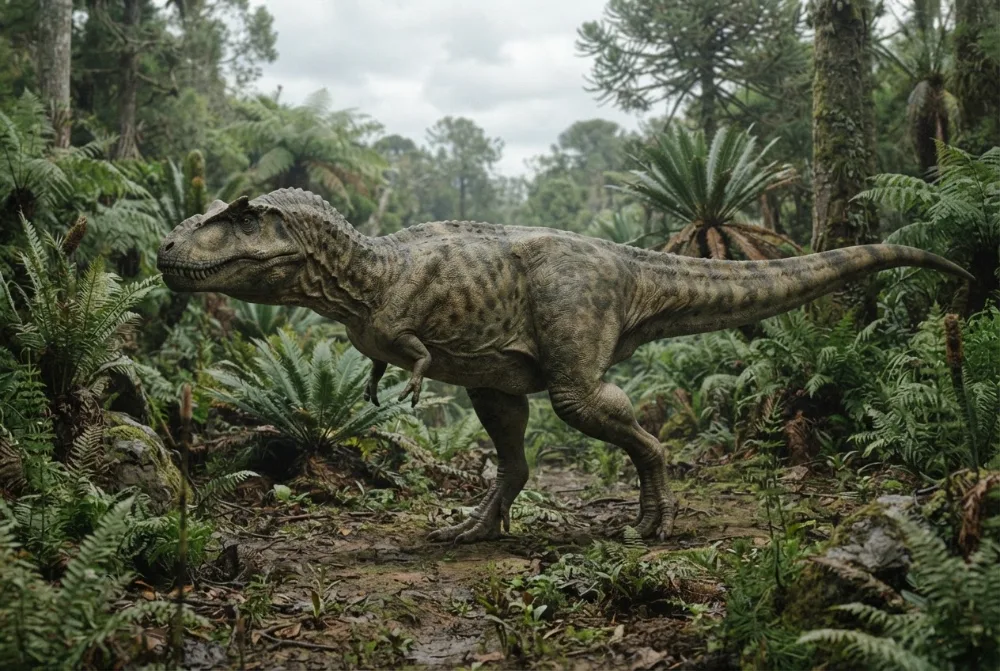
Juratyrant was about 5 metres (16 feet) long and weighed between 300 and 648 kilograms (660 and 1,429 pounds), according to different estimates.1
?When did Juratyrant live?
Juratyrant lived during the Tithonian age of the Late Jurassic, about 149.3 to 149 million years ago.1
?What did Juratyrant eat?
Juratyrant was a meat-eating dinosaur, so it likely hunted small animals, though its skull and forelimbs are not known.13
?Where was Juratyrant found?
The only Juratyrant fossil was discovered in 1984 in Dorset, England, in the Kimmeridge Clay formation.1
?Is Juratyrant a dinosaur?
Yes, Juratyrant is a dinosaur, specifically a theropod and a tyrannosauroid, related to T. rex.14
?Why is it called Juratyrant?
The name Juratyrant means 'Jurassic tyrant', because it lived during the Jurassic period and was an early relative of T. rex.1
Kwa akatswiri a madino
- Dzina la sayansi
- Juratyrant
- Anapatsidwa dzina ndi
- Brusatte and Benson 20135
- Gulu
- Matiranosauri
- Banja / kladi
- Tyrannosauroidea5
- Magawidwe a sayansi
- Theropoda > Tyrannosauroidea5
- Zaka za miyala
- zaka 145 mpaka 143 miliyoni (Tithonian)5
- Mapangidwe a miyala
- Kimmeridge Clay5
- Mayiko
- United Kingdom5
- Zolemba za mafosili
- 1 mu The Paleobiology Database5
- Kupezeka
- The only known fossil was found in 1984 in Dorset, England, by Peter Langham. It was first named Stokesosaurus langhami in 2008, but in 2013 scientists Brusatte and Benson gave it its own genus, Juratyrant.12
- Akukambiranabe
- Scientists are not sure exactly how Juratyrant is related to other early tyrannosaurs, because the fossils are so few and fragmentary.2
Kumene mfundo zimachokera
- Juratyrant (en.wikipedia.org)
- The systematics of Late Jurassic tyrannosauroid theropods ... (app.pan.pl)
- England’s Jurassic Tyrant (smithsonianmag.com)
- Juratyrant Brusatte & Benson 2013 - Encyclopedia of Life (eol.org)
- Juratyrant in The Paleobiology Database (CC BY 4.0): zaka, malo, mapangidwe a miyala, magawidwe a sayansi.
Mfundo iliyonse patsamba lino ili ndi nambala yosonyeza kumene yachokera. Ngati talakwitsa kanthu, pepa, ndife okonda madino, osati magazini ya sayansi. Tiuze pa [email protected] ndipo tikonza.
 Rex ali ndi njala! Dino Wiki ndi ntchito ya bambo kwa mwana wawo wamwamuna wokonda madainoso, yaulere popanda zotsatsa ndi zokazonda. Akuluakulu angadyetse Rex zokhwasula-khwasula kuti tsambali lipitirize kupezeka pa intaneti.Dyetsa Rex
 Tyrannosaurus
 Tarbosaurus
 Albertosaurus
 Daspletosaurus
 Gorgosaurus
 Alectrosaurus
 Stegosaurus
 Iguanodon
 Archaeopteryx
 Giganotosaurus
 Microraptor
 Deinonychus