 Kwizi ya Ndiwe dino uti?
 Nkhondo ya madino
 Mpikisano wa madino
 Masewera ang'onoang'ono a madino
 Chimbale cha zomata
 Mindandanda ya TOP ya madino
 Ndidabwitse!
Kaijutitan
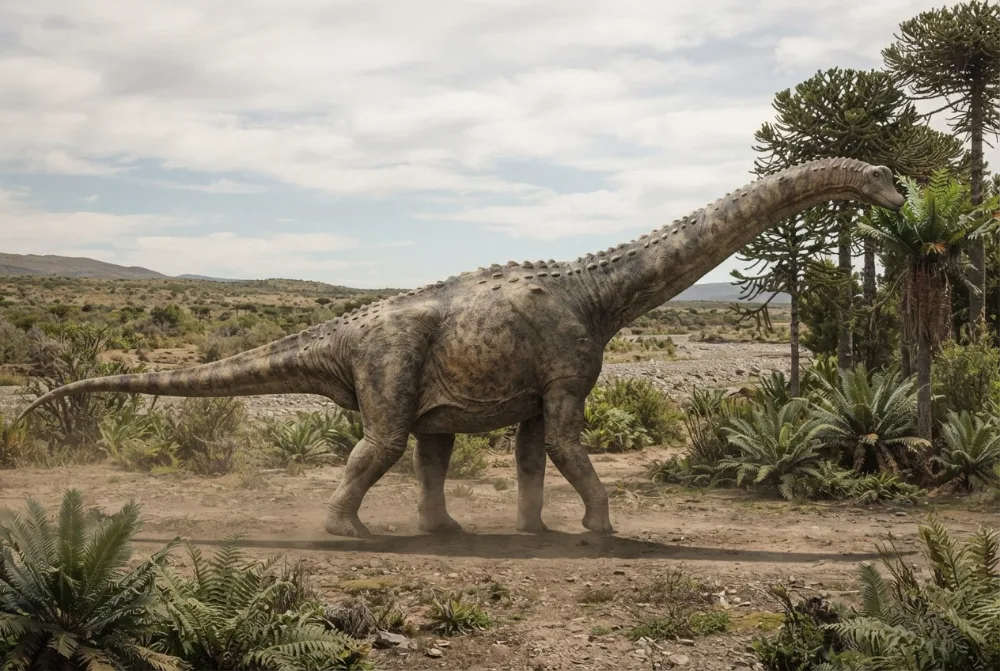
Kaijutitan was a giant, long-necked plant-eater that lived in what is now Argentina. It is one of the earliest known titanosaurs, a group that includes the biggest dinosaurs ever. Its neck bones had a strange split shape, like a fork.42
Ankakhala liti?
Anali wamkulu bwanji?
Ankalemera bwanji?

Kaijutitan anali wamkulu bwanji poyerekeza ndi IWEYO?
Ndi masamu chabe mu msakatuli wako. Palibe chimene chimasungidwa kapena kutumizidwa kwina kulikonse.
Anali ndi liwiro lotani?


Mfundo zosangalatsa
Kaijutitan is the latest known basal titanosaur, meaning it lived near the end of the time when early titanosaurs existed.2
Its neck vertebrae had bifid (split) neural spines, a feature that evolved several times among sauropods but is rare in titanosaurs.2
The fossil includes part of the skull, which is very unusual for large titanosaurs because their skulls are rarely preserved.2
Kaijutitan lived about 89 to 86 million years ago, during the Coniacian stage of the Late Cretaceous.4
Its bones were found scattered in an area of about 20 square metres, suggesting the carcass fell apart before being buried.2
The species name maui honors the Museo Municipal Argentino Urquiza (MAU), where the fossil is stored.1
Mafunso ofunsidwa kwambiri okhudza Kaijutitan
?How big was Kaijutitan?
Scientists don't know its exact size yet, but it was a huge sauropod, one of the giant titanosaurs. Its bones show it was an adult of huge body size.31
?What did Kaijutitan eat?
Kaijutitan was a plant-eater, like all sauropods. It used its long neck to reach leaves from tall trees.1
Kwa akatswiri a madino
- Dzina la sayansi
- Kaijutitan
- Anapatsidwa dzina ndi
- Filippi et al. 20194
- Gulu
- Makosi atali
- Banja / kladi
- Lithostrotia4
- Magawidwe a sayansi
- Sauropodomorpha > Sauropoda > Titanosauria > Macronaria4
- Zaka za miyala
- zaka 90 mpaka 86 miliyoni (Coniacian)4
- Mapangidwe a miyala
- Sierra Barrosa4
- Mayiko
- Argentina4
- Zolemba za mafosili
- 1 mu The Paleobiology Database4
- Kupezeka
- Kaijutitan was named in 2019 by paleontologists Leonardo Filippi, Leonardo Salgado, and Alberto Garrido. The skeleton was found by a team from the Museo Municipal Argentino Urquiza and the Museo Provincial de Ciencias Naturales in Argentina.42
- Akukambiranabe
- Scientists are not sure exactly how big Kaijutitan was, because only a partial skeleton has been found.2
Kumene mfundo zimachokera
- Kaijutitan (en.wikipedia.org)
- A new giant basal titanosaur sauropod in the Upper Cretaceous (Coniacian) of the NeuquEn Basin, Argentina (rid.unrn.edu.ar)
- KAIJUTITAN MAUI, A SAUROPOD TITANOSAUR FROM THE UPPER CRETACEOUS (SIERRA BARROSA FORMATION, NEUQUÉN BASIN) OF NORTHERN PATAGONIA ARGENTINA: HISTOLOGICAL AND TAPHONOMIC CONSIDERATIONS | Publicación Electrónica de la Asociación Paleontológica Argentina (peapaleontologica.org.ar)
- Kaijutitan in The Paleobiology Database (CC BY 4.0): zaka, malo, mapangidwe a miyala, magawidwe a sayansi.
Mfundo iliyonse patsamba lino ili ndi nambala yosonyeza kumene yachokera. Ngati talakwitsa kanthu, pepa, ndife okonda madino, osati magazini ya sayansi. Tiuze pa [email protected] ndipo tikonza.
 Rex ali ndi njala! Dino Wiki ndi ntchito ya bambo kwa mwana wawo wamwamuna wokonda madainoso, yaulere popanda zotsatsa ndi zokazonda. Akuluakulu angadyetse Rex zokhwasula-khwasula kuti tsambali lipitirize kupezeka pa intaneti.Dyetsa Rex
 Brachiosaurus
 Diplodocus
 Brontosaurus
 Argentinosaurus
 Camarasaurus
 Morosaurus
 Tyrannosaurus
 Triceratops
 Velociraptor
 Spinosaurus
 Ankylosaurus
 Parasaurolophus