 Kwizi ya Ndiwe dino uti?
 Nkhondo ya madino
 Mpikisano wa madino
 Masewera ang'onoang'ono a madino
 Chimbale cha zomata
 Mindandanda ya TOP ya madino
 Ndidabwitse!
Kamuysaurus
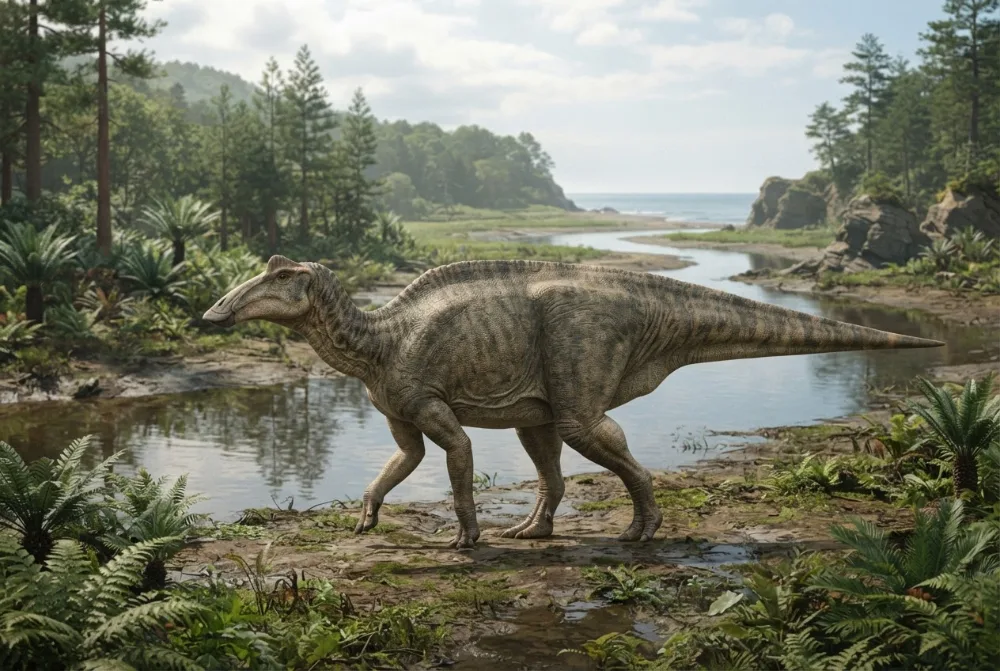
Kamuysaurus was a duck-billed dinosaur that lived in what is now Japan. It had a flat, toothless beak and hundreds of cheek teeth for chewing plants. This dinosaur is one of the most complete skeletons ever found in Japan.12
Ankakhala liti?
Anali wamkulu bwanji?
Anali wautali bwanji?
Msinkhu wake unali wautali bwanji?
kuyerekeza
Ankalemera bwanji?
 wautali ngati magalimoto 2 oimikidwa pamzere🍌wautali ngati nthochi 50 zotsatizana
 wolemera pafupifupi ngati njovu🍉wolemera ngati mavwende 1000🎒wolemera ngati makalasi athunthu a ana a sukulu 6🐻❄️wolemera ngati zimbalangondo zoyera 11🏃akanatha kuthamanga mamita 100 m'masekondi 16 (munthu waliwiro kwambiri amafunika 9.6)
Kamuysaurus anali wamkulu bwanji poyerekeza ndi IWEYO?
Ndi masamu chabe mu msakatuli wako. Palibe chimene chimasungidwa kapena kutumizidwa kwina kulikonse.
Anali ndi liwiro lotani?


Mfundo zosangalatsa
The skeleton is over 60% complete and includes the skull, making it one of the most complete dinosaur skeletons from Japan.1
It lived about 72 to 70 million years ago during the early Maastrichtian age.1
Kamuysaurus belongs to a group of duck-billed dinosaurs called Edmontosaurini, which also includes Edmontosaurus.2
The dinosaur was named after the Ainu word 'kamuy', meaning deity or god.1
It was an adult at least nine years old when it died.1
Mafunso ofunsidwa kwambiri okhudza Kamuysaurus
?How big was Kamuysaurus?
It was about 8 metres long and weighed 4 to 5.3 tonnes.1
?What did Kamuysaurus eat?
It was a plant-eater. It had a toothless beak and rows of cheek teeth for chewing tough plants.1
?When did Kamuysaurus live?
It lived about 72 to 70 million years ago, during the early Maastrichtian age of the Late Cretaceous.1
?Was Kamuysaurus a dinosaur?
Yes, it was a duck-billed dinosaur called a hadrosaur, but it was not a meat-eater.1
?Did Kamuysaurus have a crest?
It may have had a small, flat crest on its head, similar to the crest of Brachylophosaurus.24
?Where was Kamuysaurus found?
It was found in marine rocks in Hokkaido, Japan. Its body likely washed out to sea after it died.1
Kwa akatswiri a madino
- Dzina la sayansi
- Kamuysaurus
- Anapatsidwa dzina ndi
- Kobayashi et al. 20195
- Gulu
- Milomo ya bakha
- Banja / kladi
- Hadrosauridae5
- Magawidwe a sayansi
- Ornithischia > Ornithopoda > Iguanodontia > Hadrosauridae5
- Zaka za miyala
- zaka 72 mpaka 66 miliyoni (Maastrichtian)5
- Mapangidwe a miyala
- Hakobuchi5
- Mayiko
- Japani5
- Zolemba za mafosili
- 1 mu The Paleobiology Database5
- Kupezeka
- Amateur paleontologist Yoshiyuki Horita found the tail in 2003. Teams from the Hobetsu Museum and Hokkaido University Museum dug up the rest of the skeleton in 2013 and 2014. It was named Kamuysaurus japonicus in 2019 by Yoshitsugu Kobayashi and colleagues.12
- Akukambiranabe
- Scientists are not sure if Kamuysaurus had a small crest on its head, because the bones at the front of the skull are missing.2
Kumene mfundo zimachokera
- Kamuysaurus (en.wikipedia.org)
- A New Hadrosaurine (Dinosauria: Hadrosauridae) from the Marine Deposits of the Late Cretaceous Hakobuchi Formation, Yezo Group, Japan | Scientific Reports (nature.com)
- PBDB Taxon (paleobiodb.org)
- A new duck-billed dinosaur, Kamuysaurus japonicus, identified | Hokkaido University (global.hokudai.ac.jp)
- Kamuysaurus in The Paleobiology Database (CC BY 4.0): zaka, malo, mapangidwe a miyala, magawidwe a sayansi.
Mfundo iliyonse patsamba lino ili ndi nambala yosonyeza kumene yachokera. Ngati talakwitsa kanthu, pepa, ndife okonda madino, osati magazini ya sayansi. Tiuze pa [email protected] ndipo tikonza.
 Rex ali ndi njala! Dino Wiki ndi ntchito ya bambo kwa mwana wawo wamwamuna wokonda madainoso, yaulere popanda zotsatsa ndi zokazonda. Akuluakulu angadyetse Rex zokhwasula-khwasula kuti tsambali lipitirize kupezeka pa intaneti.Dyetsa Rex
 Parasaurolophus
 Edmontosaurus
 Saurolophus
 Hypacrosaurus
 Corythosaurus
 Kritosaurus
 Tyrannosaurus
 Triceratops
 Velociraptor
 Spinosaurus
 Ankylosaurus
 Pteranodon