 Kwizi ya Ndiwe dino uti?
 Nkhondo ya madino
 Mpikisano wa madino
 Masewera ang'onoang'ono a madino
 Chimbale cha zomata
 Mindandanda ya TOP ya madino
 Ndidabwitse!
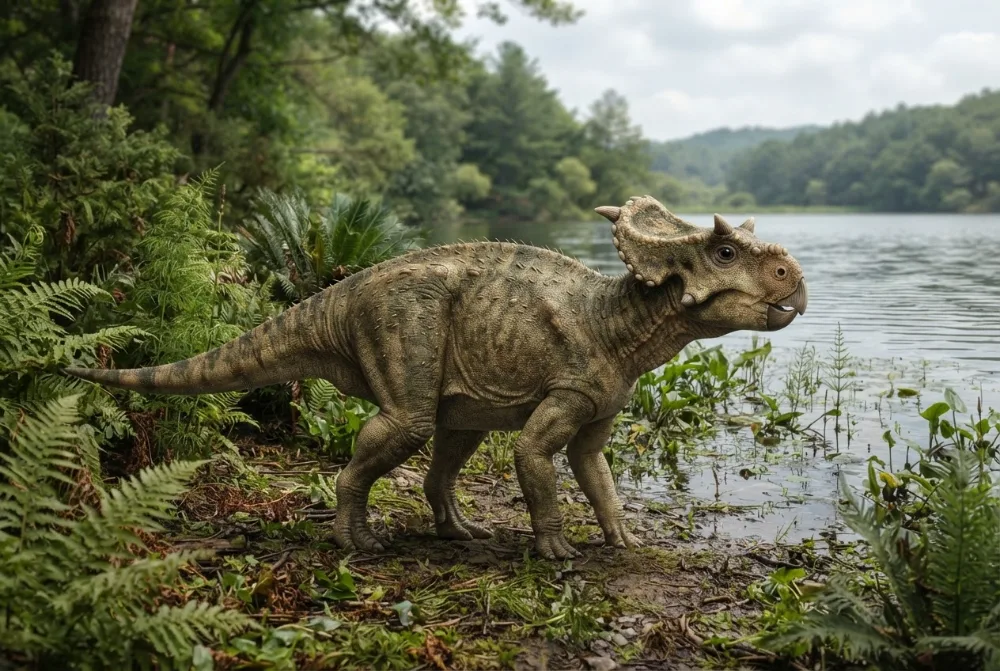
Koreaceratops
Koreaceratops was a small, plant-eating dinosaur that lived in South Korea during the Early Cretaceous. It had a beak like a parrot and walked on two legs, but scientists think it might have been a good swimmer too!12
Ankakhala liti?
Anali wamkulu bwanji?
Anali wautali bwanji?
 wautali ngati amphaka a pakhomo 2.5 otsatizana mphuno ndi mchira🍌wautali ngati nthochi 7 zotsatizana🏃akanatha kuthamanga mamita 100 m'masekondi 10 (munthu waliwiro kwambiri amafunika 9.6)
Koreaceratops anali wamkulu bwanji poyerekeza ndi IWEYO?
Ndi masamu chabe mu msakatuli wako. Palibe chimene chimasungidwa kapena kutumizidwa kwina kulikonse.
Anali ndi liwiro lotani?


Mfundo zosangalatsa
Koreaceratops had very tall spines on its tail bones, some over five times the height of the bone they attached to.12
Scientists think those tall tail spines might have helped Koreaceratops swim, like a paddle or a fin.12
The only known fossil of Koreaceratops was found in a sandstone block that had been used to build a dam.1
The type specimen was about eight years old when it died and had not yet reached full size or maturity.1
Koreaceratops lived in a semiarid environment, like a dry or dusty landscape.1
Mafunso ofunsidwa kwambiri okhudza Koreaceratops
?How big was Koreaceratops?
About 1.3 metres (4.3 feet) long, based on an estimate by paleontologist Thomas Holtz.1
?Could Koreaceratops swim?
Maybe! Scientists think its very tall tail spines might have helped it swim like a paddle, but the evidence is not certain.31
?What did Koreaceratops eat?
Koreaceratops was a plant-eater, like other ceratopsian dinosaurs.1
Kwa akatswiri a madino
- Dzina la sayansi
- Koreaceratops
- Anapatsidwa dzina ndi
- Lee et al. 20104
- Gulu
- Madino a nyanga
- Banja / kladi
- Leptoceratopsidae4
- Magawidwe a sayansi
- Ornithischia > Ceratopsia4
- Zaka za miyala
- zaka 113 mpaka 100 miliyoni (Albian)4
- Mapangidwe a miyala
- Tando beds4
- Mayiko
- Korea ya Kumwera4
- Zolemba za mafosili
- 1 mu The Paleobiology Database4
- Kupezeka
- Koreaceratops was named in 2011 by Yuong-Nam Lee and colleagues. The fossil was first noticed by a public official in 2008, after it had been built into a dam in Hwaseong City, South Korea.1
- Akukambiranabe
- Scientists are not sure exactly where Koreaceratops fits on the ceratopsian family tree. Some studies place it near Archaeoceratops, while a 2022 study suggests it is closer to Protoceratops.1
Kumene mfundo zimachokera
- Koreaceratops (en.wikipedia.org)
- The first ceratopsian dinosaur from South Korea - Seoul National University (snu.elsevierpure.com)
- Koreaceratops—A Swimming Ceratopsian? (smithsonianmag.com)
- Koreaceratops in The Paleobiology Database (CC BY 4.0): zaka, malo, mapangidwe a miyala, magawidwe a sayansi.
Mfundo iliyonse patsamba lino ili ndi nambala yosonyeza kumene yachokera. Ngati talakwitsa kanthu, pepa, ndife okonda madino, osati magazini ya sayansi. Tiuze pa [email protected] ndipo tikonza.
 Rex ali ndi njala! Dino Wiki ndi ntchito ya bambo kwa mwana wawo wamwamuna wokonda madainoso, yaulere popanda zotsatsa ndi zokazonda. Akuluakulu angadyetse Rex zokhwasula-khwasula kuti tsambali lipitirize kupezeka pa intaneti.Dyetsa Rex
 Triceratops
 Protoceratops
 Ojoceratops
 Tatankaceratops
 Psittacosaurus
 Centrosaurus
 Stegosaurus
 Iguanodon
 Archaeopteryx
 Giganotosaurus
 Microraptor
 Deinonychus