 Kwizi ya Ndiwe dino uti?
 Nkhondo ya madino
 Mpikisano wa madino
 Masewera ang'onoang'ono a madino
 Chimbale cha zomata
 Mindandanda ya TOP ya madino
 Ndidabwitse!
Lariosaurus
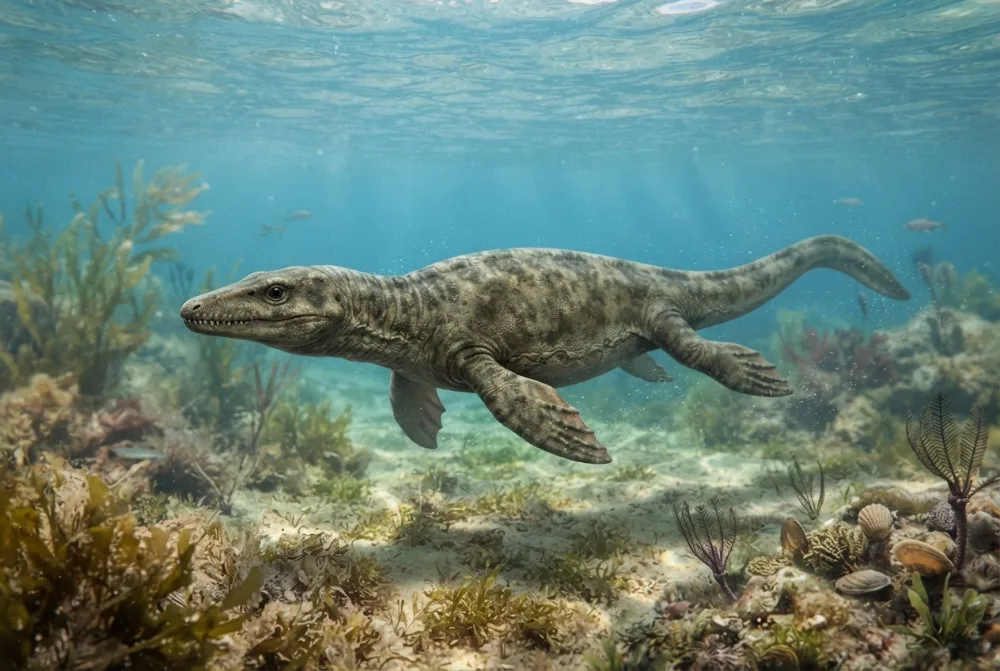
Lariosaurus was a small, ancient sea reptile that lived in warm, shallow seas during the Triassic Period. It had a short neck, small flippers, and webbed feet, and it probably spent a lot of time hunting in shallow water or even on land.12
Ankakhala liti?
Anali wamkulu bwanji?
Anali wautali bwanji?
 wautali ngati amphaka a pakhomo 1.5 otsatizana mphuno ndi mchira🍌wautali ngati nthochi 4 zotsatizana🏊akanatha kusambira utali wa dziwe lalikulu losambira (50 m) m'masekondi 26
Lariosaurus anali wamkulu bwanji poyerekeza ndi IWEYO?
Ndi masamu chabe mu msakatuli wako. Palibe chimene chimasungidwa kapena kutumizidwa kwina kulikonse.
Anali ndi liwiro lotani?


Mfundo zosangalatsa
Lariosaurus was one of the smallest nothosaurs, measuring less than one meter long.1
Its front legs were adapted into paddles, but its back legs still had five toes, which is unusual among nothosaurs.1
Scientists think Lariosaurus could give birth to live young, because fossils of babies have been found inside adults.1
A fossil with preserved skin shows that Lariosaurus had webbed hands and feet, like a duck.2
Lariosaurus had a short neck and small flippers, making it a poor swimmer compared to other nothosaurs.1
The first Lariosaurus fossil was discovered in 1830 near Lake Como, Italy, making it one of the earliest known marine reptiles from the Alps.1
Lariosaurus had a sturdy armor of belly ribs (gastralia) that protected its underside.1
Mafunso ofunsidwa kwambiri okhudza Lariosaurus
?What did Lariosaurus eat?
It ate small prey like fish and other reptiles. One fossil had two young placodonts (a type of shelled reptile) in its stomach.1
?How did Lariosaurus swim?
It swam by rowing its strong front limbs like a seal, using a 'flying-rowing' motion. Its hands and feet were webbed, not flippers.23
?Did Lariosaurus have live babies?
Yes, scientists think it gave birth to live young. Fossils of baby Lariosaurus have been found inside adults.1
Wothetsa nthano zabodza
Nthano: Some people thought Lariosaurus was a dinosaur or a stegosaur.
Zoona: Lariosaurus is a nothosaur, a type of marine reptile, not a dinosaur. The nothosaur Eupodosaurus was once mistaken for a stegosaurian dinosaur but is now considered the same as Lariosaurus.1
Kwa akatswiri a madino
- Dzina la sayansi
- Lariosaurus
- Anapatsidwa dzina ndi
- Curioni 18474
- Gulu
- Zokwawa za m'nyanja
- Banja / kladi
- Nothosauridae4
- Magawidwe a sayansi
- Sauropterygia4
- Zaka za miyala
- zaka 251 mpaka 237 miliyoni ()4
- Mapangidwe a miyala
- Falang, Meride, Perledo-Varenna4
- Mayiko
- Italiya, China, Jeremani, Sipeyini, Switzerland, Netherlands4
- Zolemba za mafosili
- 27 mu The Paleobiology Database4
- Amadziwikanso kuti
- Deirosaurus, Eupodosaurus, Macromerosauro, Macromerosaurus, Macromirosaurus, Rhaeticonia, Silvestrosaurus (mayina akale tsopano amawerengedwa ngati nyama yomweyi)4
- Kupezeka
- Lariosaurus was named in 1847 by Curioni, based on a fossil found in 1830 at Perledo on Lake Como, Italy.1
- Akukambiranabe
- Scientists debate whether the genera Ceresiosaurus and Silvestrosaurus should be considered the same as Lariosaurus.1
Kumene mfundo zimachokera
- Lariosaurus (en.wikipedia.org)
- The first specimen with skin preserved of Lariosaurus (Eusauropterygia) from the Middle Triassic of Monte San Giorgio (Switzerland) allows inferences about its swimming method | Swiss Journal of Palaeontology | Springer Nature Link (link.springer.com)
- An ancient reptile’s fossilized skin reveals how it swam like a seal (sciencenews.org)
- Lariosaurus in The Paleobiology Database (CC BY 4.0): zaka, malo, mapangidwe a miyala, magawidwe a sayansi.
Mfundo iliyonse patsamba lino ili ndi nambala yosonyeza kumene yachokera. Ngati talakwitsa kanthu, pepa, ndife okonda madino, osati magazini ya sayansi. Tiuze pa [email protected] ndipo tikonza.
 Rex ali ndi njala! Dino Wiki ndi ntchito ya bambo kwa mwana wawo wamwamuna wokonda madainoso, yaulere popanda zotsatsa ndi zokazonda. Akuluakulu angadyetse Rex zokhwasula-khwasula kuti tsambali lipitirize kupezeka pa intaneti.Dyetsa Rex
 Nothosaurus
 Placodus
 Cyamodus
 Cymatosaurus
 Proneusticosaurus
 Simosaurus
 Chonespondylus
 Cymbospondylus
 Phalarodon
 Mixosaurus
 Chaohusaurus
 Chensaurus