 Kwizi ya Ndiwe dino uti?
 Nkhondo ya madino
 Mpikisano wa madino
 Masewera ang'onoang'ono a madino
 Chimbale cha zomata
 Mindandanda ya TOP ya madino
 Ndidabwitse!
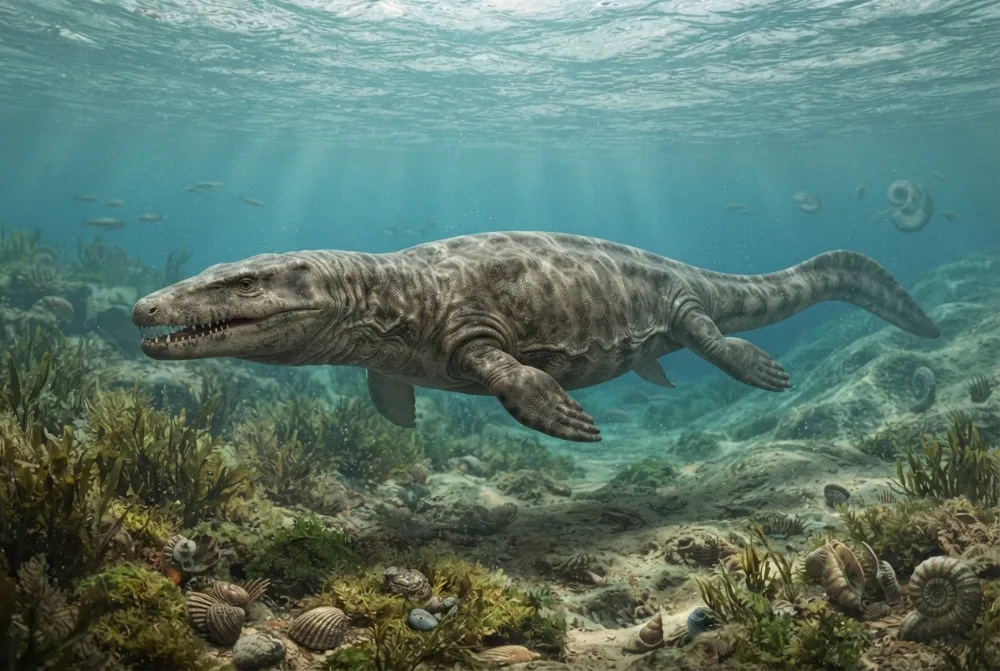
Simosaurus
Simosaurus was a marine reptile that swam in warm, shallow seas during the Middle Triassic, about 240 to 230 million years ago. It had a blunt, flattened head and blunt teeth for crushing hard-shelled prey like clams and ammonites.1
Ankakhala liti?
Anali wamkulu bwanji?
Anali wautali bwanji?
Ankalemera bwanji?
 wautali ngati agalu 4 otsatizana mphuno ndi mchira🍌wautali ngati nthochi 22 zotsatizana🍉wolemera ngati mavwende 26🧸wolemera ngati ana a sukulu ya mkaka 7🎒wolemera ngati ana a sukulu 4🏊akanatha kusambira utali wa dziwe lalikulu losambira (50 m) m'masekondi 7.8
Simosaurus anali wamkulu bwanji poyerekeza ndi IWEYO?
Ndi masamu chabe mu msakatuli wako. Palibe chimene chimasungidwa kapena kutumizidwa kwina kulikonse.
Anali ndi liwiro lotani?


Mfundo zosangalatsa
Simosaurus had large openings behind its eyes called upper temporal fossae, which were bigger than its eye sockets.1
Its jaw joint was set far back, projecting beyond the main part of the skull, giving it a unique bite.1
Simosaurus had a flattened trunk that prevented side-to-side swimming, unlike most other nothosaurs.1
It swam using powerful downstrokes of its forelimbs, but its upstroke was weak, making it a moderately strong swimmer.1
The first Simosaurus fossils were found in Lunéville, France, and described by German paleontologist Hermann von Meyer in 1842.1
Simosaurus is known from the Muschelkalk deposits in Germany, where it appears in layers marked by the ammonite Ceratites nodosus.1
Mafunso ofunsidwa kwambiri okhudza Simosaurus
?How big was Simosaurus?
Simosaurus grew from 3 to 4 metres (9.8 to 13.1 ft) in length.1
?What did Simosaurus eat?
It ate hard-shelled organisms like ammonites and holostean fish, using its blunt teeth to crush them.1
?How did Simosaurus swim?
It swam with powerful downstrokes of its forelimbs, but its upstroke was weak, making it a moderately strong swimmer.1
Kwa akatswiri a madino
- Dzina la sayansi
- Simosaurus
- Anapatsidwa dzina ndi
- Meyer 18423
- Gulu
- Zokwawa za m'nyanja
- Banja / kladi
- Simosauridae3
- Magawidwe a sayansi
- Nothosauria > Sauropterygia3
- Zaka za miyala
- zaka 247 mpaka 201 miliyoni ()3
- Mapangidwe a miyala
- Jilh, Erfurt, Gevanim3
- Mayiko
- Jeremani, Falansa, Saudi Arabiya, Israeli, Italiya3
- Zolemba za mafosili
- 15 mu The Paleobiology Database3
- Kupezeka
- German paleontologist Christian Erich Hermann von Meyer named Simosaurus in 1842 based on a skull from Lunéville, France. That original skull has since been lost.1
- Akukambiranabe
- Scientists debate whether Simosaurus was a nothosaur, a pachypleurosaur, or a more primitive sauropterygian.1
Kumene mfundo zimachokera
- Simosaurus (en.wikipedia.org)
- Bone histology, microanatomy, and growth of the nothosauroid Simosaurus gaillardoti (Sauropterygia) from the Upper Muschelkalk of southern Germany/Baden-Württemberg - Scientific Publications of the Muséum national d'Histoire naturelle, Paris (sciencepress.mnhn.fr)
- Simosaurus in The Paleobiology Database (CC BY 4.0): zaka, malo, mapangidwe a miyala, magawidwe a sayansi.
Mfundo iliyonse patsamba lino ili ndi nambala yosonyeza kumene yachokera. Ngati talakwitsa kanthu, pepa, ndife okonda madino, osati magazini ya sayansi. Tiuze pa [email protected] ndipo tikonza.
 Rex ali ndi njala! Dino Wiki ndi ntchito ya bambo kwa mwana wawo wamwamuna wokonda madainoso, yaulere popanda zotsatsa ndi zokazonda. Akuluakulu angadyetse Rex zokhwasula-khwasula kuti tsambali lipitirize kupezeka pa intaneti.Dyetsa Rex
 Nothosaurus
 Placodus
 Lariosaurus
 Cyamodus
 Cymatosaurus
 Proneusticosaurus
 Massospondylus
 Plateosaurus
 Coelophysis
 Podokesaurus
 Thecodontosaurus
 Eudimorphodon