 Kwizi ya Ndiwe dino uti?
 Nkhondo ya madino
 Mpikisano wa madino
 Masewera ang'onoang'ono a madino
 Chimbale cha zomata
 Mindandanda ya TOP ya madino
 Ndidabwitse!
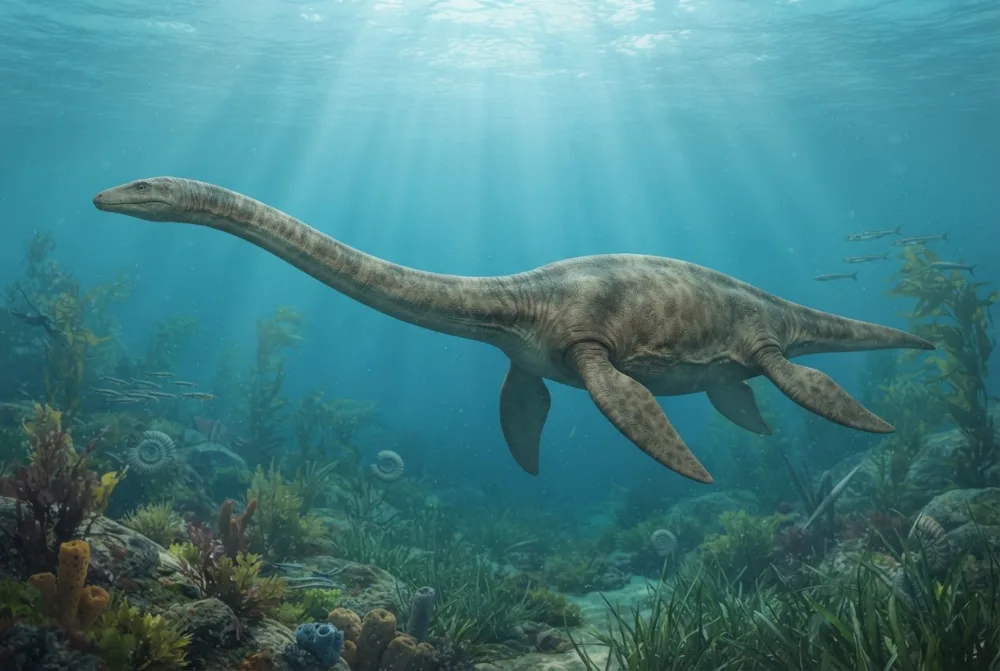
Libonectes
Libonectes was a long-necked marine reptile that swam in warm seas during the time of the dinosaurs. It used its strong flippers to paddle through the water and may have swallowed fish and ammonites whole. Fossils show it had a skull that is one of the best preserved of any elasmosaurid plesiosaur.1
Ankakhala liti?
Anali wamkulu bwanji?
Anali wautali bwanji?
 wautali ngati agalu 7 otsatizana mphuno ndi mchira🍌wautali ngati nthochi 40 zotsatizana🏊akanatha kusambira utali wa dziwe lalikulu losambira (50 m) m'masekondi 7.2
Libonectes anali wamkulu bwanji poyerekeza ndi IWEYO?
Ndi masamu chabe mu msakatuli wako. Palibe chimene chimasungidwa kapena kutumizidwa kwina kulikonse.
Anali ndi liwiro lotani?


Mfundo zosangalatsa
Libonectes had a neck that was 5.06 metres (16.6 feet) long, more than two-thirds of its total body length.1
The first fossils were found by a farmer named T.W. Tidwell in the late 1930s in Texas.1
Its skull is the best preserved skull of any elasmosaurid plesiosaur ever found.1
Libonectes lived about 93 million years ago, during the Late Cretaceous period.3
It was originally named Elasmosaurus morgani in 1949, but was given its own genus, Libonectes, in 1997.1
Gastroliths (stomach stones) have been found inside Libonectes fossils, which may have helped it digest food or control its buoyancy in the water.1
Libonectes probably swam slowly and used its large size to trap prey.1
Mafunso ofunsidwa kwambiri okhudza Libonectes
?How big was Libonectes?
Libonectes was a medium-sized plesiosaur, about 7.2 metres (24 feet) long. Its neck alone was 5.06 metres (16.6 feet) long.1
?What did Libonectes eat?
Libonectes probably ate small fish and ammonites. It may have swallowed prey whole and used stomach stones to help digest food.1
Wothetsa nthano zabodza
Nthano: Some people think plesiosaurs like Libonectes could lift their heads and necks high out of the water like a swan.
Zoona: Scientists now believe their necks were not flexible enough to lift high above the water. They probably held their necks more horizontally while swimming.1
Kwa akatswiri a madino
- Dzina la sayansi
- Libonectes
- Anapatsidwa dzina ndi
- Carpenter 19973
- Gulu
- Maplesiosauri
- Banja / kladi
- Elasmosauridae3
- Magawidwe a sayansi
- Plesiosauria > Elasmosauridae > Sauropterygia3
- Zaka za miyala
- zaka 100 mpaka 90 miliyoni (Cenomanian / Turonian)3
- Mapangidwe a miyala
- Britton, Akrabou3
- Mayiko
- Amereka, Moroko3
- Zolemba za mafosili
- 2 mu The Paleobiology Database3
- Kupezeka
- The first Libonectes fossils were found by tenant farmer T.W. Tidwell in the late 1930s in Texas. Charles Gill Morgan prepared the fossils, and the species was named Elasmosaurus morgani by Welles in 1949. It was reclassified as its own genus Libonectes by Carpenter in 1997.1
- Akukambiranabe
- Scientists are not sure whether Libonectes was a pure carnivore or an omnivore, because gastroliths could indicate plant eating or just buoyancy control.1
Kumene mfundo zimachokera
- Libonectes (en.wikipedia.org)
- Libonectes morgani, an elasmosaur with transatlantic dispersal (sachspal.de)
- Libonectes in The Paleobiology Database (CC BY 4.0): zaka, malo, mapangidwe a miyala, magawidwe a sayansi.
Mfundo iliyonse patsamba lino ili ndi nambala yosonyeza kumene yachokera. Ngati talakwitsa kanthu, pepa, ndife okonda madino, osati magazini ya sayansi. Tiuze pa [email protected] ndipo tikonza.
 Rex ali ndi njala! Dino Wiki ndi ntchito ya bambo kwa mwana wawo wamwamuna wokonda madainoso, yaulere popanda zotsatsa ndi zokazonda. Akuluakulu angadyetse Rex zokhwasula-khwasula kuti tsambali lipitirize kupezeka pa intaneti.Dyetsa Rex
 Elasmosaurus
 Pliosaurus
 Plesiosaurus
 Cimoliasaurus
 Colymbosaurus
 Trinacromerum
 Tyrannosaurus
 Triceratops
 Velociraptor
 Spinosaurus
 Ankylosaurus
 Parasaurolophus