 Kwizi ya Ndiwe dino uti?
 Nkhondo ya madino
 Mpikisano wa madino
 Masewera ang'onoang'ono a madino
 Chimbale cha zomata
 Mindandanda ya TOP ya madino
 Ndidabwitse!
Ankakhala liti?

Anali wamkulu bwanji?
Anali wautali bwanji?
Msinkhu wake unali wautali bwanji?
kuyerekeza
Ankalemera bwanji?
 wautali ngati magalimoto 2 oimikidwa pamzere🍌wautali ngati nthochi 56 zotsatizana
 wolemera pafupifupi ngati njovu🍉wolemera ngati mavwende 1000🎒wolemera ngati makalasi athunthu a ana a sukulu 6🐻❄️wolemera ngati zimbalangondo zoyera 11🏃akanatha kuthamanga mamita 100 m'masekondi 19 (munthu waliwiro kwambiri amafunika 9.6)
Mansourasaurus anali wamkulu bwanji poyerekeza ndi IWEYO?
Ndi masamu chabe mu msakatuli wako. Palibe chimene chimasungidwa kapena kutumizidwa kwina kulikonse.
Anali ndi liwiro lotani?


Mfundo zosangalatsa
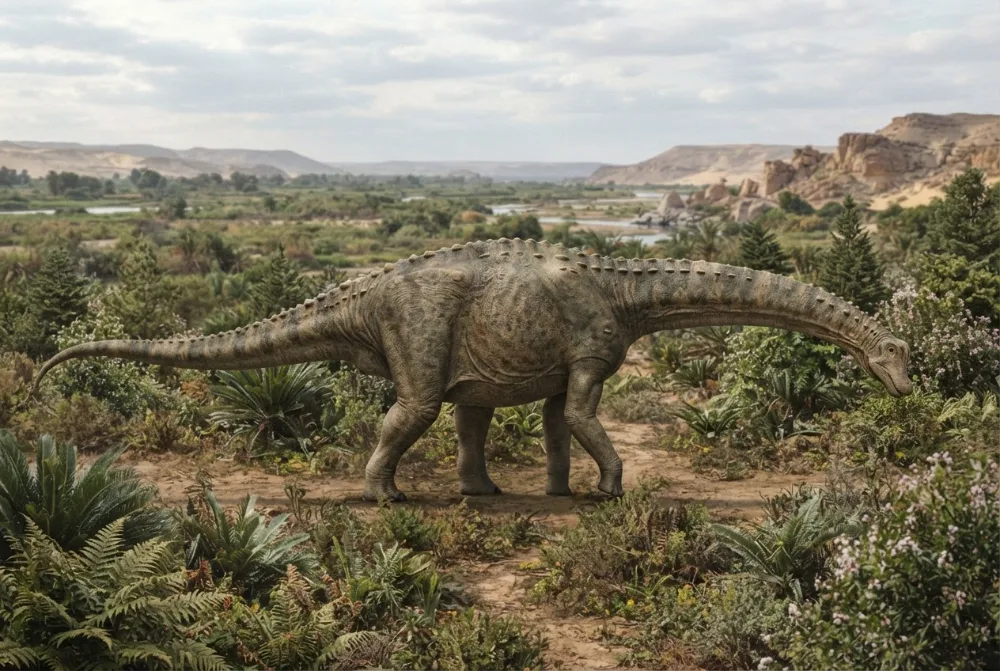
Mansourasaurus is the most complete land-living vertebrate from the last 30 million years of the Age of Dinosaurs in Africa.1
Its skeleton includes parts of the skull, which is very rare for sauropods.1
Mansourasaurus is closely related to titanosaurs from Europe and Asia, showing that dinosaurs could walk between Africa and Europe.1
It lived about 83 to 72 million years ago, during the Campanian age.2
The name honors Mansoura University, where the research team worked.1
Mafunso ofunsidwa kwambiri okhudza Mansourasaurus
?How big was Mansourasaurus?
The not fully-grown holotype was about 8 to 10 metres (26 to 33 feet) long. It probably weighed about 5,000 kilograms, roughly the same as a bull African elephant.3
?What did Mansourasaurus eat?
Mansourasaurus was a herbivore, meaning it ate plants. Each lower jaw bone had ten teeth for chewing plant material.3
?When did Mansourasaurus live?
Mansourasaurus lived during the Late Cretaceous period, about 73 million years ago. Its fossils were found in rocks from the Campanian age.3
?Where was Mansourasaurus found?
Mansourasaurus was discovered in the Dakhla Oasis in Egypt's Western Desert. It was found in the Quseir Formation.3
Wothetsa nthano zabodza
Nthano: Some people think African dinosaurs were completely isolated from Europe.
Zoona: Mansourasaurus shows that dinosaurs could move between Africa and Europe, so they were not completely isolated.1
Kwa akatswiri a madino
- Dzina la sayansi
- Mansourasaurus
- Anapatsidwa dzina ndi
- Sallam et al. 20184
- Gulu
- Makosi atali
- Banja / kladi
- Diamantinasauria4
- Magawidwe a sayansi
- Sauropodomorpha > Sauropoda > Macronaria4
- Zaka za miyala
- zaka 84 mpaka 72 miliyoni (Campanian)4
- Mapangidwe a miyala
- Quseir4
- Mayiko
- Iguputo4
- Zolemba za mafosili
- 1 mu The Paleobiology Database4
- Kupezeka
- Mansourasaurus was named by Sallam and colleagues in 2018 from fossils found in the Quseir Formation of Egypt.12
- Akukambiranabe
- Scientists still debate exactly where Mansourasaurus fits in the sauropod family tree, with some placing it in a group called Lithostrotia and others in Diamantinasauria.2
Kumene mfundo zimachokera
- New Egyptian sauropod reveals Late Cretaceous dinosaur dispersal between Europe and Africa | Nature Ecology & Evolution (nature.com)
- PBDB Taxon (paleobiodb.org)
- Mansourasaurus (en.wikipedia.org)
- Mansourasaurus in The Paleobiology Database (CC BY 4.0): zaka, malo, mapangidwe a miyala, magawidwe a sayansi.
Mfundo iliyonse patsamba lino ili ndi nambala yosonyeza kumene yachokera. Ngati talakwitsa kanthu, pepa, ndife okonda madino, osati magazini ya sayansi. Tiuze pa [email protected] ndipo tikonza.
 Rex ali ndi njala! Dino Wiki ndi ntchito ya bambo kwa mwana wawo wamwamuna wokonda madainoso, yaulere popanda zotsatsa ndi zokazonda. Akuluakulu angadyetse Rex zokhwasula-khwasula kuti tsambali lipitirize kupezeka pa intaneti.Dyetsa Rex
 Brachiosaurus
 Diplodocus
 Brontosaurus
 Argentinosaurus
 Camarasaurus
 Morosaurus
 Tyrannosaurus
 Triceratops
 Velociraptor
 Spinosaurus
 Ankylosaurus
 Parasaurolophus