 Kwizi ya Ndiwe dino uti?
 Nkhondo ya madino
 Mpikisano wa madino
 Masewera ang'onoang'ono a madino
 Chimbale cha zomata
 Mindandanda ya TOP ya madino
 Ndidabwitse!
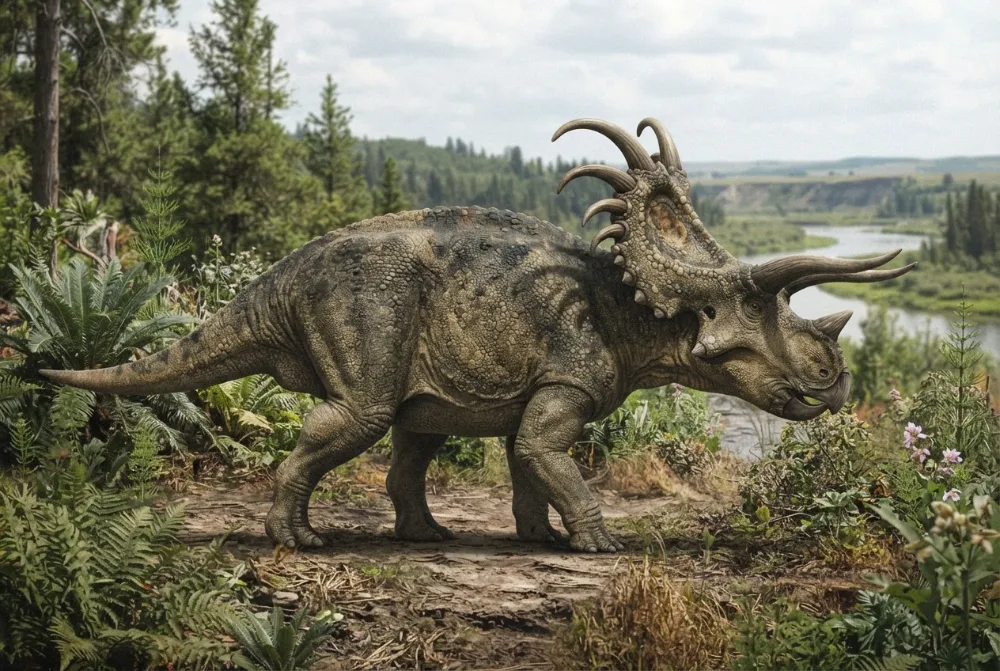
Medusaceratops
Medusaceratops was a horned dinosaur that lived about 80 million years ago. It had a big frill on its head with curved spikes that looked like the snakes of Medusa from Greek myths. This plant-eater roamed what is now Montana, USA.12
Ankakhala liti?
Anali wamkulu bwanji?
Anali wautali bwanji?
Msinkhu wake unali wautali bwanji?
kuyerekeza
Ankalemera bwanji?

 wautali ngati agalu 7 otsatizana mphuno ndi mchira🍌wautali ngati nthochi 39 zotsatizanawolemera ngati agalu 91🍉wolemera ngati mavwende 360🧸wolemera ngati ana a sukulu ya mkaka 95🎒wolemera ngati ana a sukulu 57🐻❄️wolemera ngati zimbalangondo zoyera 4🏃akanatha kuthamanga mamita 100 m'masekondi 11 (munthu waliwiro kwambiri amafunika 9.6)
Medusaceratops anali wamkulu bwanji poyerekeza ndi IWEYO?
Ndi masamu chabe mu msakatuli wako. Palibe chimene chimasungidwa kapena kutumizidwa kwina kulikonse.
Anali ndi liwiro lotani?


Mfundo zosangalatsa
Medusaceratops was first thought to be a different dinosaur called Albertaceratops, but later scientists realized it was a new species.2
Its frill had at least five pairs of bony bumps called epiparietals, including a large hooked spike on each side.2
The Mansfield bonebed where Medusaceratops was found contains many skeletons of this dinosaur, suggesting they lived in herds.2
Medusaceratops is one of the oldest known centrosaurine ceratopsids, a group of horned dinosaurs with big nose horns.2
Mafunso ofunsidwa kwambiri okhudza Medusaceratops
?How big was Medusaceratops?
About 6 metres (20 feet) long, based on a 2010 estimate.4
?What did Medusaceratops eat?
It was a plant-eater, so it ate plants like ferns and leaves.4
?When did Medusaceratops live?
It lived about 77.5 million years ago, during the Late Cretaceous period.4
?Why is it called Medusaceratops?
Its name means 'Medusa's horned face' because its frill spikes looked like the snake hair of Medusa from Greek myths.4
?Was Medusaceratops a dinosaur?
Yes, it was a horned dinosaur, a type of ceratopsian.4
?Where was Medusaceratops found?
Its fossils were found in Montana, USA, in the Judith River Formation.4
Kwa akatswiri a madino
- Dzina la sayansi
- Medusaceratops
- Anapatsidwa dzina ndi
- Ryan et al. 20105
- Gulu
- Madino a nyanga
- Banja / kladi
- Ceratopsidae5
- Magawidwe a sayansi
- Ornithischia > Ceratopsia > Ceratopsidae5
- Zaka za miyala
- zaka 84 mpaka 72 miliyoni (Campanian)5
- Mapangidwe a miyala
- Judith River5
- Mayiko
- Amereka5
- Zolemba za mafosili
- 1 mu The Paleobiology Database5
- Kupezeka
- Medusaceratops was named by Michael Ryan, Anthony Russell, and Scott Hartman in 2010 based on fossils from the Judith River Formation in Montana.15
- Akukambiranabe
- Scientists are not sure whether Medusaceratops was a chasmosaurine or a centrosaurine ceratopsid, because its frill has features of both groups.2
Kumene mfundo zimachokera
- PBDB Taxon (paleobiodb.org)
- New material and systematic re-evaluation of Medusaceratops lokii (Dinosauria, Ceratopsidae) from the Judith River Formation (Campanian, Montana) (cambridge.org)
- New horned dinosaur: Two-ton plant-eater lived 78 million years ago in Montana | ScienceDaily (sciencedaily.com)
- Medusaceratops - Wikipedia (en.wikipedia.org)
- Medusaceratops in The Paleobiology Database (CC BY 4.0): zaka, malo, mapangidwe a miyala, magawidwe a sayansi.
Mfundo iliyonse patsamba lino ili ndi nambala yosonyeza kumene yachokera. Ngati talakwitsa kanthu, pepa, ndife okonda madino, osati magazini ya sayansi. Tiuze pa [email protected] ndipo tikonza.
 Rex ali ndi njala! Dino Wiki ndi ntchito ya bambo kwa mwana wawo wamwamuna wokonda madainoso, yaulere popanda zotsatsa ndi zokazonda. Akuluakulu angadyetse Rex zokhwasula-khwasula kuti tsambali lipitirize kupezeka pa intaneti.Dyetsa Rex
 Triceratops
 Protoceratops
 Ojoceratops
 Tatankaceratops
 Psittacosaurus
 Centrosaurus
 Tyrannosaurus
 Velociraptor
 Spinosaurus
 Ankylosaurus
 Parasaurolophus
 Pteranodon