 Kwizi ya Ndiwe dino uti?
 Nkhondo ya madino
 Mpikisano wa madino
 Masewera ang'onoang'ono a madino
 Chimbale cha zomata
 Mindandanda ya TOP ya madino
 Ndidabwitse!
Ankakhala liti?

Anali wamkulu bwanji?
Anali wautali bwanji?
Msinkhu wake unali wautali bwanji?
kuyerekeza
Ankalemera bwanji?
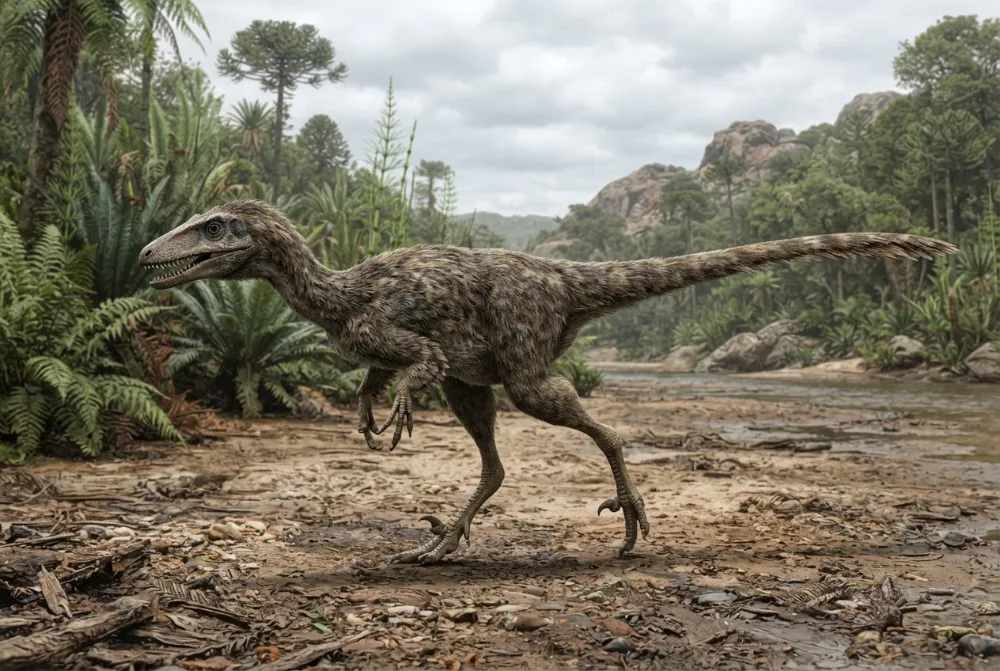
 wautali ngati amphaka a pakhomo 4 otsatizana mphuno ndi mchira🍌wautali ngati nthochi 12 zotsatizana🍌wolemera ngati nthochi 110🏃akanatha kuthamanga mamita 100 m'masekondi 9.2 (munthu waliwiro kwambiri amafunika 9.6)
Megapnosaurus anali wamkulu bwanji poyerekeza ndi IWEYO?
Ndi masamu chabe mu msakatuli wako. Palibe chimene chimasungidwa kapena kutumizidwa kwina kulikonse.
Anali ndi liwiro lotani?


Mfundo zosangalatsa
Megapnosaurus was one of the first dinosaurs ever shown with feathers in pictures, even though no one has found actual feathers with its fossils.1
At least 30 Megapnosaurus skeletons were found together in Zimbabwe, which suggests they might have lived or hunted in groups.1
Its name changed over time: first it was called Syntarsus, but that name was already used for a beetle, so scientists gave it a new name in 2001.1
Megapnosaurus had an S-shaped neck and long hind legs that looked like the legs of a secretary bird.1
Its hands had four fingers, which is more than most later meat-eating dinosaurs had.1
Some scientists think Megapnosaurus might actually belong to the genus Coelophysis, but most recent studies say it is its own genus.1
Mafunso ofunsidwa kwambiri okhudza Megapnosaurus
?How big was Megapnosaurus?
Megapnosaurus grew up to about 2.2 metres (7.2 feet) long and weighed up to 13 kilograms (29 pounds).1
?What did Megapnosaurus eat?
Megapnosaurus was a carnivore, meaning it ate meat. It may have hunted in packs and preyed on early plant-eating dinosaurs and lizards.1
?When did Megapnosaurus live?
Megapnosaurus lived during the Early Jurassic Period, about 199 to 188 million years ago.1
?Where was Megapnosaurus found?
Fossils of Megapnosaurus were found in Zimbabwe and South Africa in Africa.1
?Did Megapnosaurus have feathers?
Nobody knows for sure. It was one of the first dinosaurs shown with feathers in pictures, but no actual feathers have been found with its fossils.1
?Why is it called Megapnosaurus?
Megapnosaurus means 'big dead lizard' in Greek. It got this name after its first name, Syntarsus, was already used for a beetle.1
Kwa akatswiri a madino
- Dzina la sayansi
- Megapnosaurus
- Anapatsidwa dzina ndi
- Ivie et al. 20012
- Gulu
- Madino odya nyama
- Banja / kladi
- Coelophysidae2
- Magawidwe a sayansi
- Theropoda > Coelophysoidea2
- Zaka za miyala
- zaka 201 mpaka 193 miliyoni (Hettangian / Sinemurian)2
- Mapangidwe a miyala
- Forest Sandstone, Nyamandhlovu Sandstones, Elliot2
- Mayiko
- Zimbabwe, South Africa, China, Amereka2
- Zolemba za mafosili
- 8 mu The Paleobiology Database2
- Kupezeka
- The first fossils were found in 1963 by students in Zimbabwe. Scientist Michael Raath named it Syntarsus rhodesiensis in 1969, and later it was renamed Megapnosaurus in 2001.1
- Akukambiranabe
- Scientists still debate whether Megapnosaurus should be its own genus or just a species of Coelophysis.1
Kumene mfundo zimachokera
- Megapnosaurus (en.wikipedia.org)
- Megapnosaurus in The Paleobiology Database (CC BY 4.0): zaka, malo, mapangidwe a miyala, magawidwe a sayansi.
Mfundo iliyonse patsamba lino ili ndi nambala yosonyeza kumene yachokera. Ngati talakwitsa kanthu, pepa, ndife okonda madino, osati magazini ya sayansi. Tiuze pa [email protected] ndipo tikonza.
 Rex ali ndi njala! Dino Wiki ndi ntchito ya bambo kwa mwana wawo wamwamuna wokonda madainoso, yaulere popanda zotsatsa ndi zokazonda. Akuluakulu angadyetse Rex zokhwasula-khwasula kuti tsambali lipitirize kupezeka pa intaneti.Dyetsa Rex
 Allosaurus
 Carnotaurus
 Dilophosaurus
 Giganotosaurus
 Compsognathus
 Paronychodon
 Stenopterygius
 Dorygnathus
 Lufengosaurus
 Scutellosaurus
 Yunnanosaurus
 Temnodontosaurus