 Kwizi ya Ndiwe dino uti?
 Nkhondo ya madino
 Mpikisano wa madino
 Masewera ang'onoang'ono a madino
 Chimbale cha zomata
 Mindandanda ya TOP ya madino
 Ndidabwitse!
Ankakhala liti?

Anali wamkulu bwanji?
Anali wautali bwanji?
Msinkhu wake unali wautali bwanji?
Ankalemera bwanji?
 wautali ngati amphaka a pakhomo 3 otsatizana mphuno ndi mchira🍌wautali ngati nthochi 8 zotsatizana🍌wolemera ngati nthochi 83🏃akanatha kuthamanga mamita 100 m'masekondi 11 (munthu waliwiro kwambiri amafunika 9.6)
Nhandumirim anali wamkulu bwanji poyerekeza ndi IWEYO?
Ndi masamu chabe mu msakatuli wako. Palibe chimene chimasungidwa kapena kutumizidwa kwina kulikonse.
Anali ndi liwiro lotani?


Mfundo zosangalatsa
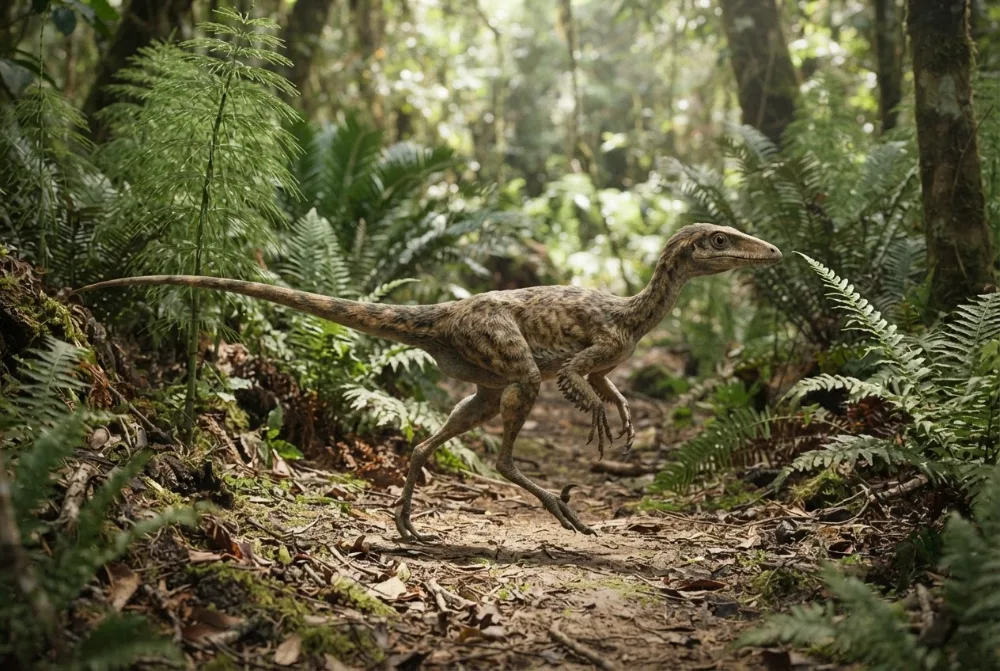
Nhandumirim means 'small rhea' in the Tupi-Guarani language, because it was a speedy little dinosaur like a rhea bird.21
Its fossils were found in a small area, only about 50 centimeters wide, and were semi-articulated, meaning many bones were still in their original positions.2
The tail bones of Nhandumirim have a sharp keel along the bottom, a feature that helps scientists tell it apart from other early dinosaurs.2
Nhandumirim lived in a floodplain environment, alongside other ancient animals like the rhynchosaur Hyperodapedon and the early dinosaur Saturnalia.1
This dinosaur is about 233 million years old, making it one of the oldest known dinosaurs from the Triassic Period.24
Scientists think Nhandumirim could run fast on its long, slender legs, just like the bird it was named after.2
Mafunso ofunsidwa kwambiri okhudza Nhandumirim
?How big was Nhandumirim?
It was a small dinosaur, about the size of a modern rhea bird. Its name means 'small rhea' in the Tupi language.3
?What did Nhandumirim eat?
Scientists are not sure, but because it is an early sauropodomorph, it was probably a plant-eater. Some studies suggest it might have been a meat-eater like early theropods.3
?When did Nhandumirim live?
It lived about 233 million years ago during the Late Triassic Period, in what is now Brazil.3
?Is Nhandumirim a dinosaur?
Yes, it is a dinosaur. It is a basal sauropodomorph, one of the earliest dinosaurs ever discovered.3
Kwa akatswiri a madino
- Dzina la sayansi
- Nhandumirim
- Anapatsidwa dzina ndi
- Marsola et al. 20194
- Gulu
- Madainoso oyamba
- Banja / kladi
- Saurischia4
- Zaka za miyala
- zaka 227 mpaka 206 miliyoni (Norian)4
- Mapangidwe a miyala
- Caturrita4
- Mayiko
- Brazil4
- Zolemba za mafosili
- 1 mu The Paleobiology Database4
- Kupezeka
- Nhandumirim was named in 2019 by a team of scientists including J. C. A. Marsola, based on a partial skeleton found at the Waldsanga site in Brazil. The fossils were first collected from the red mudstones of the Santa Maria Formation.42
- Akukambiranabe
- Scientists are not sure if Nhandumirim is a true theropod or just a very close relative, because it has some features that are similar to both theropods and other early dinosaurs.2
Kumene mfundo zimachokera
- A new dinosaur with theropod affinities from the Late Triassic Santa Maria Formation, South Brazil (paleolab.com.br)
- University of Birmingham (pure-oai.bham.ac.uk)
- Nhandumirim (en.wikipedia.org)
- Nhandumirim in The Paleobiology Database (CC BY 4.0): zaka, malo, mapangidwe a miyala, magawidwe a sayansi.
Mfundo iliyonse patsamba lino ili ndi nambala yosonyeza kumene yachokera. Ngati talakwitsa kanthu, pepa, ndife okonda madino, osati magazini ya sayansi. Tiuze pa [email protected] ndipo tikonza.
 Rex ali ndi njala! Dino Wiki ndi ntchito ya bambo kwa mwana wawo wamwamuna wokonda madainoso, yaulere popanda zotsatsa ndi zokazonda. Akuluakulu angadyetse Rex zokhwasula-khwasula kuti tsambali lipitirize kupezeka pa intaneti.Dyetsa Rex
 Herrerasaurus
 Tawa
Tawa Chindesaurus
 Nyasasaurus
 Staurikosaurus
 Alwalkeria
 Nothosaurus
 Massospondylus
 Plateosaurus
 Coelophysis
 Podokesaurus
 Simosaurus