 Kwizi ya Ndiwe dino uti?
 Nkhondo ya madino
 Mpikisano wa madino
 Masewera ang'onoang'ono a madino
 Chimbale cha zomata
 Mindandanda ya TOP ya madino
 Ndidabwitse!
Ankakhala liti?

Anali wamkulu bwanji?
Anali wautali bwanji?
Msinkhu wake unali wautali bwanji?
kuyerekeza
 wautali ngati agalu 5 otsatizana mphuno ndi mchira🍌wautali ngati nthochi 28 zotsatizana🏃akanatha kuthamanga mamita 100 m'masekondi 21 (munthu waliwiro kwambiri amafunika 9.6)
Nipponopelta anali wamkulu bwanji poyerekeza ndi IWEYO?
Ndi masamu chabe mu msakatuli wako. Palibe chimene chimasungidwa kapena kutumizidwa kwina kulikonse.
Anali ndi liwiro lotani?


Mfundo zosangalatsa
Scientists used CT scans to see hidden bones inside the rock, like two complete teeth and part of the inner ear.12
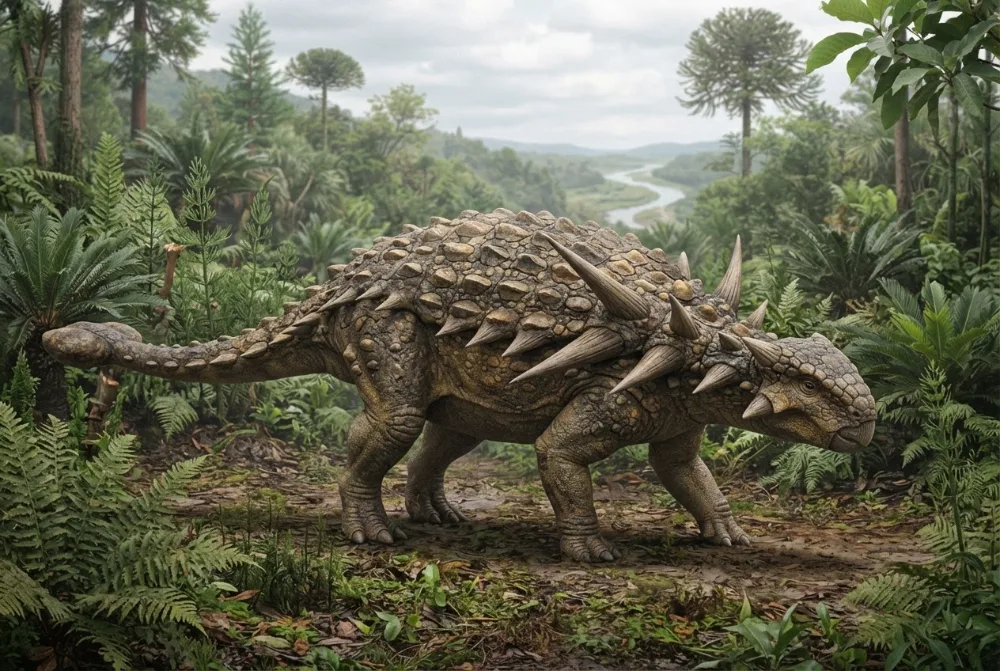
Nipponopelta belonged to a group called nodosaurids, which had long spikes on their shoulders but no tail club.23
Its ancestors likely walked from North America to Asia across a land bridge called Beringia about 100 million years ago.32
Mafunso ofunsidwa kwambiri okhudza Nipponopelta
?How big was Nipponopelta?
Scientists do not know its exact size because only a partial skull and a few bones have been found. It was probably similar in size to other nodosaurids, which were medium-sized, four-legged plant-eaters.1
?What did Nipponopelta eat?
It ate plants. Its teeth were small and leaf-shaped, good for cropping vegetation.3
?When did Nipponopelta live?
It lived during the Late Cretaceous period, about 96 to 94 million years ago.5
?Where was Nipponopelta found?
Its fossils were found in Hokkaido, Japan, along the bank of the Omakizawa River in Yūbari city.1
?Did Nipponopelta have a tail club?
No. Nipponopelta was a nodosaurid, and nodosaurids did not have a tail club. Instead, they had long spikes on their shoulders.3
?How did Nipponopelta get to Japan?
Its ancestors likely walked from North America to Asia across a land bridge called Beringia about 100 million years ago.3
?Is Nipponopelta a dinosaur?
Yes, Nipponopelta is a dinosaur. It is a type of armored dinosaur called a nodosaurid ankylosaur.1
?Why is it called Nipponopelta?
Its name means 'Japanese shield' in Greek and Japanese. 'Nippon' means Japan and 'pelta' means shield.1
Kwa akatswiri a madino
- Dzina la sayansi
- Nipponopelta
- Anapatsidwa dzina ndi
- Oyabu et al. 20276
- Gulu
- Madino a zishango
- Banja / kladi
- Nodosauridae6
- Magawidwe a sayansi
- Ornithischia > Ankylosauria > Nodosauridae > Thyreophora6
- Zaka za miyala
- zaka 100 mpaka 94 miliyoni (Cenomanian)6
- Mapangidwe a miyala
- Hikagenosawa6
- Mayiko
- Japani6
- Zolemba za mafosili
- 1 mu The Paleobiology Database6
- Kupezeka
- The fossil was found by Eijiro Goto in 1995 in Yūbari, Hokkaido, Japan. In 2026, Shumpei Oyabu and colleagues named it Nipponopelta yezoensis after studying it with CT scans.12
- Akukambiranabe
- Scientists are not sure if Nipponopelta lived right on the coast or if its body was carried to the sea after death.13
Kumene mfundo zimachokera
- Nipponopelta (en.wikipedia.org)
- 北海道産恐竜化石を「ニッポノペルタ・エゾエンシス」と命名 (hokudai.ac.jp)
- Rare armored dinosaur found in Japan may have ancestors that migrated across a land bridge 100 million years ago | Live Science (livescience.com)
- Nipponopelta yezoensis, Japan's First Definitive Ankylosaur (blog.everythingdinosaur.com)
- New Species of Armored Dinosaur Identified in Japan | Sci.News (sci.news)
- Nipponopelta in The Paleobiology Database (CC BY 4.0): zaka, malo, mapangidwe a miyala, magawidwe a sayansi.
Mfundo iliyonse patsamba lino ili ndi nambala yosonyeza kumene yachokera. Ngati talakwitsa kanthu, pepa, ndife okonda madino, osati magazini ya sayansi. Tiuze pa [email protected] ndipo tikonza.
 Rex ali ndi njala! Dino Wiki ndi ntchito ya bambo kwa mwana wawo wamwamuna wokonda madainoso, yaulere popanda zotsatsa ndi zokazonda. Akuluakulu angadyetse Rex zokhwasula-khwasula kuti tsambali lipitirize kupezeka pa intaneti.Dyetsa Rex
 Ankylosaurus
 Sauropelta
 Pinacosaurus
 Scutellosaurus
 Struthiosaurus
 Euoplocephalus
 Tyrannosaurus
 Triceratops
 Velociraptor
 Spinosaurus
 Parasaurolophus
 Pteranodon