 Kwizi ya Ndiwe dino uti?
 Nkhondo ya madino
 Mpikisano wa madino
 Masewera ang'onoang'ono a madino
 Chimbale cha zomata
 Mindandanda ya TOP ya madino
 Ndidabwitse!
Opisthocoelicaudia
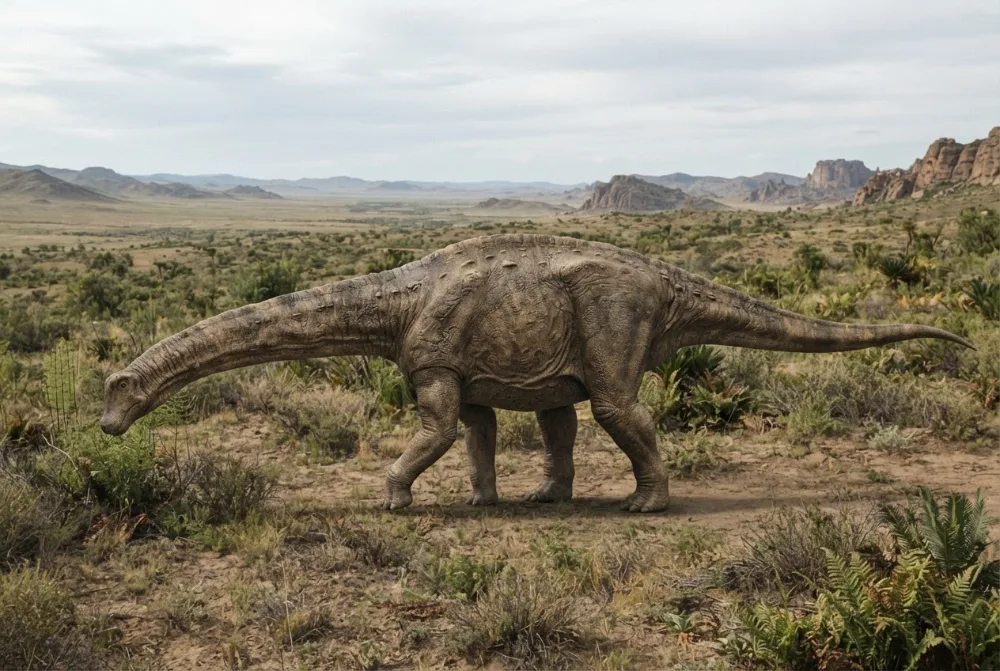
Opisthocoelicaudia was a big, long-necked plant eater that lived in the Late Cretaceous. It had a barrel-shaped body and four thick legs, like an elephant. Scientists found a nearly complete skeleton without the head and neck, so they know a lot about its body.1
Ankakhala liti?
Anali wamkulu bwanji?
Anali wautali bwanji?
Msinkhu wake unali wautali bwanji?
Ankalemera bwanji?

 wautali ngati magalimoto 3 oimikidwa pamzere🍌wautali ngati nthochi 72 zotsatizanawolemera ngati magalimoto 17🍉wolemera ngati mavwende 5100🎒wolemera ngati makalasi athunthu a ana a sukulu 32🐻❄️wolemera ngati zimbalangondo zoyera 56🏃akanatha kuthamanga mamita 100 m'masekondi 28 (munthu waliwiro kwambiri amafunika 9.6)
Opisthocoelicaudia anali wamkulu bwanji poyerekeza ndi IWEYO?
Ndi masamu chabe mu msakatuli wako. Palibe chimene chimasungidwa kapena kutumizidwa kwina kulikonse.
Anali ndi liwiro lotani?


Mfundo zosangalatsa
Its tail vertebrae were shaped like ball-and-socket joints, which is unusual and gives it the name 'posterior cavity tail'.1
The skeleton had tooth marks from big meat-eating dinosaurs, which probably ate the carcass and carried away the head and neck.1
It could probably rear up on its hind legs to reach higher food, because its tail was strong and could act like a tripod.12
Its back vertebrae had split spines, creating a double row of bumps along its spine, a feature also seen in Diplodocus.1
It had six hip vertebrae, one more than most sauropods, which made its hips extra strong.1
The neck was about 5 meters (16 feet) long, which is medium for a sauropod.1
Mafunso ofunsidwa kwambiri okhudza Opisthocoelicaudia
?How big was Opisthocoelicaudia?
It was a relatively small sauropod, measuring about 11.4 to 13 metres (37 to 43 feet) long. Its body mass has been estimated at between 8.4 and 25.4 tonnes in different studies.1
?What did Opisthocoelicaudia eat?
Like other sauropods, it was a herbivore that ate plants. It probably fed on a variety of vegetation in its floodplain and riverine environment.3
?When did Opisthocoelicaudia live?
It lived during the Late Cretaceous Period, specifically in the ?Upper Campanian or Lower Maastrichtian, about 72 to 66 million years ago.12
?Where was Opisthocoelicaudia found?
Its fossils were discovered in the Gobi Desert of Mongolia, in the Nemegt Formation. The type specimen was found at Altan Uul in Ömnögovi Province.1
?Could Opisthocoelicaudia rear up on its hind legs?
Yes, scientists think it could rear up on its hind legs to reach higher food. Its strong tail could act like a tripod to support its weight.1
?Is Opisthocoelicaudia a dinosaur?
Yes, it is a sauropod dinosaur. It belongs to the group Titanosauria and lived during the Late Cretaceous.1
Wothetsa nthano zabodza
Nthano: Some people think Opisthocoelicaudia was a kind of camarasaur, but scientists now know it was a titanosaur.
Zoona: It was first classified as a camarasaurid, but later studies placed it in Titanosauria, a group of sauropods.1
Kwa akatswiri a madino
- Dzina la sayansi
- Opisthocoelicaudia
- Anapatsidwa dzina ndi
- Borsuk-Bialynicka 19774
- Gulu
- Makosi atali
- Banja / kladi
- Saltasauridae4
- Magawidwe a sayansi
- Sauropodomorpha > Sauropoda > Titanosauria > Macronaria4
- Zaka za miyala
- zaka 72 mpaka 66 miliyoni (Maastrichtian)4
- Mapangidwe a miyala
- Nemegt4
- Mayiko
- Mongoliya4
- Zolemba za mafosili
- 1 mu The Paleobiology Database4
- Kupezeka
- It was discovered in 1965 by a Polish-Mongolian expedition in the Gobi Desert. Polish paleontologist Maria Magdalena Borsuk-Białynicka named it in 1977.12
- Akukambiranabe
- Scientists debate whether Opisthocoelicaudia and Nemegtosaurus are actually the same species, because only the skull of Nemegtosaurus is known and Opisthocoelicaudia lacks a skull.1
Kumene mfundo zimachokera
- Opisthocoelicaudia (en.wikipedia.org)
- A NEW CAMARASAURID SAUROPOD OPISTHOCOELICAUDIA SKARZYNSKII GEN. N., SP. N. FROM THE UPPER CRETACEOUS OF MONGOLIA (palaeontologia.pan.pl)
- Opisthocoelicaudia: a Late Cretaceous Mongolian titanosaur (en.alegsaonline.com)
- Opisthocoelicaudia in The Paleobiology Database (CC BY 4.0): zaka, malo, mapangidwe a miyala, magawidwe a sayansi.
Mfundo iliyonse patsamba lino ili ndi nambala yosonyeza kumene yachokera. Ngati talakwitsa kanthu, pepa, ndife okonda madino, osati magazini ya sayansi. Tiuze pa [email protected] ndipo tikonza.
 Rex ali ndi njala! Dino Wiki ndi ntchito ya bambo kwa mwana wawo wamwamuna wokonda madainoso, yaulere popanda zotsatsa ndi zokazonda. Akuluakulu angadyetse Rex zokhwasula-khwasula kuti tsambali lipitirize kupezeka pa intaneti.Dyetsa Rex
 Brachiosaurus
 Diplodocus
 Brontosaurus
 Argentinosaurus
 Camarasaurus
 Morosaurus
 Tyrannosaurus
 Triceratops
 Velociraptor
 Spinosaurus
 Ankylosaurus
 Parasaurolophus