 Kwizi ya Ndiwe dino uti?
 Nkhondo ya madino
 Mpikisano wa madino
 Masewera ang'onoang'ono a madino
 Chimbale cha zomata
 Mindandanda ya TOP ya madino
 Ndidabwitse!
Pentaceratops
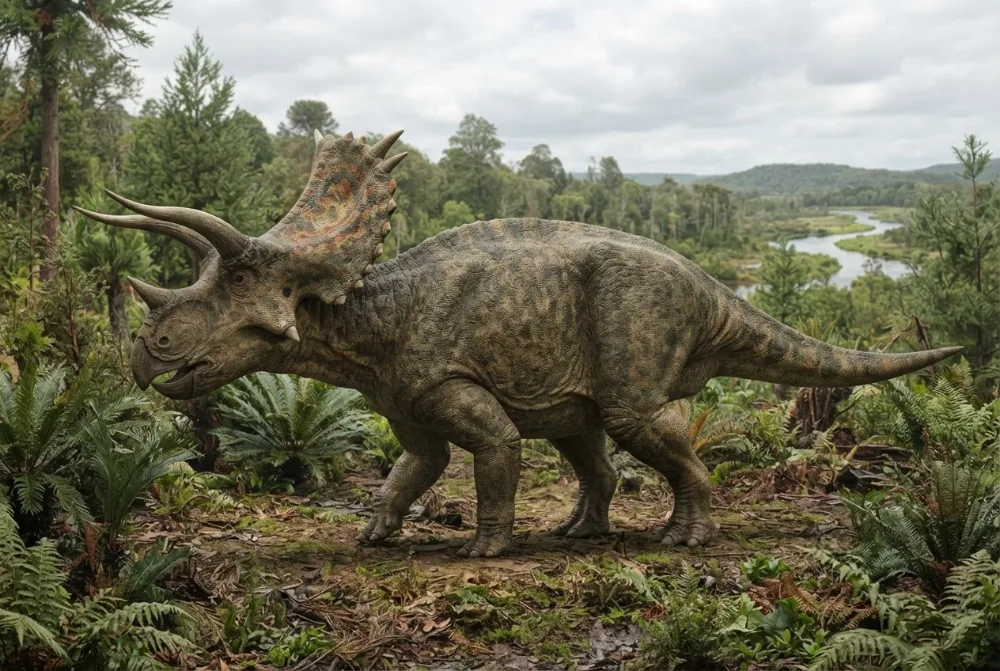
Pentaceratops was a plant-eating dinosaur that lived about 76 to 73 million years ago. It had a huge skull with five horns: two long ones above its eyes, a short one on its nose, and two long spikes sticking out from its cheeks. Its head frill was very long and had small triangular hornlets along the edge.1
Ankakhala liti?
Anali wamkulu bwanji?
Anali wautali bwanji?
Msinkhu wake unali wautali bwanji?
kuyerekeza
Ankalemera bwanji?

 wautali ngati agalu 6 otsatizana mphuno ndi mchira🍌wautali ngati nthochi 33 zotsatizanawolemera ngati agalu 120🍉wolemera ngati mavwende 500🎒wolemera ngati makalasi athunthu a ana a sukulu 3🐻❄️wolemera ngati zimbalangondo zoyera 6🏃akanatha kuthamanga mamita 100 m'masekondi 12 (munthu waliwiro kwambiri amafunika 9.6)
Pentaceratops anali wamkulu bwanji poyerekeza ndi IWEYO?
Ndi masamu chabe mu msakatuli wako. Palibe chimene chimasungidwa kapena kutumizidwa kwina kulikonse.
Anali ndi liwiro lotani?


Mfundo zosangalatsa
Pentaceratops means 'five-horned face' because it had five horns: two brow horns, one nose horn, and two long spikes on its cheekbones.1
Its skull could be over 2.3 meters (7.5 feet) long, making it one of the largest skulls of any land animal.1
Pentaceratops lived alongside the duck-billed dinosaur Parasaurolophus and the tyrannosaur Bistahieversor.1
The first fossils were found in 1921 by Charles Hazelius Sternberg in New Mexico. The dinosaur was named in 1923 by Henry Fairfield Osborn.1
One very large Pentaceratops skull was later renamed Titanoceratops because it looked more like Triceratops.1
Pentaceratops is used as a guide fossil: its appearance marks the start of the Kirtlandian land vertebrate age.1
Mafunso ofunsidwa kwambiri okhudza Pentaceratops
?How big was Pentaceratops?
Pentaceratops was about 5.5 to 6 meters (18 to 20 feet) long and weighed around 2.5 metric tons (2.8 short tons).1
?What did Pentaceratops eat?
Pentaceratops was an herbivore, meaning it ate plants. It likely fed on ferns, cycads, and conifers using its sharp beak and cheek teeth.1
?When did Pentaceratops live?
Pentaceratops lived during the Late Cretaceous Period, about 76 to 73 million years ago.1
?Where was Pentaceratops found?
Pentaceratops fossils have been found in the Kirtland Formation in the San Juan Basin of New Mexico, USA.1
?Did Pentaceratops have feathers?
No, Pentaceratops did not have feathers. It was a ceratopsian dinosaur with scaly skin, like other horned dinosaurs.1
?Was Pentaceratops bigger than Triceratops?
No, Pentaceratops was smaller than Triceratops. Pentaceratops was about 5.5 to 6 meters long, while Triceratops could reach up to 9 meters.1
?How many horns did Pentaceratops have?
Pentaceratops had five horns: two long brow horns, one short nose horn, and two long spikes on its cheekbones.1
?Could Pentaceratops swim?
Nobody knows for sure, but Pentaceratops was a land dinosaur with sturdy legs, so it probably did not swim often.1
Wothetsa nthano zabodza
Nthano: Some people think Pentaceratops had five horns on its head like a crown.
Zoona: The 'fifth horn' is actually a long spike on each cheekbone (the jugal bone), not a true horn on the skull roof.1
Kwa akatswiri a madino
- Dzina la sayansi
- Pentaceratops
- Anapatsidwa dzina ndi
- Osborn 19232
- Gulu
- Madino a nyanga
- Banja / kladi
- Ceratopsidae2
- Magawidwe a sayansi
- Ornithischia > Ceratopsia > Ceratopsidae2
- Zaka za miyala
- zaka 84 mpaka 66 miliyoni (Campanian / Maastrichtian)2
- Mapangidwe a miyala
- Fruitland, Kirtland, Williams Fork2
- Mayiko
- Amereka2
- Zolemba za mafosili
- 14 mu The Paleobiology Database2
- Kupezeka
- The first Pentaceratops fossils were collected in 1921 by Charles Hazelius Sternberg in the San Juan Basin of New Mexico. The species was named Pentaceratops sternbergii by Henry Fairfield Osborn in 1923, honoring Sternberg.1
- Akukambiranabe
- Scientists debate whether the species Pentaceratops aquilonius from Canada really belongs to Pentaceratops or is a different dinosaur called Spiclypeus.1
Kumene mfundo zimachokera
- Pentaceratops (en.wikipedia.org)
- Pentaceratops in The Paleobiology Database (CC BY 4.0): zaka, malo, mapangidwe a miyala, magawidwe a sayansi.
Mfundo iliyonse patsamba lino ili ndi nambala yosonyeza kumene yachokera. Ngati talakwitsa kanthu, pepa, ndife okonda madino, osati magazini ya sayansi. Tiuze pa [email protected] ndipo tikonza.
 Rex ali ndi njala! Dino Wiki ndi ntchito ya bambo kwa mwana wawo wamwamuna wokonda madainoso, yaulere popanda zotsatsa ndi zokazonda. Akuluakulu angadyetse Rex zokhwasula-khwasula kuti tsambali lipitirize kupezeka pa intaneti.Dyetsa Rex
 Triceratops
 Protoceratops
 Ojoceratops
 Tatankaceratops
 Psittacosaurus
 Centrosaurus
 Tyrannosaurus
 Velociraptor
 Spinosaurus
 Ankylosaurus
 Parasaurolophus
 Pteranodon