 Kwizi ya Ndiwe dino uti?
 Nkhondo ya madino
 Mpikisano wa madino
 Masewera ang'onoang'ono a madino
 Chimbale cha zomata
 Mindandanda ya TOP ya madino
 Ndidabwitse!
Qianxisaurus
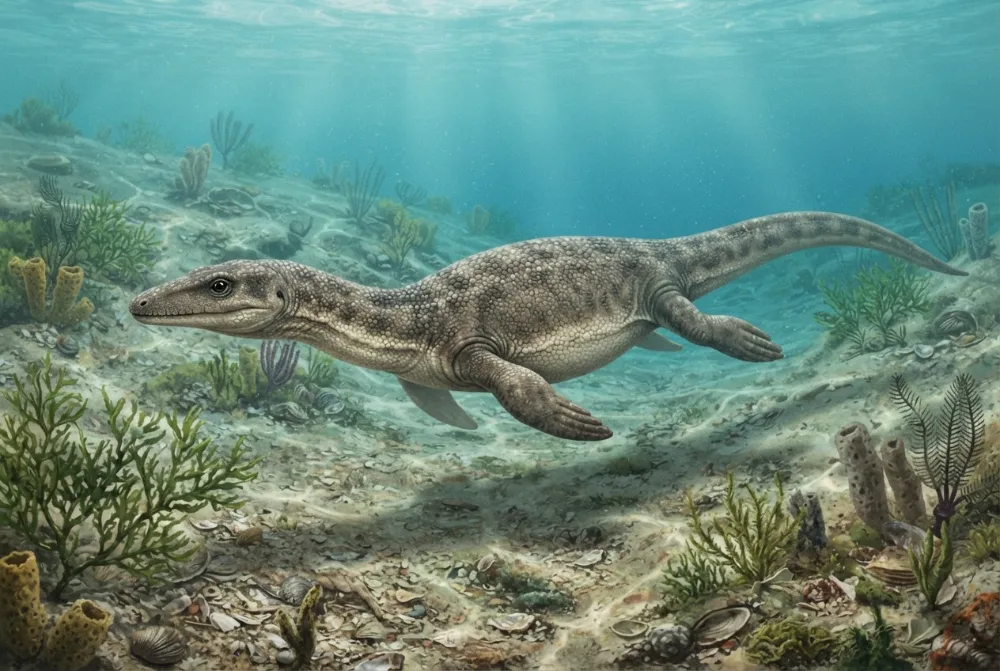
Qianxisaurus was a marine reptile that swam in the warm seas of China about 238 million years ago. It had a long body, a long tail, and a snout longer than the rest of its skull. This creature was not a dinosaur, but a type of eosauropterygian, a group of ancient sea reptiles.1
Ankakhala liti?
Anali wamkulu bwanji?
Anali wautali bwanji?
 wautali ngati amphaka a pakhomo 1.5 otsatizana mphuno ndi mchira🍌wautali ngati nthochi 4 zotsatizana🏊akanatha kusambira utali wa dziwe lalikulu losambira (50 m) m'masekondi 26
Qianxisaurus anali wamkulu bwanji poyerekeza ndi IWEYO?
Ndi masamu chabe mu msakatuli wako. Palibe chimene chimasungidwa kapena kutumizidwa kwina kulikonse.
Anali ndi liwiro lotani?


Mfundo zosangalatsa
Qianxisaurus had 28 back vertebrae and four sacral vertebrae, which is unusual for early sauropterygians.1
Its skull was only 7.6 cm (3 inches) long, but the whole animal was over 80 cm (2 feet 7 inches) in length.1
The name Qianxisaurus comes from 'Qianxi', meaning western Guizhou in Chinese, and 'saurus' meaning lizard.1
Qianxisaurus had a very small supratemporal fenestra, a hole in the skull roof, which was only slightly larger than a foramen in the parietal bone.1
Its dorsal ribs had a longitudinal groove on the upper-back surface, a feature shared with some other early marine reptiles like Corosaurus and Sanchiaosaurus.1
The only known fossil of Qianxisaurus was discovered in 2006 near the Huangnihe River in Xingyi, Guizhou, and is now kept at the National Museum of Natural Science in Taiwan.1
Kwa akatswiri a madino
- Dzina la sayansi
- Qianxisaurus
- Anapatsidwa dzina ndi
- Cheng et al. 20122
- Gulu
- Zokwawa za m'nyanja
- Banja / kladi
- Eosauropterygia2
- Magawidwe a sayansi
- Sauropterygia2
- Zaka za miyala
- zaka 241 mpaka 237 miliyoni (Ladinian)2
- Mapangidwe a miyala
- Falang2
- Mayiko
- China2
- Zolemba za mafosili
- 1 mu The Paleobiology Database2
- Kupezeka
- Qianxisaurus was named by Yen-Nien Cheng, Xiao-Chun Wu, Tamaki Sato and Hsi-Yin Shan in 2012 based on a nearly complete skeleton found in the Zhuganpo Member of the Falang Formation in Guizhou, China.1
- Akukambiranabe
- Scientists are not sure whether Qianxisaurus was a pachypleurosaur or a more basal eosauropterygian, and its exact relationships within the group are still debated.1
Kumene mfundo zimachokera
- Qianxisaurus (en.wikipedia.org)
- Qianxisaurus in The Paleobiology Database (CC BY 4.0): zaka, malo, mapangidwe a miyala, magawidwe a sayansi.
Mfundo iliyonse patsamba lino ili ndi nambala yosonyeza kumene yachokera. Ngati talakwitsa kanthu, pepa, ndife okonda madino, osati magazini ya sayansi. Tiuze pa [email protected] ndipo tikonza.
 Rex ali ndi njala! Dino Wiki ndi ntchito ya bambo kwa mwana wawo wamwamuna wokonda madainoso, yaulere popanda zotsatsa ndi zokazonda. Akuluakulu angadyetse Rex zokhwasula-khwasula kuti tsambali lipitirize kupezeka pa intaneti.Dyetsa Rex
 Nothosaurus
 Placodus
 Lariosaurus
 Cyamodus
 Cymatosaurus
 Proneusticosaurus
 Chonespondylus
 Cymbospondylus
 Phalarodon
 Mixosaurus
 Chaohusaurus
 Chensaurus