 Kwizi ya Ndiwe dino uti?
 Nkhondo ya madino
 Mpikisano wa madino
 Masewera ang'onoang'ono a madino
 Chimbale cha zomata
 Mindandanda ya TOP ya madino
 Ndidabwitse!
Rajasaurus
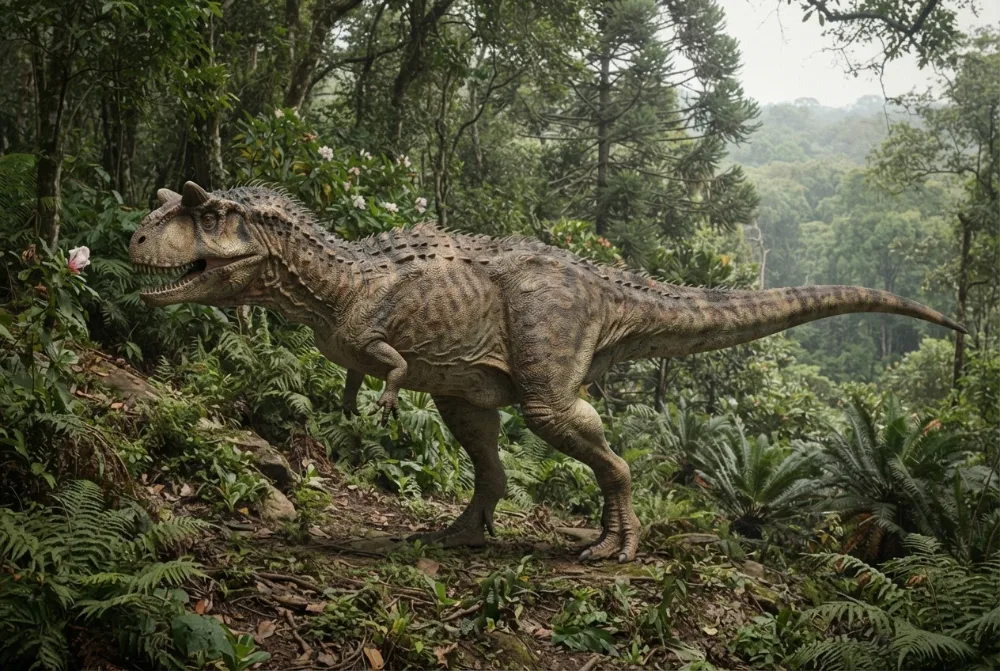
Rajasaurus was a meat-eating dinosaur that lived in India near the end of the Cretaceous Period. It had a single short horn on its forehead and used its strong neck and jaws to catch prey. This dinosaur was an ambush predator, hiding and then pouncing on its food.1
Ankakhala liti?
Anali wamkulu bwanji?
Anali wautali bwanji?
Msinkhu wake unali wautali bwanji?
Ankalemera bwanji?

 wautali ngati agalu 7 otsatizana mphuno ndi mchira🍌wautali ngati nthochi 37 zotsatizanawolemera ngati agalu 200🍉wolemera ngati mavwende 800🎒wolemera ngati makalasi athunthu a ana a sukulu 5🐻❄️wolemera ngati zimbalangondo zoyera 9🏃akanatha kuthamanga mamita 100 m'masekondi 14 (munthu waliwiro kwambiri amafunika 9.6)
Rajasaurus anali wamkulu bwanji poyerekeza ndi IWEYO?
Ndi masamu chabe mu msakatuli wako. Palibe chimene chimasungidwa kapena kutumizidwa kwina kulikonse.
Anali ndi liwiro lotani?


Mfundo zosangalatsa
Rajasaurus had a single low horn on its forehead made mostly of nasal bone, unlike the horn of its relative Majungasaurus.2
It was one of the larger abelisaurids, measuring about 6.6 metres (22 feet) long.1
Rajasaurus lived on the island of India during the Late Cretaceous, when India was isolated from other continents.1
Its fossils were found in the Lameta Formation, which was once a river valley with an arid or semi-arid climate.2
The horn on its head might have been used for display or for head-butting other Rajasaurus during fights.12
Rajasaurus had short arms and four fingers, so it relied on its powerful head and jaws to catch prey.2
It is the first Indian theropod dinosaur to have preserved bones from the spine, hips, legs, and tail.2
Mafunso ofunsidwa kwambiri okhudza Rajasaurus
?How big was Rajasaurus?
Rajasaurus was about 6.6 metres (22 feet) long, though one scientist estimated it at 11 metres (36 feet). It weighed around 4 metric tons (4.4 short tons).21
?What did Rajasaurus eat?
Rajasaurus was a carnivore that ate meat. It probably hunted large prey like sauropod dinosaurs and may have also scavenged for food.13
?Did Rajasaurus have feathers?
No one knows for sure. The fossils don't show feathers, and most abelisaurids are not known to have had them, but some scientists think many theropods might have had simple feathers.21
?Was Rajasaurus bigger than T. rex?
No, Rajasaurus was smaller. T. rex could reach about 12 metres (40 feet) long, while Rajasaurus was only about 6.6 metres (22 feet) long.12
?Why did Rajasaurus have a horn?
The horn was probably used for display to attract mates or for head-butting other Rajasaurus during fights. It was made mostly of nasal bone.12
?Could Rajasaurus swim?
Probably not. It was a land dinosaur with strong legs for walking and running, not swimming. It lived near rivers but likely stayed on land.21
Kwa akatswiri a madino
- Dzina la sayansi
- Rajasaurus
- Anapatsidwa dzina ndi
- Wilson et al. 20034
- Gulu
- Madino odya nyama
- Banja / kladi
- Abelisauridae4
- Magawidwe a sayansi
- Theropoda > Ceratosauria > Abelisauridae4
- Zaka za miyala
- zaka 72 mpaka 66 miliyoni (Maastrichtian)4
- Mapangidwe a miyala
- Lameta4
- Mayiko
- India4
- Zolemba za mafosili
- 1 mu The Paleobiology Database4
- Kupezeka
- Rajasaurus was named in 2003 by Jeffrey A. Wilson and colleagues. The fossils were found in the Lameta Formation of Gujarat, India, after dinosaur eggs were discovered there in 1981.24
- Akukambiranabe
- Scientists are not sure what the horn on its head was used for. It may have been for display or for head-butting, but no one knows for certain.1
Kumene mfundo zimachokera
- Rajasaurus | Natural History Museum (nhm.ac.uk)
- Rajasaurus (en.wikipedia.org)
- Discoveries | Paul Sereno - Paleontologist | The University of Chicago (paulsereno.uchicago.edu)
- Rajasaurus in The Paleobiology Database (CC BY 4.0): zaka, malo, mapangidwe a miyala, magawidwe a sayansi.
Mfundo iliyonse patsamba lino ili ndi nambala yosonyeza kumene yachokera. Ngati talakwitsa kanthu, pepa, ndife okonda madino, osati magazini ya sayansi. Tiuze pa [email protected] ndipo tikonza.
 Rex ali ndi njala! Dino Wiki ndi ntchito ya bambo kwa mwana wawo wamwamuna wokonda madainoso, yaulere popanda zotsatsa ndi zokazonda. Akuluakulu angadyetse Rex zokhwasula-khwasula kuti tsambali lipitirize kupezeka pa intaneti.Dyetsa Rex
 Allosaurus
 Carnotaurus
 Dilophosaurus
 Giganotosaurus
 Compsognathus
 Paronychodon
 Tyrannosaurus
 Triceratops
 Velociraptor
 Spinosaurus
 Ankylosaurus
 Parasaurolophus