 Kwizi ya Ndiwe dino uti?
 Nkhondo ya madino
 Mpikisano wa madino
 Masewera ang'onoang'ono a madino
 Chimbale cha zomata
 Mindandanda ya TOP ya madino
 Ndidabwitse!
Ankakhala liti?

Anali wamkulu bwanji?
Anali wautali bwanji?
Msinkhu wake unali wautali bwanji?
Ankalemera bwanji?
 wautali ngati amphaka a pakhomo 3 otsatizana mphuno ndi mchira🍌wautali ngati nthochi 8 zotsatizanawolemera pafupifupi ngati mphaka wa pakhomo🍌wolemera ngati nthochi 58🏃akanatha kuthamanga mamita 100 m'masekondi 12 (munthu waliwiro kwambiri amafunika 9.6)
Segisaurus anali wamkulu bwanji poyerekeza ndi IWEYO?
Ndi masamu chabe mu msakatuli wako. Palibe chimene chimasungidwa kapena kutumizidwa kwina kulikonse.
Anali ndi liwiro lotani?


Mfundo zosangalatsa
Segisaurus had a wishbone, called a furcula, just like birds do. This was one of the first times such a bone was found in a non-bird dinosaur.2
Its bones were first thought to be solid, but a 2005 study showed they were actually hollow, like other theropods.2
The only known fossil was found by a Navajo man named Max Littlesalt in 1933, who was keeping livestock in the canyon.2
Segisaurus lived in an environment like modern sand dunes, and its fossil was buried in sandstone.2
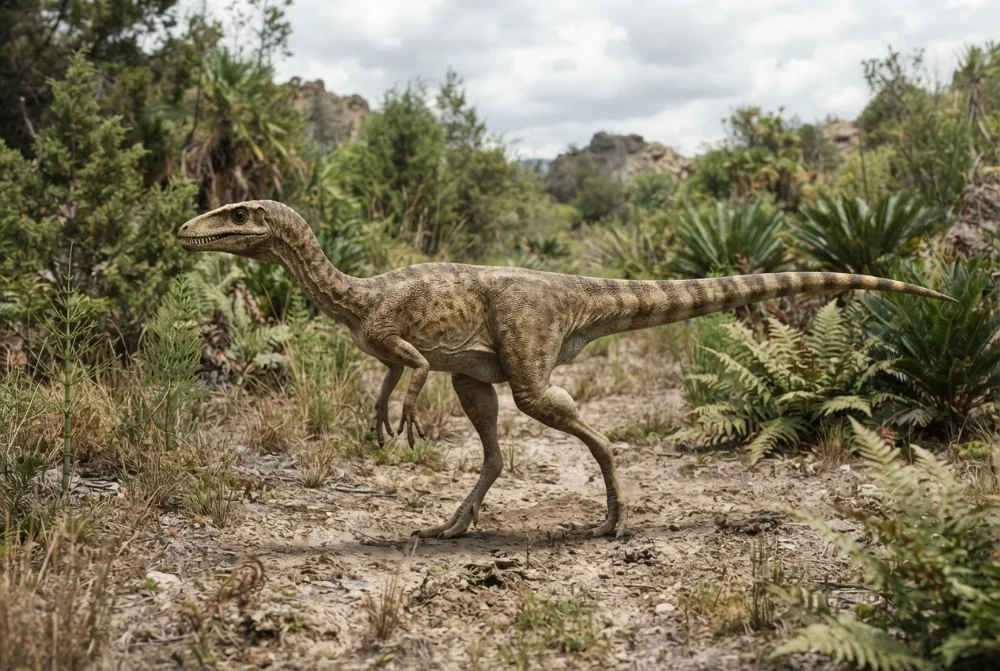
It had a long tail and long forearms, and its legs were powerful and long compared to its body.2
Scientists think Segisaurus was closely related to Coelophysis, but it had some unusual features that made them question that at first.2
Mafunso ofunsidwa kwambiri okhudza Segisaurus
?How big was Segisaurus?
Segisaurus was about 1 metre (3.3 feet) long, half a metre (1.65 feet) tall, and weighed about 4 to 7 kilograms. That is roughly the size of a goose.2
?What did Segisaurus eat?
Segisaurus was a meat-eater, probably eating insects and small prey. It may also have scavenged meat.21
?When did Segisaurus live?
Segisaurus lived during the Early Jurassic period, about 200 to 174 million years ago.2
?Did Segisaurus have feathers?
The sources do not mention feathers on Segisaurus. It did have a wishbone, or furcula, like birds, which is a feature linked to birds.2
?Was Segisaurus a dinosaur?
Yes, Segisaurus was a small theropod dinosaur, a meat-eating dinosaur that walked on two legs.21
?Where was Segisaurus found?
The only Segisaurus fossil was found in Tsegi Canyon, Arizona, in the Navajo Sandstone. It was discovered by Max Littlesalt in 1933.2
Wothetsa nthano zabodza
Nthano: Some people thought Segisaurus had solid bones and might not be a true theropod.
Zoona: A 2005 re-examination showed its bones were hollow, and it is firmly classified as a coelophysoid theropod.2
Kwa akatswiri a madino
- Dzina la sayansi
- Segisaurus
- Anapatsidwa dzina ndi
- Camp 19363
- Gulu
- Madino odya nyama
- Banja / kladi
- Coelophysidae3
- Magawidwe a sayansi
- Theropoda > Coelophysoidea3
- Zaka za miyala
- zaka 193 mpaka 175 miliyoni (Pliensbachian / Toarcian)3
- Mapangidwe a miyala
- Navajo Sandstone3
- Mayiko
- Amereka3
- Zolemba za mafosili
- 2 mu The Paleobiology Database3
- Kupezeka
- The fossil was discovered in 1933 by Max Littlesalt in Tsegi Canyon, Arizona. Paleontologist Charles Lewis Camp described and named it in 1936.21
- Akukambiranabe
- Because only a sub-adult skeleton has been found, scientists are not sure how big a full-grown Segisaurus could get.2
Kumene mfundo zimachokera
- Segisaurus | Natural History Museum (nhm.ac.uk)
- Segisaurus (en.wikipedia.org)
- Segisaurus in The Paleobiology Database (CC BY 4.0): zaka, malo, mapangidwe a miyala, magawidwe a sayansi.
Mfundo iliyonse patsamba lino ili ndi nambala yosonyeza kumene yachokera. Ngati talakwitsa kanthu, pepa, ndife okonda madino, osati magazini ya sayansi. Tiuze pa [email protected] ndipo tikonza.
 Rex ali ndi njala! Dino Wiki ndi ntchito ya bambo kwa mwana wawo wamwamuna wokonda madainoso, yaulere popanda zotsatsa ndi zokazonda. Akuluakulu angadyetse Rex zokhwasula-khwasula kuti tsambali lipitirize kupezeka pa intaneti.Dyetsa Rex
 Allosaurus
 Carnotaurus
 Dilophosaurus
 Giganotosaurus
 Compsognathus
 Paronychodon
 Stenopterygius
 Dorygnathus
 Lufengosaurus
 Scutellosaurus
 Yunnanosaurus
 Temnodontosaurus