 Kwizi ya Ndiwe dino uti?
 Nkhondo ya madino
 Mpikisano wa madino
 Masewera ang'onoang'ono a madino
 Chimbale cha zomata
 Mindandanda ya TOP ya madino
 Ndidabwitse!
Ankakhala liti?

Anali wamkulu bwanji?
Anali wautali bwanji?
Msinkhu wake unali wautali bwanji?
kuyerekeza
Ankalemera bwanji?
 wautali ngati amphaka a pakhomo 3 otsatizana mphuno ndi mchira🍌wautali ngati nthochi 8 zotsatizanawolemera pafupifupi ngati mphaka wa pakhomo🍌wolemera ngati nthochi 42🏃akanatha kuthamanga mamita 100 m'masekondi 12 (munthu waliwiro kwambiri amafunika 9.6)
Shanag anali wamkulu bwanji poyerekeza ndi IWEYO?
Ndi masamu chabe mu msakatuli wako. Palibe chimene chimasungidwa kapena kutumizidwa kwina kulikonse.
Anali ndi liwiro lotani?


Mfundo zosangalatsa
Shanag is known from only a partial skull: a right maxilla (upper jaw bone), dentary (lower jaw bone), and part of the splenial (a jaw bone).2
It was a dromaeosaurid, meaning it was a close relative of famous raptors like Velociraptor and Deinonychus.2
Shanag had special air pockets inside its jawbone between the tooth sockets, called interalveolar pneumatic cavities.2
Unlike many other theropods, Shanag lacked a promaxillary fenestra, a small opening in the front of the snout.2
Shanag lived alongside Psittacosaurus, a small horned dinosaur, and large sauropods in the Öösh region.1
The fossils of Shanag were found in rocks that are about 130 million years old, from the Early Cretaceous period.1
Mafunso ofunsidwa kwambiri okhudza Shanag
?How big was Shanag?
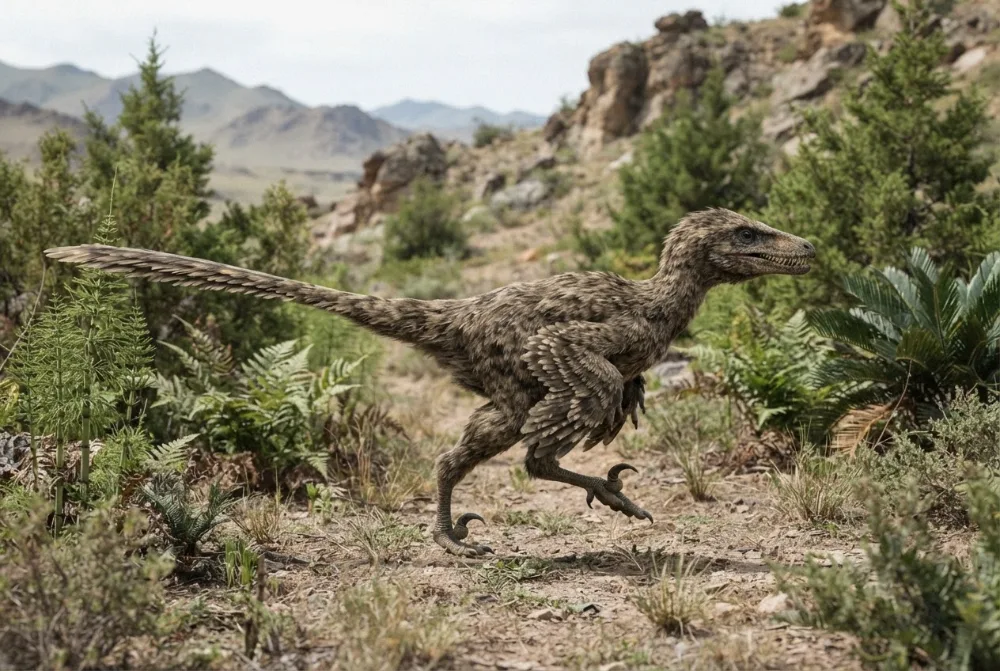
Shanag was a small predator, about 1.5 metres (4.9 feet) long and weighing around 5 kilograms (11 pounds).3
?Did Shanag have feathers?
Yes, as a theropod, Shanag had hollow bones and feathers. Its feathers helped with climbing, thermoregulation, and stabilizing while on prey.3
?What did Shanag eat?
Shanag was a meat-eating dinosaur with sharp teeth and claws. It likely used its claws to grip and pin down prey, similar to modern birds of prey.3
?Is Shanag a dromaeosaurid?
It may be a dromaeosaurid, but some researchers are skeptical. It shows a mix of dromaeosaurid, troodontid, and basal avialan traits, so its exact classification is debated.3
Kwa akatswiri a madino
- Dzina la sayansi
- Shanag
- Anapatsidwa dzina ndi
- Turner et al. 20074
- Gulu
- Maraputala
- Banja / kladi
- Dromaeosauridae4
- Magawidwe a sayansi
- Theropoda > Dromaeosauridae4
- Zaka za miyala
- zaka 143 mpaka 100 miliyoni (Berriasian / Albian)4
- Mapangidwe a miyala
- Öösh4
- Mayiko
- Mongoliya4
- Zolemba za mafosili
- 1 mu The Paleobiology Database4
- Kupezeka
- Shanag was named in 2007 by Alan H. Turner, Sunny H. Hwang, and Mark A. Norell. The only known fossil was found by a Mongolian Academy of Sciences,American Museum of Natural History expedition in 1999 at the Öösh locality in Mongolia.21
- Akukambiranabe
- Scientists are unsure about the exact size of Shanag because only a partial skull has been found.2
Kumene mfundo zimachokera
- digitallibrary.amnh.org (digitallibrary.amnh.org)
- A small derived theropod from Öösh, early Cretaceous, Baykhangor Mongolia ; American Museum novitates, no. 3557 (digitallibrary.amnh.org)
- Shanag (en.wikipedia.org)
- Shanag in The Paleobiology Database (CC BY 4.0): zaka, malo, mapangidwe a miyala, magawidwe a sayansi.
Mfundo iliyonse patsamba lino ili ndi nambala yosonyeza kumene yachokera. Ngati talakwitsa kanthu, pepa, ndife okonda madino, osati magazini ya sayansi. Tiuze pa [email protected] ndipo tikonza.
 Rex ali ndi njala! Dino Wiki ndi ntchito ya bambo kwa mwana wawo wamwamuna wokonda madainoso, yaulere popanda zotsatsa ndi zokazonda. Akuluakulu angadyetse Rex zokhwasula-khwasula kuti tsambali lipitirize kupezeka pa intaneti.Dyetsa Rex
 Velociraptor
 Microraptor
 Deinonychus
 Asiamericana
 Richardoestesia
 Saurornitholestes
 Stegosaurus
 Iguanodon
 Archaeopteryx
 Giganotosaurus
 Baryonyx
 Paronychodon