 Kwizi ya Ndiwe dino uti?
 Nkhondo ya madino
 Mpikisano wa madino
 Masewera ang'onoang'ono a madino
 Chimbale cha zomata
 Mindandanda ya TOP ya madino
 Ndidabwitse!
Sinornithosaurus
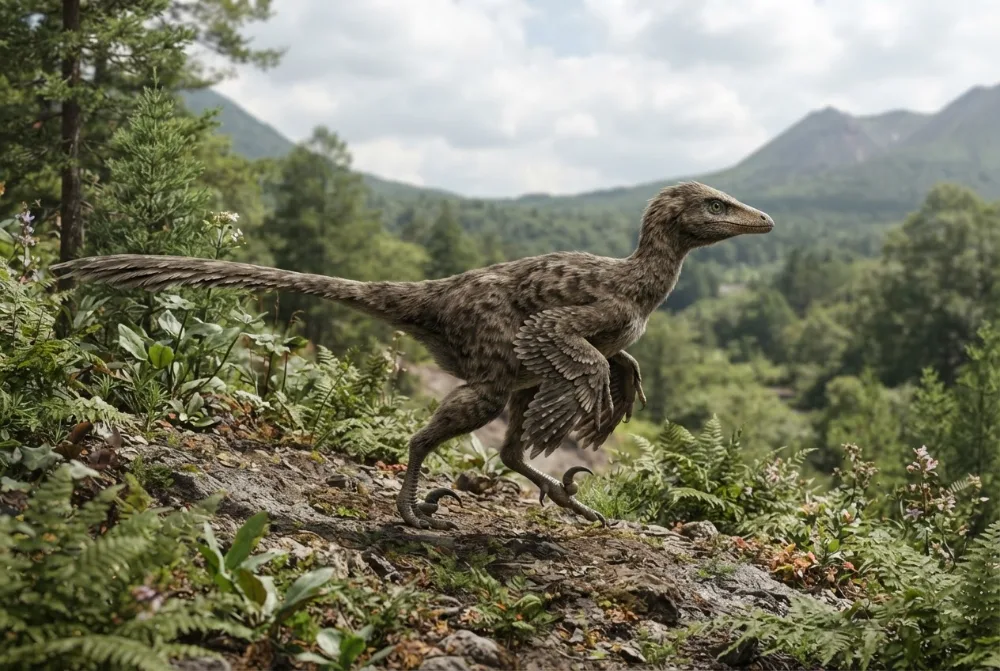
Sinornithosaurus was a small, feathered raptor that lived in what is now China. It looked a lot like a bird and could probably glide or flap its arms. This dinosaur helps scientists understand how birds evolved from meat-eating dinosaurs.21
Ankakhala liti?
Anali wamkulu bwanji?
Anali wautali bwanji?
Msinkhu wake unali wautali bwanji?
kuyerekeza
Ankalemera bwanji?
 wautali ngati amphaka a pakhomo 4 otsatizana mphuno ndi mchira🍌wautali ngati nthochi 11 zotsatizanawolemera pafupifupi ngati mphaka wa pakhomo🍌wolemera ngati nthochi 42🏃akanatha kuthamanga mamita 100 m'masekondi 12 (munthu waliwiro kwambiri amafunika 9.6)
Sinornithosaurus anali wamkulu bwanji poyerekeza ndi IWEYO?
Ndi masamu chabe mu msakatuli wako. Palibe chimene chimasungidwa kapena kutumizidwa kwina kulikonse.
Anali ndi liwiro lotani?


Mfundo zosangalatsa
Sinornithosaurus had feathers all over its body, like a bird.2
It is one of the earliest and most complete dromaeosaurid dinosaurs ever found.2
Its shoulder bones show it could probably flap its arms, even though it could not fly like a modern bird.2
Sinornithosaurus lived about 122 to 120 million years ago during the Early Cretaceous.1
It was about 2 metres (6.6 feet) long, about the size of a large turkey.1
Scientists think Sinornithosaurus is more closely related to birds than to some other dinosaurs like Troodon.2
Mafunso ofunsidwa kwambiri okhudza Sinornithosaurus
?How big was Sinornithosaurus?
About 1.2 metres long and weighed 3 to 5 kilograms. It was among the smallest dromaeosaurids.3
?Did Sinornithosaurus have feathers?
Yes, it had feathers all over its body and on its wings. The feathers were very similar to those of birds from the same time.31
?Could Sinornithosaurus fly?
It could probably glide for short distances after leaping from trees, but it could not fly like a modern bird. Some scientists think it was too heavy to fly.3
?Was Sinornithosaurus venomous?
Maybe. One study suggested it had a venomous bite, but another study disagreed, so scientists are not sure.3
Kwa akatswiri a madino
- Dzina la sayansi
- Sinornithosaurus
- Anapatsidwa dzina ndi
- Xu et al. 19995
- Gulu
- Maraputala
- Banja / kladi
- Dromaeosauridae5
- Magawidwe a sayansi
- Theropoda > Dromaeosauridae5
- Zaka za miyala
- zaka 126 mpaka 120 miliyoni (Barremian / Aptian)5
- Mapangidwe a miyala
- Yixian5
- Mayiko
- China5
- Zolemba za mafosili
- 3 mu The Paleobiology Database5
- Kupezeka
- Sinornithosaurus was named in 1999 by Xu Xing, Wang Xiaolin, and Wu Xiaochun based on a nearly complete skeleton found at Sihetun in Liaoning, China.21
- Akukambiranabe
- Scientists still debate whether Sinornithosaurus could actually fly or just glide, and how its feathers were used.2
Kumene mfundo zimachokera
- Sinornithosaurus | Natural History Museum (nhm.ac.uk)
- A dromaeosaurid dinosaur with a filamentous integument from the Yixian Formation of China (ideas.repec.org)
- Sinornithosaurus (en.wikipedia.org)
- Sinornithosaurus (wikipedia.nlaha.com)
- Sinornithosaurus in The Paleobiology Database (CC BY 4.0): zaka, malo, mapangidwe a miyala, magawidwe a sayansi.
Mfundo iliyonse patsamba lino ili ndi nambala yosonyeza kumene yachokera. Ngati talakwitsa kanthu, pepa, ndife okonda madino, osati magazini ya sayansi. Tiuze pa [email protected] ndipo tikonza.
 Rex ali ndi njala! Dino Wiki ndi ntchito ya bambo kwa mwana wawo wamwamuna wokonda madainoso, yaulere popanda zotsatsa ndi zokazonda. Akuluakulu angadyetse Rex zokhwasula-khwasula kuti tsambali lipitirize kupezeka pa intaneti.Dyetsa Rex
 Velociraptor
 Microraptor
 Deinonychus
 Asiamericana
 Richardoestesia
 Saurornitholestes
 Stegosaurus
 Iguanodon
 Archaeopteryx
 Giganotosaurus
 Baryonyx
 Paronychodon