 Kwizi ya Ndiwe dino uti?
 Nkhondo ya madino
 Mpikisano wa madino
 Masewera ang'onoang'ono a madino
 Chimbale cha zomata
 Mindandanda ya TOP ya madino
 Ndidabwitse!
Thecodontosaurus
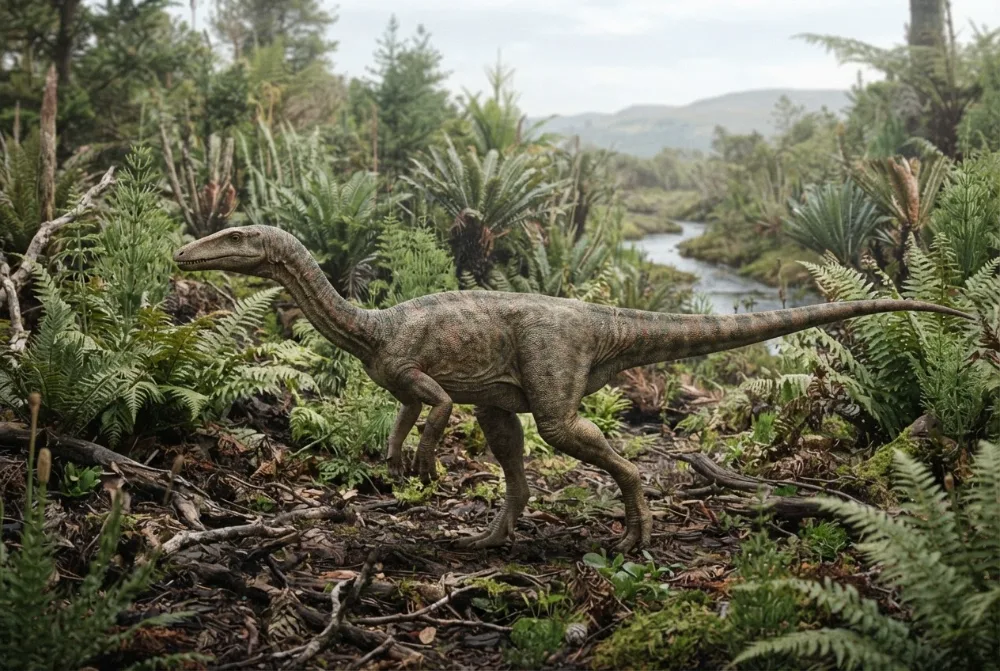
Thecodontosaurus was one of the very first dinosaurs to ever live. It was a small, speedy plant-eater that ran on two legs and lived in what is now England. This little dinosaur is one of the oldest dinosaurs known to science.1
Ankakhala liti?
Anali wamkulu bwanji?
Anali wautali bwanji?
Msinkhu wake unali wautali bwanji?
Ankalemera bwanji?

 wautali ngati agalu 2.5 otsatizana mphuno ndi mchira🍌wautali ngati nthochi 14 zotsatizana🍌wolemera ngati nthochi 92🪑wamng'ono moti angayende pansi pa mpando🏃akanatha kuthamanga mamita 100 m'masekondi 12 (munthu waliwiro kwambiri amafunika 9.6)
Thecodontosaurus anali wamkulu bwanji poyerekeza ndi IWEYO?
Ndi masamu chabe mu msakatuli wako. Palibe chimene chimasungidwa kapena kutumizidwa kwina kulikonse.
Anali ndi liwiro lotani?


Mfundo zosangalatsa
Thecodontosaurus was one of the first dinosaurs ever named, back in 1836, even before the word 'dinosaur' existed.1
It had five fingers on each hand and five toes on each foot, with a long claw on each finger.1
Its tail was longer than its head, neck and body put together.1
Thecodontosaurus was a fast runner, and its brain and inner ear helped it keep its head steady while moving.2
For a long time, scientists thought Thecodontosaurus was a lizard, not a dinosaur. It was only in 1870 that Thomas Huxley showed it was a dinosaur.1
Some fossils of Thecodontosaurus were once mistaken for a dinosaur from Australia, but they actually came from England.1
Thecodontosaurus lived during the Late Triassic period, about 205 to 201 million years ago.2
Mafunso ofunsidwa kwambiri okhudza Thecodontosaurus
?How big was Thecodontosaurus?
On average, it was about 1.2 metres (3.9 ft) long, 30 centimetres (12 in) tall, and weighed 11 kilograms (24 lb). The largest individuals reached about 2.5 metres (8.2 ft) in length.1
?What did Thecodontosaurus eat?
It was an herbivore, eating plants. Its jaws had many small to medium-sized, serrated, leaf-shaped teeth for chewing vegetation.1
?When did Thecodontosaurus live?
It lived during the late Triassic period, about 205 to 201 million years ago.1
?Where was Thecodontosaurus found?
Its fossils have been found in southern England, especially near Bristol, and also in Wales.13
?Was Thecodontosaurus a dinosaur?
Yes, it is a dinosaur. It was one of the first dinosaurs to be discovered and one of the oldest that ever existed.1
Kwa akatswiri a madino
- Dzina la sayansi
- Thecodontosaurus
- Anapatsidwa dzina ndi
- Riley and Stutchbury 18364
- Gulu
- Makosi atali
- Banja / kladi
- Sauropodomorpha4
- Magawidwe a sayansi
- Sauropodomorpha4
- Zaka za miyala
- zaka 247 mpaka 193 miliyoni ()4
- Mapangidwe a miyala
- Forest Sandstone, Magnesian Conglomerate, Elliot4
- Mayiko
- United Kingdom, Zimbabwe, Falansa, Jeremani, Lesotho4
- Zolemba za mafosili
- 14 mu The Paleobiology Database4
- Kupezeka
- Thecodontosaurus was discovered in 1834 by surgeon Henry Riley and curator Samuel Stutchbury in a quarry near Bristol, England. They named it in 1836, and the full species name Thecodontosaurus antiquus was given by John Morris in 1843.1
- Akukambiranabe
- Scientists are not sure whether Thecodontosaurus ate only plants or also ate small animals. Its teeth suggest it was mostly a plant-eater, but it might have eaten meat sometimes.2
Kumene mfundo zimachokera
- Thecodontosaurus (en.wikipedia.org)
- The braincase, brain and palaeobiology of the basal sauropodomorph dinosaur Thecodontosaurus antiquus (cpb-eu-w2.wpmucdn.com)
- The Bristol Dinosaur - Bristol Museums Collections (collections.bristolmuseums.org.uk)
- Thecodontosaurus in The Paleobiology Database (CC BY 4.0): zaka, malo, mapangidwe a miyala, magawidwe a sayansi.
Mfundo iliyonse patsamba lino ili ndi nambala yosonyeza kumene yachokera. Ngati talakwitsa kanthu, pepa, ndife okonda madino, osati magazini ya sayansi. Tiuze pa [email protected] ndipo tikonza.
 Rex ali ndi njala! Dino Wiki ndi ntchito ya bambo kwa mwana wawo wamwamuna wokonda madainoso, yaulere popanda zotsatsa ndi zokazonda. Akuluakulu angadyetse Rex zokhwasula-khwasula kuti tsambali lipitirize kupezeka pa intaneti.Dyetsa Rex
 Brachiosaurus
 Diplodocus
 Brontosaurus
 Argentinosaurus
 Camarasaurus
 Morosaurus
 Nothosaurus
 Coelophysis
 Podokesaurus
 Simosaurus
 Eudimorphodon
 Herrerasaurus