 Kwizi ya Ndiwe dino uti?
 Nkhondo ya madino
 Mpikisano wa madino
 Masewera ang'onoang'ono a madino
 Chimbale cha zomata
 Mindandanda ya TOP ya madino
 Ndidabwitse!
Ugrunaaluk
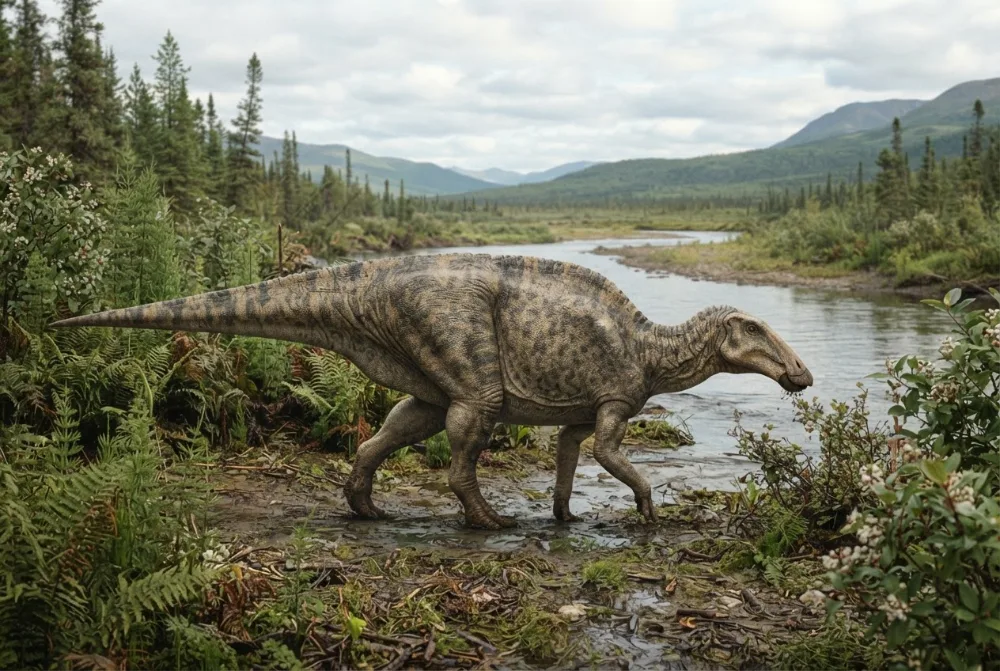
Ugrunaaluk was a duck-billed dinosaur that lived in the ancient Arctic, where it was cold and dark for part of the year. It had a long, flat beak and hundreds of teeth for chewing tough plants. This dinosaur is special because it shows that some dinosaurs could survive in polar regions.51
Ankakhala liti?
Anali wamkulu bwanji?
Anali wautali bwanji?
Msinkhu wake unali wautali bwanji?
kuyerekeza
Ankalemera bwanji?
 wautali ngati magalimoto 2.5 oimikidwa pamzere🍌wautali ngati nthochi 67 zotsatizana
 wolemera pafupifupi ngati njovu🍉wolemera ngati mavwende 1100🎒wolemera ngati makalasi athunthu a ana a sukulu 7🐻❄️wolemera ngati zimbalangondo zoyera 12🏃akanatha kuthamanga mamita 100 m'masekondi 17 (munthu waliwiro kwambiri amafunika 9.6)
Ugrunaaluk anali wamkulu bwanji poyerekeza ndi IWEYO?
Ndi masamu chabe mu msakatuli wako. Palibe chimene chimasungidwa kapena kutumizidwa kwina kulikonse.
Anali ndi liwiro lotani?


Mfundo zosangalatsa
Ugrunaaluk lived in the Arctic about 69 million years ago, when the climate was much cooler than today, with average temperatures around 5 to 6°C.1
Most of the Ugrunaaluk fossils found are from young animals, not fully grown adults. Scientists think a whole herd of juveniles may have died together in a flood.1
Its name comes from the Iñupiaq language of Alaska. Ugruŋnaq means a grazing animal with grinding teeth, and -aluk means old, so Ugrunaaluk is 'ancient grazer'.1
Ugrunaaluk was a close relative of Edmontosaurus, but scientists found enough differences in its skull bones to give it its own name.1
The Liscomb bonebed where Ugrunaaluk was found has thousands of bones, mostly from this dinosaur, along with a few teeth from tyrannosaurs and other small dinosaurs.1
During the time of Ugrunaaluk, the Arctic had polar woodlands with flowering plants in the understory, and the days were dark for months in winter.1
Mafunso ofunsidwa kwambiri okhudza Ugrunaaluk
?How big was Ugrunaaluk?
Ugrunaaluk was about 7.6 to 9.1 meters (25 to 30 feet) long and stood about 1.8 to 2.1 meters (6 to 7 feet) tall at the hip.4
?What did Ugrunaaluk eat?
It was a plant-eater, with a flat beak and hundreds of teeth for chewing tough plants. Its jaw had at least 1,000 teeth with coarse surfaces perfect for pulverizing plants.4
?Did Ugrunaaluk live in the Arctic?
Yes, Ugrunaaluk lived in the ancient Arctic, above the Arctic Circle, about 69 million years ago. It endured cold and dark winters, with average temperatures around 5 to 6°C.41
?Was Ugrunaaluk a duck-billed dinosaur?
Yes, Ugrunaaluk belonged to the hadrosaur group of duck-billed dinosaurs. It had a long, flat beak and hundreds of teeth for chewing plants.4
?Why is Ugrunaaluk special?
Ugrunaaluk is special because it shows that some dinosaurs could survive in polar regions. It lived above the Arctic Circle, enduring months of darkness and cold.4
?How many teeth did Ugrunaaluk have?
Ugrunaaluk had at least 1,000 teeth in its jaw, with coarse surfaces perfect for pulverizing plants.4
?When did Ugrunaaluk live?
Ugrunaaluk lived about 69 million years ago, during the Late Cretaceous period, in the ancient Arctic.4
?Is Ugrunaaluk related to Edmontosaurus?
Yes, Ugrunaaluk is closely related to Edmontosaurus, but scientists found enough differences in its skull bones to give it its own name.1
?Where was Ugrunaaluk found?
Ugrunaaluk fossils were found in the Liscomb bonebed in the Prince Creek Formation of northern Alaska, along the Colville River.1
Wothetsa nthano zabodza
Nthano: Ugrunaaluk is just a young Edmontosaurus and not a real separate dinosaur.
Zoona: Scientists showed that Ugrunaaluk has unique skull features that make it a distinct species, even when accounting for age differences.1
Kwa akatswiri a madino
- Dzina la sayansi
- Ugrunaaluk
- Anapatsidwa dzina ndi
- Mori et al. 20165
- Gulu
- Milomo ya bakha
- Banja / kladi
- Hadrosauridae5
- Magawidwe a sayansi
- Ornithischia > Ornithopoda > Iguanodontia > Hadrosauridae5
- Zaka za miyala
- zaka 72 mpaka 66 miliyoni (Maastrichtian)5
- Mapangidwe a miyala
- Prince Creek5
- Mayiko
- Amereka5
- Zolemba za mafosili
- 1 mu The Paleobiology Database5
- Kupezeka
- Ugrunaaluk was named in 2016 by Hirotsugu Mori, Patrick Druckenmiller, and Gregory Erickson. The fossils were found in the Liscomb bonebed along the Colville River in northern Alaska.51
- Akukambiranabe
- Scientists are not sure exactly how big adult Ugrunaaluk grew, because almost all the fossils are from juveniles.1
Kumene mfundo zimachokera
- Formation (lower Maastrichtian) of northern Alaska (app.pan.pl)
- Edmontosaurus (en.wikipedia.org)
- Edmontosaurus regalis (en.wikipedia.org)
- New Dinosaur Species Probably Endured Snow and Darkness for Months on End | NOVA | PBS (pbs.org)
- Ugrunaaluk in The Paleobiology Database (CC BY 4.0): zaka, malo, mapangidwe a miyala, magawidwe a sayansi.
Mfundo iliyonse patsamba lino ili ndi nambala yosonyeza kumene yachokera. Ngati talakwitsa kanthu, pepa, ndife okonda madino, osati magazini ya sayansi. Tiuze pa [email protected] ndipo tikonza.
 Rex ali ndi njala! Dino Wiki ndi ntchito ya bambo kwa mwana wawo wamwamuna wokonda madainoso, yaulere popanda zotsatsa ndi zokazonda. Akuluakulu angadyetse Rex zokhwasula-khwasula kuti tsambali lipitirize kupezeka pa intaneti.Dyetsa Rex
 Parasaurolophus
 Edmontosaurus
 Saurolophus
 Hypacrosaurus
 Corythosaurus
 Kritosaurus
 Tyrannosaurus
 Triceratops
 Velociraptor
 Spinosaurus
 Ankylosaurus
 Pteranodon