 Kwizi ya Ndiwe dino uti?
 Nkhondo ya madino
 Mpikisano wa madino
 Masewera ang'onoang'ono a madino
 Chimbale cha zomata
 Mindandanda ya TOP ya madino
 Ndidabwitse!
Vallibonavenatrix
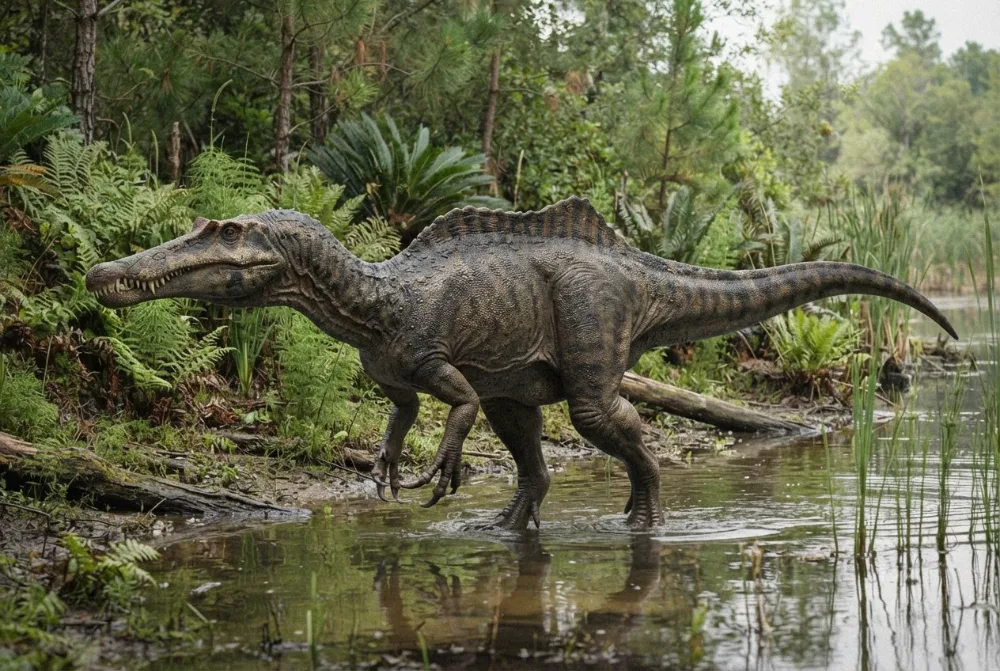
Vallibonavenatrix was a medium-sized spinosaurid dinosaur that lived in what is now Spain during the Early Cretaceous. It had a long, crocodile-like snout and probably ate fish, just like its bigger cousin Spinosaurus. This dinosaur is the most complete spinosaur ever found in the Iberian Peninsula.1
Ankakhala liti?
Anali wamkulu bwanji?
Anali wautali bwanji?
Msinkhu wake unali wautali bwanji?
Ankalemera bwanji?
 wautali ngati agalu 7 otsatizana mphuno ndi mchira🍌wautali ngati nthochi 39 zotsatizana🍉wolemera ngati mavwende 200🧸wolemera ngati ana a sukulu ya mkaka 53🎒wolemera ngati ana a sukulu 31🐻❄️wolemera ngati zimbalangondo zoyera 2🏃akanatha kuthamanga mamita 100 m'masekondi 12 (munthu waliwiro kwambiri amafunika 9.6)
Vallibonavenatrix anali wamkulu bwanji poyerekeza ndi IWEYO?
Ndi masamu chabe mu msakatuli wako. Palibe chimene chimasungidwa kapena kutumizidwa kwina kulikonse.
Anali ndi liwiro lotani?


Mfundo zosangalatsa
Vallibonavenatrix had a sail on its back made of tall, fan-shaped spines, similar to the dinosaur Ichthyovenator.1
Its bones were full of air pockets, making its skeleton lighter. This is called being pneumatic.1
The first fossils were found by amateur fossil collector Juan Cano Forner in the 1980s and 1990s.1
Vallibonavenatrix lived about 129 to 125 million years ago, during the Barremian stage of the Early Cretaceous.1
It shared its home with other dinosaurs like Iguanodon and the spinosaurid Protathlitis.1
Mafunso ofunsidwa kwambiri okhudza Vallibonavenatrix
?How big was Vallibonavenatrix?
It was a medium-sized spinosaurid, but scientists do not know its exact length or weight because only a partial skeleton has been found.1
?What did Vallibonavenatrix eat?
It probably ate fish, just like its bigger cousin Spinosaurus, because it had a long, crocodile-like snout.1
?Did Vallibonavenatrix have a sail?
Yes, it likely had a sail on its back made of tall, fan-shaped spines, similar to the dinosaur Ichthyovenator.1
?When did Vallibonavenatrix live?
It lived about 129 to 125 million years ago, during the Barremian stage of the Early Cretaceous.1
?Where was Vallibonavenatrix found?
Its fossils were found in the Arcillas de Morella Formation near Vallibona, Castellón, Spain.12
?Is Vallibonavenatrix a dinosaur?
Yes, it is a spinosaurid dinosaur, a type of theropod dinosaur.1
Wothetsa nthano zabodza
Nthano: Vallibonavenatrix was a close relative of Baryonyx from Europe.
Zoona: Scientists disagree. Some studies place it closer to spinosaurines from Africa and South America, like Spinosaurus and Irritator.1
Kwa akatswiri a madino
- Dzina la sayansi
- Vallibonavenatrix
- Anapatsidwa dzina ndi
- Malafaia et al. 20192
- Gulu
- Maspinosauri
- Banja / kladi
- Spinosauridae2
- Magawidwe a sayansi
- Theropoda > Spinosauridae2
- Zaka za miyala
- zaka 126 mpaka 121 miliyoni (Barremian)2
- Mapangidwe a miyala
- Arcillas de Morella2
- Mayiko
- Sipeyini2
- Zolemba za mafosili
- 1 mu The Paleobiology Database2
- Kupezeka
- Vallibonavenatrix was named in 2019 by Elisabete Malafaia and colleagues. The species name cani honors Juan Cano Forner, who discovered the fossils.1
- Akukambiranabe
- Scientists are not sure whether Vallibonavenatrix belongs to the Spinosaurinae or Baryonychinae group, or if it is a more primitive spinosaurid.1
Kumene mfundo zimachokera
- Vallibonavenatrix (en.wikipedia.org)
- Vallibonavenatrix in The Paleobiology Database (CC BY 4.0): zaka, malo, mapangidwe a miyala, magawidwe a sayansi.
Mfundo iliyonse patsamba lino ili ndi nambala yosonyeza kumene yachokera. Ngati talakwitsa kanthu, pepa, ndife okonda madino, osati magazini ya sayansi. Tiuze pa [email protected] ndipo tikonza.
 Rex ali ndi njala! Dino Wiki ndi ntchito ya bambo kwa mwana wawo wamwamuna wokonda madainoso, yaulere popanda zotsatsa ndi zokazonda. Akuluakulu angadyetse Rex zokhwasula-khwasula kuti tsambali lipitirize kupezeka pa intaneti.Dyetsa Rex
 Spinosaurus
 Baryonyx
 Suchomimus
 Angaturama
 Camarillasaurus
 Ceratosuchops
 Stegosaurus
 Iguanodon
 Archaeopteryx
 Giganotosaurus
 Microraptor
 Deinonychus