 Kwizi ya Ndiwe dino uti?
 Nkhondo ya madino
 Mpikisano wa madino
 Masewera ang'onoang'ono a madino
 Chimbale cha zomata
 Mindandanda ya TOP ya madino
 Ndidabwitse!
Ankakhala liti?

Anali wamkulu bwanji?
Anali wautali bwanji?
Msinkhu wake unali wautali bwanji?
kuyerekeza
Ankalemera bwanji?
 wautali ngati amphaka a pakhomo 3 otsatizana mphuno ndi mchira🍌wautali ngati nthochi 9 zotsatizanawolemera pafupifupi ngati mphaka wa pakhomo🍌wolemera ngati nthochi 46🏃akanatha kuthamanga mamita 100 m'masekondi 11 (munthu waliwiro kwambiri amafunika 9.6)
Vitakrisaurus anali wamkulu bwanji poyerekeza ndi IWEYO?
Ndi masamu chabe mu msakatuli wako. Palibe chimene chimasungidwa kapena kutumizidwa kwina kulikonse.
Anali ndi liwiro lotani?


Mfundo zosangalatsa
Vitakrisaurus was named by scientist Muhammad Sadiq Malkani in 2010.2
Its fossils include hand bones like carpals, metacarpals, and claws, which are rare for theropods from this region.1
This dinosaur lived during the very end of the Cretaceous Period, about 67 to 66 million years ago.1
Vitakrisaurus is known from the Vitakri Lameta Formation in central Pakistan.1
It belongs to a group of theropods called abelisauroids, which were common in the southern continents.1
The species name saraiki honors the Saraiki language spoken by people living near where the fossils were found.1
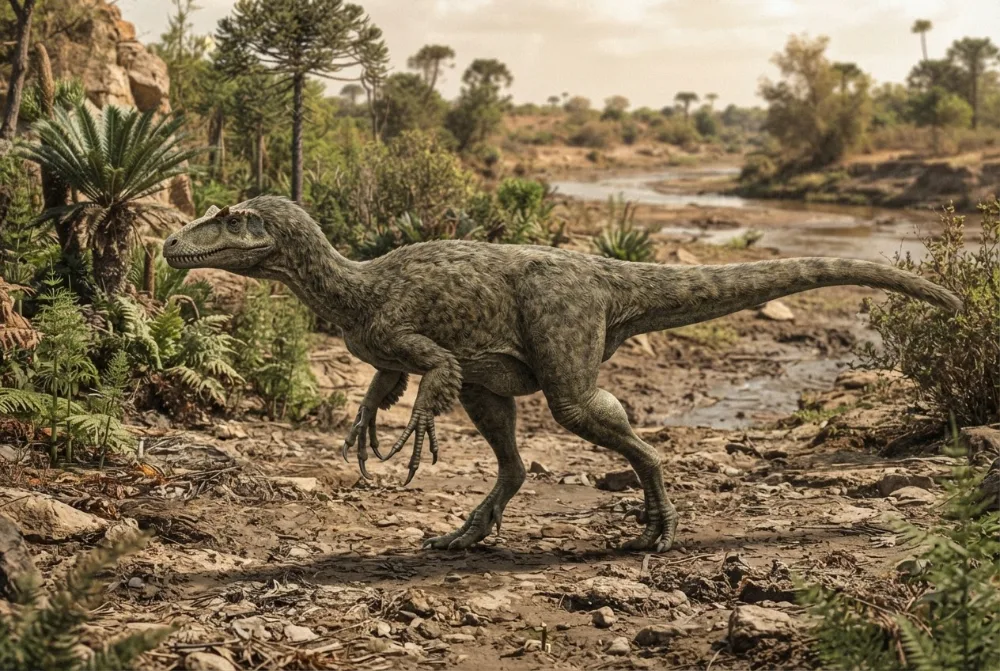
Mafunso ofunsidwa kwambiri okhudza Vitakrisaurus
?How big was Vitakrisaurus?
It was a medium sized theropod, about 10 metres long. That is roughly the length of a school bus.4
?What did Vitakrisaurus eat?
It was a carnivore, meaning it ate meat. It used its strong hands and claws to catch prey.4
?When did Vitakrisaurus live?
It lived at the very end of the Cretaceous Period, about 67 to 66 million years ago.4
?Where was Vitakrisaurus found?
Its fossils were found in the Vitakri Lameta Formation in Balochistan, central Pakistan.14
?Is Vitakrisaurus a dinosaur?
Yes, it is a dinosaur. It belongs to the group Theropoda, which includes meat-eating dinosaurs like T. rex.4
?Did Vitakrisaurus have feathers?
Scientists do not know for sure. No feathers have been found with its fossils, but many theropods related to it may have had feathers.1
?How fast could Vitakrisaurus run?
Nobody knows for sure. As a medium-sized theropod, it was probably a fast runner, but no speed estimates have been published.4
?Why is it called Vitakrisaurus?
Its name honors the Vitakri locality where it was found, and 'saurus' means lizard. The species name saraiki honors the Saraiki language of Pakistan.1
Kwa akatswiri a madino
- Dzina la sayansi
- Vitakrisaurus
- Anapatsidwa dzina ndi
- Malkani 20104
- Gulu
- Madino odya nyama
- Banja / kladi
- Vitakrisauridae4
- Magawidwe a sayansi
- Theropoda > Ceratosauria4
- Zaka za miyala
- zaka 72 mpaka 66 miliyoni (Maastrichtian)4
- Mapangidwe a miyala
- Vitakri4
- Mayiko
- Pakisitani4
- Zolemba za mafosili
- 3 mu The Paleobiology Database4
- Kupezeka
- Vitakrisaurus was named by Muhammad Sadiq Malkani in 2010 based on fossils from the mid Bor 2 locality in the Barkhan district of Balochistan, Pakistan.21
- Akukambiranabe
- Scientists are not sure exactly how big Vitakrisaurus grew, because only a few bones have been found.1
Kumene mfundo zimachokera
- Vitakrisaurus saraiki Theropod from South Asia (scirp.org)
- PBDB Taxon (paleobiodb.org)
- Vitakrisaurus saraiki | Dinosaur Database by DinoAnimals.com (dinoanimals.com)
- Vitakrisaurus in The Paleobiology Database (CC BY 4.0): zaka, malo, mapangidwe a miyala, magawidwe a sayansi.
Mfundo iliyonse patsamba lino ili ndi nambala yosonyeza kumene yachokera. Ngati talakwitsa kanthu, pepa, ndife okonda madino, osati magazini ya sayansi. Tiuze pa [email protected] ndipo tikonza.
 Rex ali ndi njala! Dino Wiki ndi ntchito ya bambo kwa mwana wawo wamwamuna wokonda madainoso, yaulere popanda zotsatsa ndi zokazonda. Akuluakulu angadyetse Rex zokhwasula-khwasula kuti tsambali lipitirize kupezeka pa intaneti.Dyetsa Rex
 Allosaurus
 Carnotaurus
 Dilophosaurus
 Giganotosaurus
 Compsognathus
 Paronychodon
 Tyrannosaurus
 Triceratops
 Velociraptor
 Spinosaurus
 Ankylosaurus
 Parasaurolophus