 Kwizi ya Ndiwe dino uti?
 Nkhondo ya madino
 Mpikisano wa madino
 Masewera ang'onoang'ono a madino
 Chimbale cha zomata
 Mindandanda ya TOP ya madino
 Ndidabwitse!
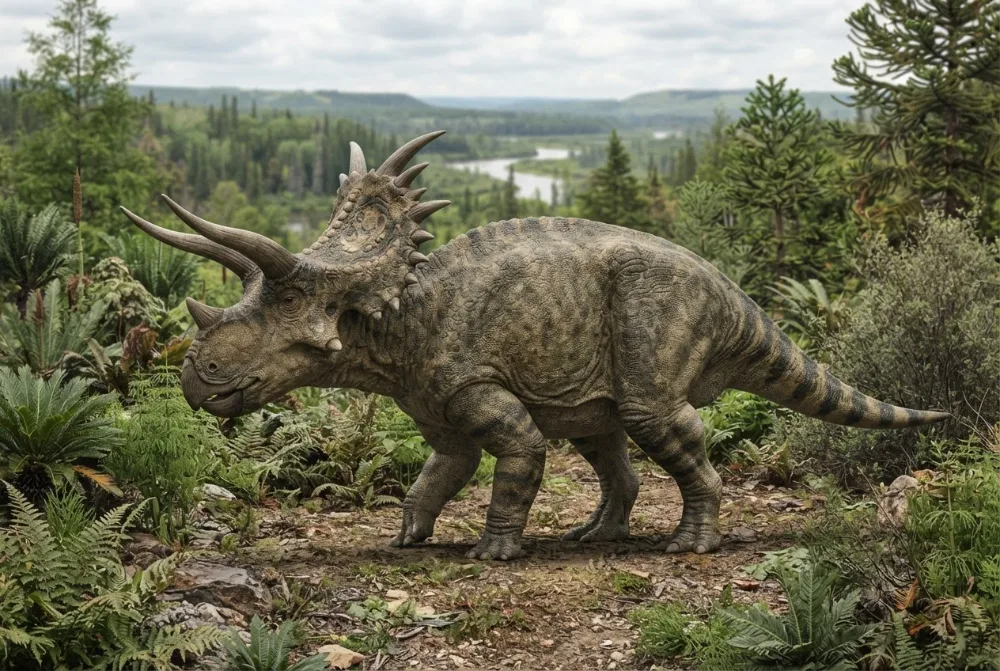
Xenoceratops
Xenoceratops was an early horned dinosaur that lived in Canada about 78 million years ago. It had a big frill on its head with spikes and two long horns above its eyes, making it look a bit like an alien. It was one of the oldest large horned dinosaurs ever found in North America.1
Ankakhala liti?
Anali wamkulu bwanji?
Anali wautali bwanji?
Msinkhu wake unali wautali bwanji?
kuyerekeza
Ankalemera bwanji?

 wautali ngati agalu 6 otsatizana mphuno ndi mchira🍌wautali ngati nthochi 33 zotsatizanawolemera ngati agalu 90🍉wolemera ngati mavwende 360🧸wolemera ngati ana a sukulu ya mkaka 95🎒wolemera ngati ana a sukulu 56🐻❄️wolemera ngati zimbalangondo zoyera 4🏃akanatha kuthamanga mamita 100 m'masekondi 11 (munthu waliwiro kwambiri amafunika 9.6)
Xenoceratops anali wamkulu bwanji poyerekeza ndi IWEYO?
Ndi masamu chabe mu msakatuli wako. Palibe chimene chimasungidwa kapena kutumizidwa kwina kulikonse.
Anali ndi liwiro lotani?


Mfundo zosangalatsa
Xenoceratops is the oldest known ceratopsid dinosaur from Canada, living about 78 million years ago.2
Its name means 'alien horned face' because it was found in rocks that had not yielded horned dinosaur fossils before.2
The fossils were collected in 1958 by paleontologist Wann Langston Jr., but they sat in a museum for decades before scientists realized they belonged to a new species.1
Unlike Triceratops, Xenoceratops had spikes on its frill in addition to the two long brow horns.1
Xenoceratops was about 6 metres long and weighed more than 2 tons, about as heavy as a large rhinoceros.1
It lived in a subtropical environment in Alberta, which at that time had no snow or frost.1
Scientists think Xenoceratops is the most primitive centrosaurine, meaning it branched off early in the evolution of this group of horned dinosaurs.2
Wothetsa nthano zabodza
Nthano: Xenoceratops is just a small, unimportant dinosaur.
Zoona: Xenoceratops is important because it is the oldest known large horned dinosaur from Canada, and it shows that horned dinosaurs evolved their fancy frills and horns very early.1
Kwa akatswiri a madino
- Dzina la sayansi
- Xenoceratops
- Anapatsidwa dzina ndi
- Ryan et al. 20123
- Gulu
- Madino a nyanga
- Banja / kladi
- Ceratopsidae3
- Magawidwe a sayansi
- Ornithischia > Ceratopsia > Ceratopsidae3
- Zaka za miyala
- zaka 84 mpaka 72 miliyoni (Campanian)3
- Mapangidwe a miyala
- Foremost3
- Mayiko
- Kanada3
- Zolemba za mafosili
- 1 mu The Paleobiology Database3
- Kupezeka
- Xenoceratops was named in 2012 by Michael Ryan and colleagues. The fossils were originally collected in 1958 by Wann Langston Jr. from a bone bed in the Foremost Formation of Alberta, Canada, and later rediscovered in the Canadian Museum of Nature.2
- Akukambiranabe
- Scientists are not sure exactly what the complete skull of Xenoceratops looked like, because only parts of the frill and horns have been found.2
Kumene mfundo zimachokera
- Two-Ton "Alien" Horned Dinosaur Found, "Different From Every Other" | National Geographic (nationalgeographic.com)
- cdnsciencepub.com (cdnsciencepub.com)
- Xenoceratops in The Paleobiology Database (CC BY 4.0): zaka, malo, mapangidwe a miyala, magawidwe a sayansi.
Mfundo iliyonse patsamba lino ili ndi nambala yosonyeza kumene yachokera. Ngati talakwitsa kanthu, pepa, ndife okonda madino, osati magazini ya sayansi. Tiuze pa [email protected] ndipo tikonza.
 Rex ali ndi njala! Dino Wiki ndi ntchito ya bambo kwa mwana wawo wamwamuna wokonda madainoso, yaulere popanda zotsatsa ndi zokazonda. Akuluakulu angadyetse Rex zokhwasula-khwasula kuti tsambali lipitirize kupezeka pa intaneti.Dyetsa Rex
 Triceratops
 Protoceratops
 Ojoceratops
 Tatankaceratops
 Psittacosaurus
 Centrosaurus
 Tyrannosaurus
 Velociraptor
 Spinosaurus
 Ankylosaurus
 Parasaurolophus
 Pteranodon