 Ati daayinoo kami? Qormaata
 Lola daayinoo
 Dorgommii daayinoo
 Taphoota daayinoo xixiqqoo
 Albamii istiikarii
 Tarreewwan TOP daayinoo
 Na dinqisiisi!
Edmontonia
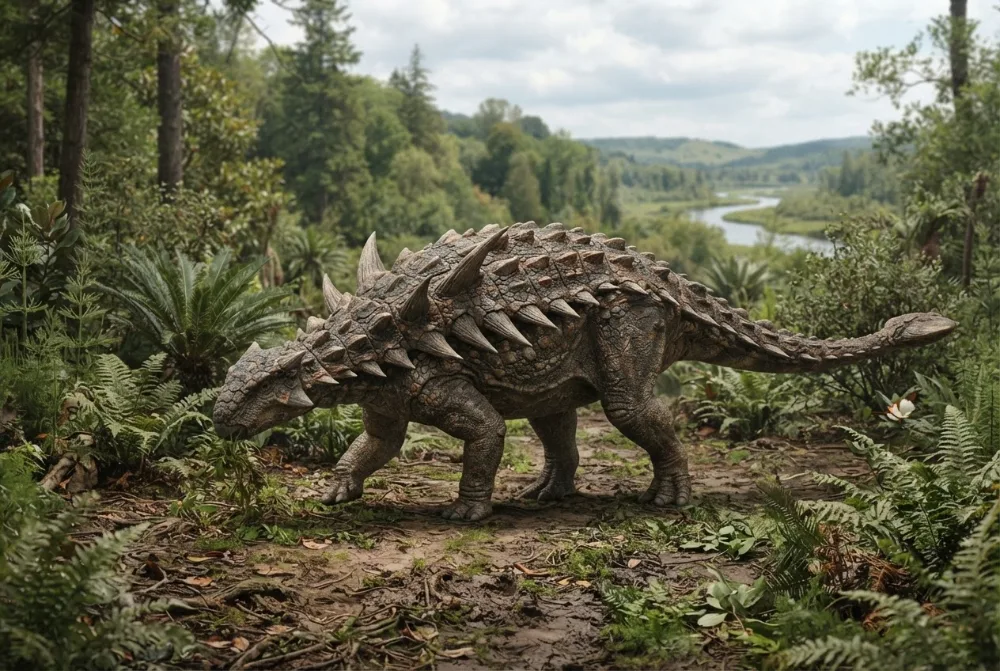
Edmontonia was a tank-like dinosaur covered in bony plates and sharp spikes. It walked on four legs and munched on low-growing plants. This nodosaurid dinosaur lived in western North America near the end of the Age of Dinosaurs.1
Yoom jiraate?
Hammam guddaa ture?
Hammam dheeraa ture?
Hammam ol-dheeraa ture?
Hammam ulfaataa ture?

 akka saree 7 funyaan hanga eegeetti dheeraa🍌akka muuzii 37 walitti hiriiran dheeraaakka saree 150 ulfaata🍉akka habxuu 600 ulfaata🎒akka kutaalee mana barumsaa guutuu 4 ulfaata🐻❄️akka beeraa adii 7 ulfaata🏃meetira 100 sekondii 28 keessatti fiiguu danda'a (namni hunda caalaa saffisaan 9.6 barbaada)
SI wajjin yoo wal bira qabamu, Edmontonia hammam guddaa ture?
Herrega qofa barbaadduu kee keessatti. Wanti tokkollee hin olkaa'amu, eessayyuu hin ergamu.
Hammam saffisaa ture?


Odeeffannoowwan bashannansiisoo
Edmontonia had four huge spikes sticking out from each shoulder, the largest of any nodosaurid. These spikes could have been used to fight other Edmontonia or to stab attacking predators.1
Its back and head were covered with small, oval bony plates that had a ridge down the middle. Its neck and shoulders were protected by three half-rings made of large keeled plates.1
Edmontonia lived alongside many other giant plant-eaters like the duck-billed dinosaurs Gryposaurus and Corythosaurus, and the horned dinosaurs Centrosaurus and Chasmosaurus.1
The only large predators that lived with Edmontonia were the tyrannosaurids Gorgosaurus and Daspletosaurus.1
Scientists think Edmontonia might have crouched down to protect its soft belly from predators, making it hard for a predator to flip it over.1
One species of Edmontonia, E. rugosidens, lived about 76.5 to 75 million years ago. The other species, E. longiceps, lived about 72 million years ago.1
Gaaffiiwwan waa'ee Edmontonia baay'ee gaafataman
?How big was Edmontonia?
Edmontonia was about 6 to 6.6 metres (20 to 22 ft) long and weighed around 3 tonnes (about 6,600 lb).15
?What did Edmontonia eat?
Edmontonia was an herbivore that ate low-growing plants like ferns and cycads. Its small teeth and weak jaws suggest it processed food differently than modern mammals.156
?Did Edmontonia have armor?
Yes, Edmontonia was covered in small oval bony plates on its back and head, and had three half-rings of large keeled plates protecting its neck and shoulders. It also had four huge spikes on each shoulder.15
?How fast could Edmontonia run?
No source gives a speed for Edmontonia, but its heavy armor and short, thick legs suggest it was slow-moving, like a tank.15
?Was Edmontonia bigger than T. rex?
No, Edmontonia was much smaller. T. rex could be over 12 metres (40 ft) long, while Edmontonia was only about 6 to 6.6 metres (20 to 22 ft) long.1
?When did Edmontonia live?
Edmontonia lived during the Late Cretaceous Period, about 76.5 to 68 million years ago.16
?Where was Edmontonia found?
Edmontonia fossils have been found in western North America, especially in Alberta, Canada, and also in the Talkeetna Mountains near Denali National Park in Alaska.15
?Could Edmontonia swim?
No source says Edmontonia could swim. Its heavy armor and short legs probably kept it on land.1
Seenaa sobaa diigaa
Seenaa sobaa: Edmontonia could swing its tail like a club to defend itself.
Dhugaa: Edmontonia was a nodosaurid, not an ankylosaurid. Nodosaurids did not have a tail club. Instead, Edmontonia relied on its shoulder spikes and body armor for protection.1
Ogeeyyii daayinootiif
- Maqaa saayinsii
- Edmontonia
- Kan maqaa baase
- Sternberg 19287
- Garee
- Daayinoowwan gaachanaa
- Maatii / kilaadii
- Nodosauridae7
- Ramaddii
- Ornithischia > Ankylosauria > Nodosauridae > Thyreophora7
- Umurii dhagaawwanii
- waggaa miliyoona 84 hanga 66 (Campanian / Maastrichtian)7
- Caasaawwan dhagaa
- Judith River, Aguja, Hell Creek7
- Biyyoota
- Ameerikaa, Kanaadaa7
- Galmee fosilii
- 16 The Paleobiology Database keessa7
- Maqaan biraa
- Chassternbergia, Denversaurus (maqaawwan durii amma akka bineensa tokkootti lakkaa'amu)7
- Argannoo
- Edmontonia was named by Charles M. Sternberg in 1928. The first fossils, including a skull and much of the skeleton, were found near Morrin, Alberta, Canada in 1924 by George Paterson.1
- Ammallee falmisiisaa
- Scientists still debate whether the fossils called Denversaurus and Chassternbergia are really separate dinosaurs or just different species of Edmontonia.2
Odeeffannoon eessaa dhufa
- Edmontonia (en.wikipedia.org)
- PBDB Taxon (paleobiodb.org)
- EDMONTONIA - DinoChecker dinosaur archive (dinochecker.com)
- Edmontonia | Dino Tail - Dinosaur Encyclopedia (dino-tail.com)
- Edmontonia - Denali National Park & Preserve (U.S. National Park Service) (nps.gov)
- enchantedlearning.com (enchantedlearning.com)
- Edmontonia in The Paleobiology Database (CC BY 4.0): umurii, bakkeewwan, caasaawwan dhagaa, ramaddii.
Odeeffannoon fuula kana irra jiru hundi lakkoofsa madda isaa agarsiisu qaba. Yoo waa dogoggorre, dhiifama, nuti jaallattoota daayinoo malee joornaalii saayinsii miti. [email protected] irratti nutti himi, nus ni sirreessina.
 Rex beela'eera! Dino Wiki pirojektii abbaa tokkoo kan ilma isaa daayinoo jaallatuuf hojjetame, bilisa, beeksisa malee fi hordoftuu malee. Ga'eessonni akka inni interneetii irra turuuf Rexiif nyaata xiqqoo kennuu danda'u.Rex soori
 Ankylosaurus
 Sauropelta
 Pinacosaurus
 Scutellosaurus
 Struthiosaurus
 Euoplocephalus
 Tyrannosaurus
 Triceratops
 Velociraptor
 Spinosaurus
 Parasaurolophus
 Pteranodon