 Ati daayinoo kami? Qormaata
 Lola daayinoo
 Dorgommii daayinoo
 Taphoota daayinoo xixiqqoo
 Albamii istiikarii
 Tarreewwan TOP daayinoo
 Na dinqisiisi!
Haestasaurus
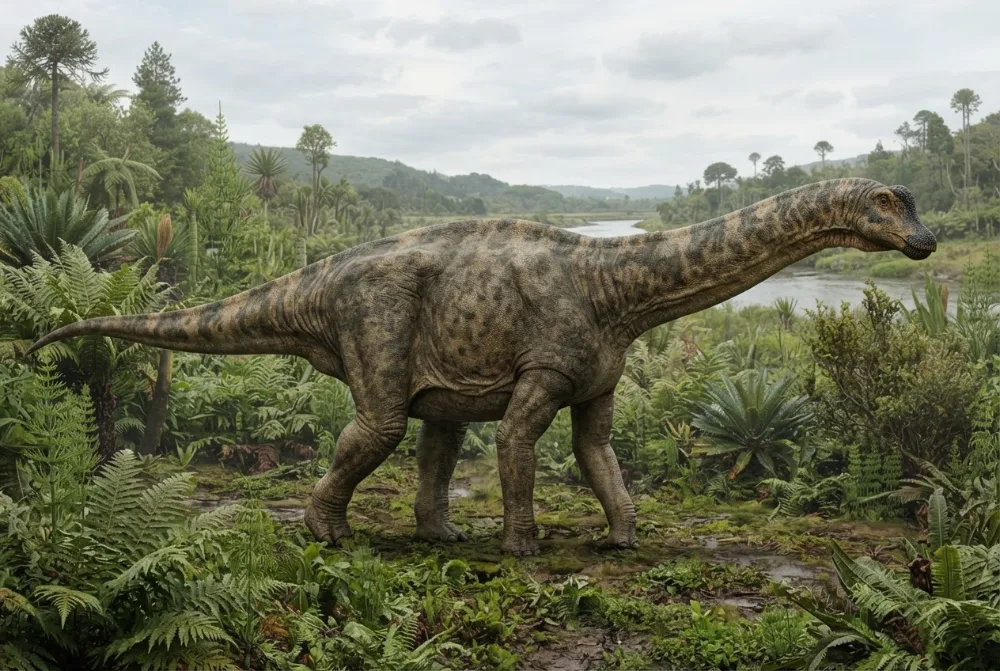
Haestasaurus was a huge, long-necked dinosaur that munched plants in Early Cretaceous England. It is famous for its arm bones and a piece of fossilized skin, which was the first dinosaur skin ever found by scientists!42
Yoom jiraate?
Hammam saffisaa ture?


Odeeffannoowwan bashannansiisoo
Haestasaurus is known from a left upper arm bone (humerus), a forearm bone (ulna), a radius, and a skin impression. The skin was the first dinosaur skin ever recognized by science.12
Scientists created the new name Haestasaurus in 2015 because the old name Pelorosaurus was used for different bones in earlier studies.1
The fossils come from the Hastings Beds Group, which are about 139 to 133 million years old (Early Cretaceous).4
Haestasaurus had a very thick and strong ulna (forearm bone) but a slim radius next to it. That unusual combination helps scientists tell it apart from other sauropods.1
The upper arm bone had a special hook-like bump on its lower inner corner. This bump is a unique feature not seen in any other sauropod.1
Haestasaurus is classified as a macronarian, a group of sauropods that includes the huge titanosaurs. But scientists are not sure if it was a very early titanosaur or a close cousin.1
The skin impression shows small, round scales. This was the first direct evidence that sauropods had scaly skin, not feathers.2
Gaaffiiwwan waa'ee Haestasaurus baay'ee gaafataman
?How big was Haestasaurus?
Scientists are not sure of its total size because only a forelimb is known. The upper arm bone (humerus) is 599 millimetres (about 60 cm) long, the ulna 421 millimetres, and the radius 404 millimetres.3
?What did Haestasaurus eat?
Haestasaurus was a herbivore, meaning it ate plants. It was a long-necked sauropod that munched on vegetation in Early Cretaceous England.3
Ogeeyyii daayinootiif
- Maqaa saayinsii
- Haestasaurus
- Kan maqaa baase
- Upchurch et al. 20154
- Garee
- Morma-dheertota
- Maatii / kilaadii
- Eusauropoda4
- Ramaddii
- Sauropodomorpha > Sauropoda4
- Umurii dhagaawwanii
- waggaa miliyoona 139 hanga 133 (Berriasian / Valanginian)4
- Caasaawwan dhagaa
- Hastings Beds4
- Biyyoota
- Biriteen4
- Galmee fosilii
- 1 The Paleobiology Database keessa4
- Argannoo
- The fossils were discovered in 1852 near Hastings, England. The species was first named Pelorosaurus becklesii by Gideon Mantell in 1852, but later moved to a new genus, Haestasaurus, by Paul Upchurch and colleagues in 2015.1
- Ammallee falmisiisaa
- Scientists are not sure whether Haestasaurus was a very early member of the titanosaur group or a different type of macronarian sauropod.1
Odeeffannoon eessaa dhufa
- The Anatomy and Phylogenetic Relationships of “Pelorosaurus“ becklesii (Neosauropoda, Macronaria) from the Early Cretaceous of England | PLOS One (journals.plos.org)
- Newly detected data from Haestasaurus and review of sauropod skin morphology suggests Early Jurassic origin of skin papillae | Communications Biology (nature.com)
- Haestasaurus (en.wikipedia.org)
- Haestasaurus in The Paleobiology Database (CC BY 4.0): umurii, bakkeewwan, caasaawwan dhagaa, ramaddii.
Odeeffannoon fuula kana irra jiru hundi lakkoofsa madda isaa agarsiisu qaba. Yoo waa dogoggorre, dhiifama, nuti jaallattoota daayinoo malee joornaalii saayinsii miti. [email protected] irratti nutti himi, nus ni sirreessina.
 Rex beela'eera! Dino Wiki pirojektii abbaa tokkoo kan ilma isaa daayinoo jaallatuuf hojjetame, bilisa, beeksisa malee fi hordoftuu malee. Ga'eessonni akka inni interneetii irra turuuf Rexiif nyaata xiqqoo kennuu danda'u.Rex soori
 Brachiosaurus
 Diplodocus
 Brontosaurus
 Argentinosaurus
 Camarasaurus
 Morosaurus
 Stegosaurus
 Iguanodon
 Archaeopteryx
 Giganotosaurus
 Microraptor
 Deinonychus