 Ati daayinoo kami? Qormaata
 Lola daayinoo
 Dorgommii daayinoo
 Taphoota daayinoo xixiqqoo
 Albamii istiikarii
 Tarreewwan TOP daayinoo
 Na dinqisiisi!
Lagenanectes
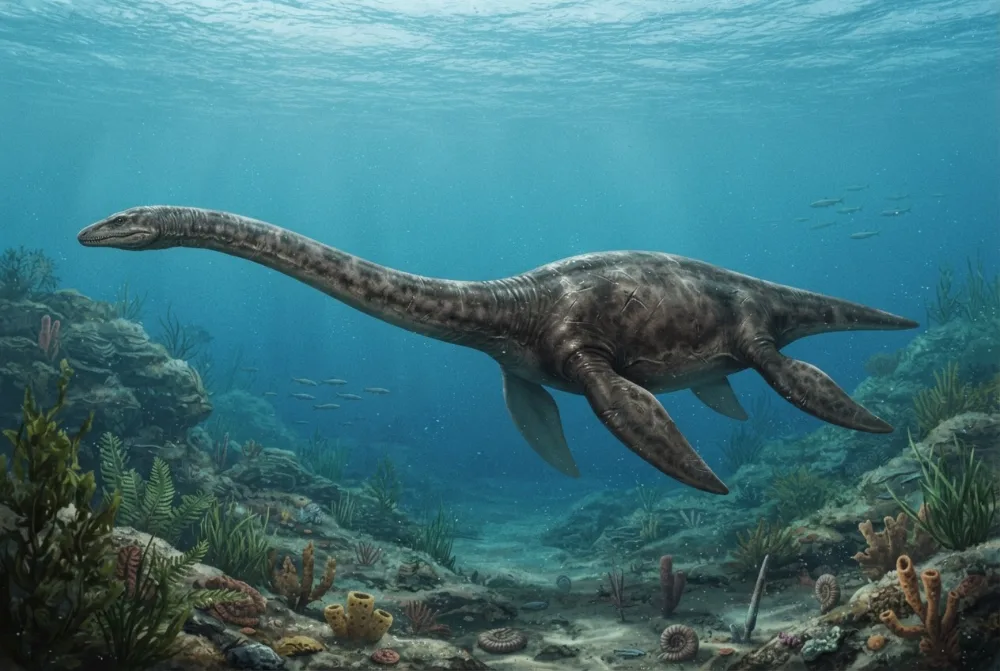
Lagenanectes was a long-necked marine reptile that swam in the seas of what is now Germany. It was not a dinosaur, but a plesiosaur, and it used its four flippers to paddle through the water. This ancient creature grew to about 8 meters long, as long as a school bus!21
Yoom jiraate?
Hammam guddaa ture?
Hammam dheeraa ture?
 akka saree 8 funyaan hanga eegeetti dheeraa🍌akka muuzii 44 walitti hiriiran dheeraa🏊dheerina bishaan daakaa guddaa (50 m) sekondii 7.5 keessatti daakuu danda'a
SI wajjin yoo wal bira qabamu, Lagenanectes hammam guddaa ture?
Herrega qofa barbaadduu kee keessatti. Wanti tokkollee hin olkaa'amu, eessayyuu hin ergamu.
Hammam saffisaa ture?


Odeeffannoowwan bashannansiisoo
Lagenanectes is one of the earliest known elasmosaurids, a group of plesiosaurs with very long necks. It lived about 130 million years ago during the Early Cretaceous.21
The front part of its lower jaw had a unique platform with dents, and the tooth sockets pointed sideways. This is different from most other plesiosaurs.1
Grooves on the top of its skull may have held electroreceptors, which helped Lagenanectes detect prey hidden in the dark water.1
The only known fossil of Lagenanectes shows signs of bone disease. The back of the skull and first neck vertebra had bony outgrowths, possibly from a bacterial infection.21
The fossil was discovered in 1964 by a private collector named Kurt Wiedenroth in a clay pit near Sarstedt, Germany. The pit no longer exists.21
Lagenanectes was named in 2017, more than 50 years after its discovery. Scientists finally studied the bones and realized it was a new genus.1
Ogeeyyii daayinootiif
- Maqaa saayinsii
- Lagenanectes
- Kan maqaa baase
- Sachs et al. 20174
- Garee
- Pileesiyoosaroota
- Maatii / kilaadii
- Elasmosauridae4
- Ramaddii
- Plesiosauria > Elasmosauridae > Sauropterygia4
- Umurii dhagaawwanii
- waggaa miliyoona 133 hanga 126 (Hauterivian)4
- Caasaawwan dhagaa
- Stadthagen4
- Biyyoota
- Jarmanii4
- Galmee fosilii
- 1 The Paleobiology Database keessa4
- Argannoo
- Lagenanectes was discovered in 1964 by fossil collector Kurt Wiedenroth in a clay pit near Sarstedt, Germany. It was named and described as a new genus and species by Sven Sachs, Jahn J. Hornung and Benjamin P. Kear in 2017.21
- Ammallee falmisiisaa
- The exact age of the Lagenanectes fossil is uncertain. It could be from the lower Hauterivian to lower Barremian stages, but scientists think it is most likely upper Hauterivian.21
Odeeffannoon eessaa dhufa
- Lagenanectes (en.wikipedia.org)
- Lagenanectes richterae, an early elasmosaurid from Germany (sachspal.de)
- PBDB Taxon (paleobiodb.org)
- Lagenanectes in The Paleobiology Database (CC BY 4.0): umurii, bakkeewwan, caasaawwan dhagaa, ramaddii.
Odeeffannoon fuula kana irra jiru hundi lakkoofsa madda isaa agarsiisu qaba. Yoo waa dogoggorre, dhiifama, nuti jaallattoota daayinoo malee joornaalii saayinsii miti. [email protected] irratti nutti himi, nus ni sirreessina.
 Rex beela'eera! Dino Wiki pirojektii abbaa tokkoo kan ilma isaa daayinoo jaallatuuf hojjetame, bilisa, beeksisa malee fi hordoftuu malee. Ga'eessonni akka inni interneetii irra turuuf Rexiif nyaata xiqqoo kennuu danda'u.Rex soori
 Elasmosaurus
 Pliosaurus
 Plesiosaurus
 Cimoliasaurus
 Colymbosaurus
 Trinacromerum
 Stegosaurus
 Iguanodon
 Archaeopteryx
 Giganotosaurus
 Microraptor
 Deinonychus