 Ati daayinoo kami? Qormaata
 Lola daayinoo
 Dorgommii daayinoo
 Taphoota daayinoo xixiqqoo
 Albamii istiikarii
 Tarreewwan TOP daayinoo
 Na dinqisiisi!
Navaornis
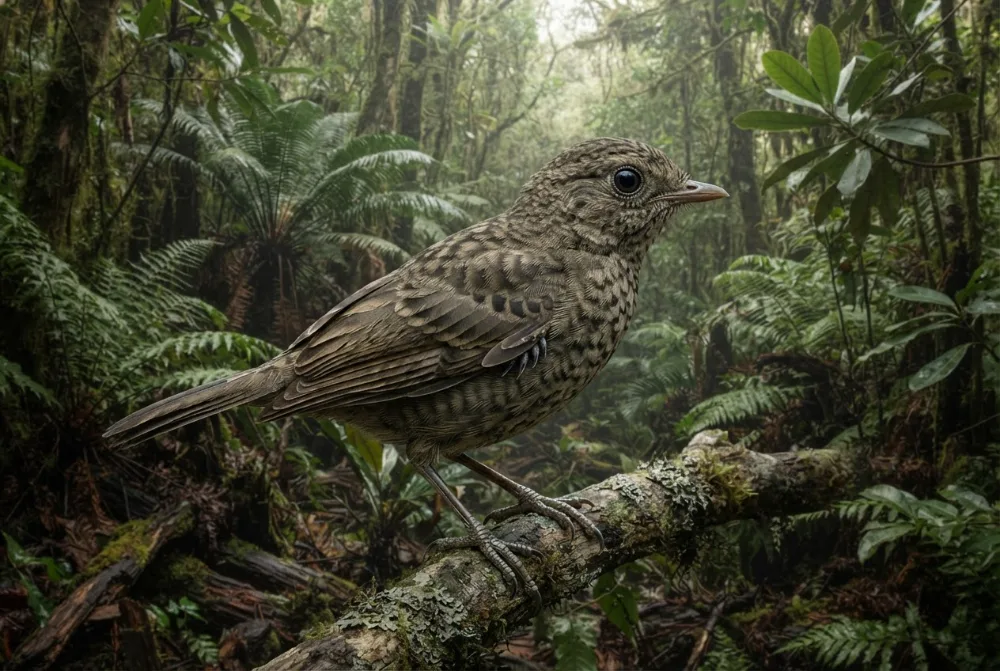
Navaornis was a starling-sized bird that lived about 80 million years ago in what is now Brazil. It had a toothless, large-eyed skull that looked almost like a modern bird, but it belonged to an ancient group called enantiornithines. Its beautifully preserved skull let scientists see inside its brain for the first time in such an old bird.12
Yoom jiraate?
Hammam saffisaa ture?


Odeeffannoowwan bashannansiisoo
Navaornis had a toothless skull with large eyes, just like many birds today, but its brain still had some ancient features like a small cerebellum and a weakly expanded telencephalon.1
Its skull is the best-preserved Mesozoic bird skull ever found, preserved in three dimensions without being flattened.1
The fossil site where Navaornis was found is very small, only about 6 square meters, but it has yielded hundreds of enantiornithine bird bones.1
Navaornis belongs to a group called Enantiornithes, which were the most diverse birds of the Mesozoic and lived on every continent except Antarctica.12
Its inner ear (bony labyrinth) was shaped like that of many modern birds but was much larger.1
Ogeeyyii daayinootiif
- Maqaa saayinsii
- Navaornis
- Kan maqaa baase
- Chiappe et al. 20243
- Garee
- Simbirroota jalqabaa
- Maatii / kilaadii
- Enantiornithes3
- Ramaddii
- Theropoda > Avialae3
- Umurii dhagaawwanii
- waggaa miliyoona 84 hanga 66 (Campanian / Maastrichtian)3
- Caasaawwan dhagaa
- Adamantina3
- Biyyoota
- Biraazil3
- Galmee fosilii
- 1 The Paleobiology Database keessa3
- Argannoo
- The fossil site was discovered in 2004 by William Nava, and the holotype skull was found in 2016. The species was named Navaornis hestiae by Chiappe and colleagues in 2024.13
- Ammallee falmisiisaa
- Scientists are still debating exactly how Navaornis is related to other enantiornithines, because its toothless skull and modern-looking head make it hard to place in the family tree.1
Odeeffannoon eessaa dhufa
- Cretaceous bird from Brazil informs the evolution of the avian skull and brain | Nature (nature.com)
- Cretaceous bird from Brazil informs the evolution of the avian skull and brain (pmc.ncbi.nlm.nih.gov)
- Navaornis in The Paleobiology Database (CC BY 4.0): umurii, bakkeewwan, caasaawwan dhagaa, ramaddii.
Odeeffannoon fuula kana irra jiru hundi lakkoofsa madda isaa agarsiisu qaba. Yoo waa dogoggorre, dhiifama, nuti jaallattoota daayinoo malee joornaalii saayinsii miti. [email protected] irratti nutti himi, nus ni sirreessina.
 Rex beela'eera! Dino Wiki pirojektii abbaa tokkoo kan ilma isaa daayinoo jaallatuuf hojjetame, bilisa, beeksisa malee fi hordoftuu malee. Ga'eessonni akka inni interneetii irra turuuf Rexiif nyaata xiqqoo kennuu danda'u.Rex soori
 Archaeopteryx
 Hesperornis
 Ichthyornis
 Baptornis
 Jurapteryx
 Gobipteryx
 Tyrannosaurus
 Triceratops
 Velociraptor
 Spinosaurus
 Ankylosaurus
 Parasaurolophus