 Ati daayinoo kami? Qormaata
 Lola daayinoo
 Dorgommii daayinoo
 Taphoota daayinoo xixiqqoo
 Albamii istiikarii
 Tarreewwan TOP daayinoo
 Na dinqisiisi!
Yoom jiraate?

Hammam guddaa ture?
Hammam dheeraa ture?
Hammam ol-dheeraa ture?
tilmaama
 akka adurree manaa 2 funyaan hanga eegeetti dheeraa🍌akka muuzii 5 walitti hiriiran dheeraa🪑akka barcuma jala deemuu danda'utti xiqqaa🏊dheerina bishaan daakaa guddaa (50 m) sekondii 20 keessatti daakuu danda'a
SI wajjin yoo wal bira qabamu, Parahesperornis hammam guddaa ture?
Herrega qofa barbaadduu kee keessatti. Wanti tokkollee hin olkaa'amu, eessayyuu hin ergamu.
Hammam saffisaa ture?


Odeeffannoowwan bashannansiisoo
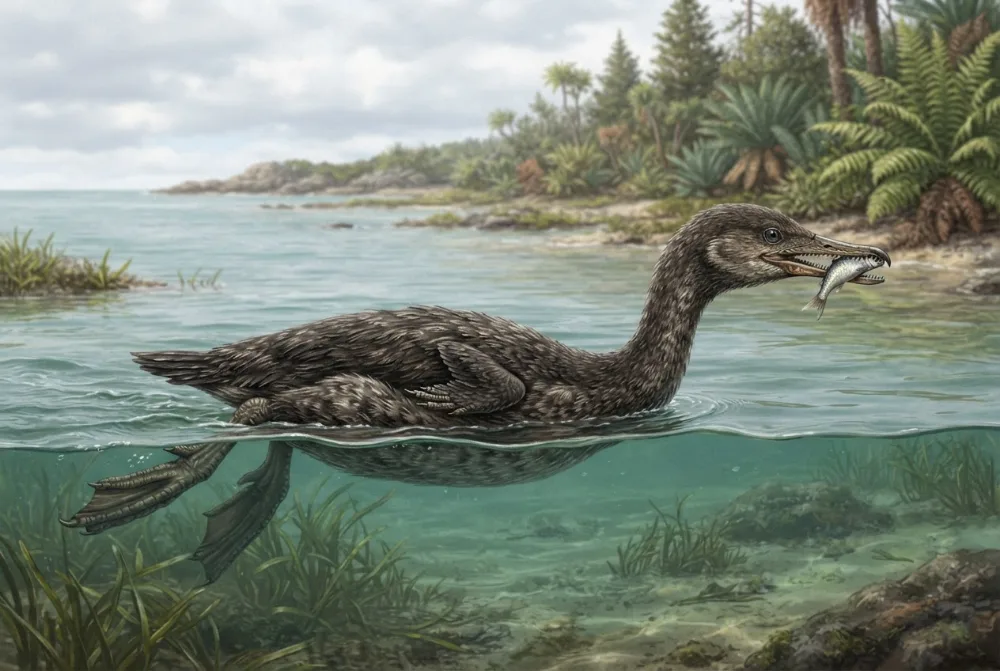
Parahesperornis could not fly. Its wings were tiny and useless for flying, but its legs were strong for swimming.12
It had sharp teeth in its beak, which is unusual for modern birds. These teeth helped it grab slippery fish.12
Parahesperornis is known from two nearly complete skeletons, which is rare for ancient birds. Most are found as just a few bones.2
It lived in the Western Interior Seaway, a shallow sea that covered central North America during the Cretaceous.1
The first fossil of Parahesperornis was found in 1894, but it was not named until 1984 by scientist L. D. Martin.24
Parahesperornis was about the size of a modern loon or a small penguin, around 60 to 90 centimeters long.2
Gaaffiiwwan waa'ee Parahesperornis baay'ee gaafataman
?Was Parahesperornis a dinosaur?
Yes, it was a type of prehistoric bird. While birds are descendants of dinosaurs, scientists classify Parahesperornis as an avialan bird rather than a dinosaur.1
?How big was Parahesperornis?
It was about 60 to 90 centimetres (2 to 3 feet) long, roughly the size of a modern loon or a small penguin.1
?Did Parahesperornis have teeth?
Yes, it had sharp teeth in its beak, which helped it grab slippery fish.2
?Could Parahesperornis swim?
Yes, it was a foot-propelled diving bird that swam like a penguin, using its strong legs to chase fish underwater.3
Ogeeyyii daayinootiif
- Maqaa saayinsii
- Parahesperornis
- Kan maqaa baase
- Martin 19844
- Garee
- Simbirroota jalqabaa
- Maatii / kilaadii
- Hesperornithidae4
- Ramaddii
- Theropoda > Avialae4
- Umurii dhagaawwanii
- waggaa miliyoona 90 hanga 84 (Coniacian / Santonian)4
- Caasaawwan dhagaa
- Niobrara4
- Biyyoota
- Ameerikaa4
- Galmee fosilii
- 3 The Paleobiology Database keessa4
- Argannoo
- The first fossil of Parahesperornis alexi was found in 1894 by H. T. Martin in Graham County, Kansas. It was later named by L. D. Martin in 1984.24
- Ammallee falmisiisaa
- Scientists are not sure if some fossils from Mongolia belong to Parahesperornis or a different, similar bird.1
Odeeffannoon eessaa dhufa
- Parahesperornis (en.wikipedia.org)
- Anatomy of Parahesperornis: Evolutionary Mosaicism in the Cretaceous Hesperornithiformes (Aves) (mdpi.com)
- Anatomy of Parahesperornis: Evolutionary Mosaicism in the Cretaceous Hesperornithiformes (Aves) (pmc.ncbi.nlm.nih.gov)
- Parahesperornis in The Paleobiology Database (CC BY 4.0): umurii, bakkeewwan, caasaawwan dhagaa, ramaddii.
Odeeffannoon fuula kana irra jiru hundi lakkoofsa madda isaa agarsiisu qaba. Yoo waa dogoggorre, dhiifama, nuti jaallattoota daayinoo malee joornaalii saayinsii miti. [email protected] irratti nutti himi, nus ni sirreessina.
 Rex beela'eera! Dino Wiki pirojektii abbaa tokkoo kan ilma isaa daayinoo jaallatuuf hojjetame, bilisa, beeksisa malee fi hordoftuu malee. Ga'eessonni akka inni interneetii irra turuuf Rexiif nyaata xiqqoo kennuu danda'u.Rex soori
 Archaeopteryx
 Hesperornis
 Ichthyornis
 Baptornis
 Jurapteryx
 Gobipteryx
 Tyrannosaurus
 Triceratops
 Velociraptor
 Spinosaurus
 Ankylosaurus
 Parasaurolophus