 Ati daayinoo kami? Qormaata
 Lola daayinoo
 Dorgommii daayinoo
 Taphoota daayinoo xixiqqoo
 Albamii istiikarii
 Tarreewwan TOP daayinoo
 Na dinqisiisi!
Anhanguera
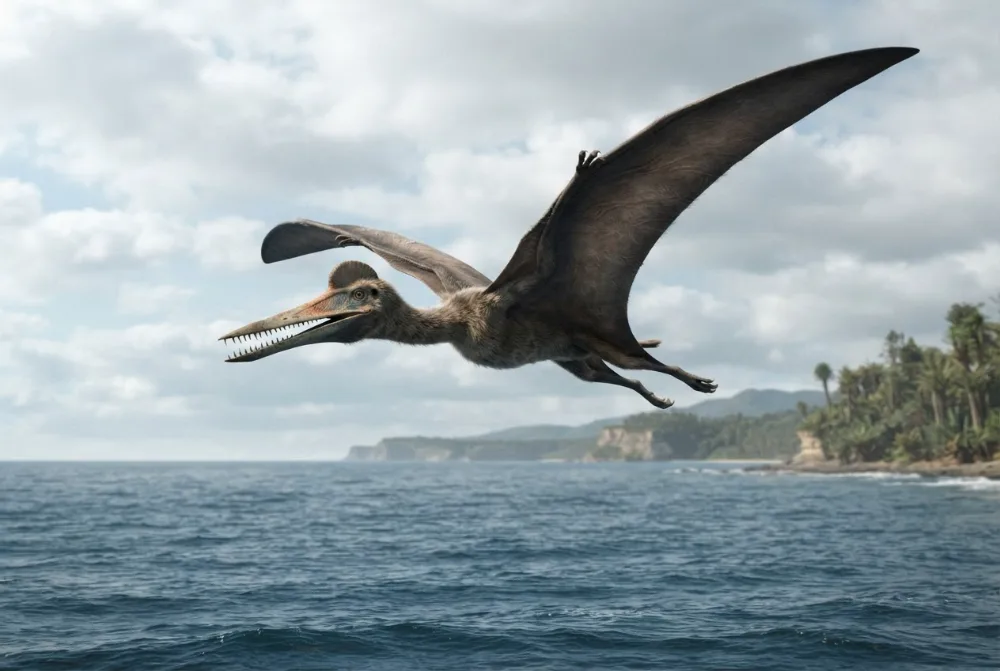
Anhanguera was a flying reptile that soared over ancient seas. It had a long, toothy beak and a wingspan as wide as a car. It was not a dinosaur, but a pterosaur, a close cousin of dinosaurs.1
Yoom jiraate?
Hammam guddaa ture?
Hammam dheeraa ture?
Hammam ulfaataa ture?
 akka adurree manaa 4 funyaan hanga eegeetti dheeraa🍌akka muuzii 11 walitti hiriiran dheeraa🍉akka habxuu 6 ulfaata⚽dirree kubbaa miilaa guutuu sekondii 5.7 keessatti balali'ee ce'uu danda'a
SI wajjin yoo wal bira qabamu, Anhanguera hammam guddaa ture?
Herrega qofa barbaadduu kee keessatti. Wanti tokkollee hin olkaa'amu, eessayyuu hin ergamu.
Hammam saffisaa ture?


Odeeffannoowwan bashannansiisoo
Anhanguera had a crest on the front of its upper jaw, but it was set farther back on the skull than in its close relatives Coloborhynchus and Ornithocheirus.1
Some Anhanguera fossils have a small, blunt crest at the back of the skull, similar to other pteranodontoids.1
A study in 2003 showed that Anhanguera likely held its head at an angle to the ground, based on its inner ear structure, which helped it keep its balance.1
Anhanguera had bony rings in its eye sockets called scleral rings, which may have supported its eyes, similar to modern birds.1
The name Anhanguera comes from the Tupi language and means 'old spirit' or 'spirit protector of the animals'.1
Anhanguera lived during the Early to Late Cretaceous, from about 112 to 93 million years ago.1
Gaaffiiwwan waa'ee Anhanguera baay'ee gaafataman
?How big was Anhanguera?
Anhanguera had a wingspan of about 4.6 meters (15 ft).1
?What did Anhanguera eat?
Anhanguera ate fish. It had sharp, curved teeth to pierce and grip slippery fish.13
?Why did Anhanguera have a crest?
Scientists aren't sure. It might have been for display to attract mates or show off, or it might have helped the animal eat.3
?Could Anhanguera fly?
Yes, Anhanguera was a flying reptile. It had thin, light bones to save weight and a large brain area for coordinating flight, similar to birds.3
?When did Anhanguera live?
Anhanguera lived during the Early to Late Cretaceous, from about 112 to 93 million years ago.1
Ogeeyyii daayinootiif
- Maqaa saayinsii
- Anhanguera
- Kan maqaa baase
- Campos and Kellner 19854
- Garee
- Harkifattoota balali'an
- Maatii / kilaadii
- Ornithocheiroidea4
- Ramaddii
- Pterosauria > Pterodactyloidea4
- Umurii dhagaawwanii
- waggaa miliyoona 137 hanga 94 (Valanginian / Cenomanian)4
- Caasaawwan dhagaa
- Romualdo, West Melbury Marly Chalk, Toolebuc4
- Biyyoota
- Biraazil, Biriteen, Awustiraaliyaa, Morookoo, Gibxi, Kolombiyaa4
- Galmee fosilii
- 18 The Paleobiology Database keessa4
- Argannoo
- Anhanguera was named in 1985 by Brazilian paleontologists Diogenes de Almeida Campos and Alexander Wilhelm Armin Kellner, based on a complete skull found in the Romualdo Formation of Brazil.14
- Ammallee falmisiisaa
- Scientists are not sure whether the crests on the jaws were present in all Anhanguera individuals or only in some, possibly depending on age or sex.1
Odeeffannoon eessaa dhufa
- Anhanguera (pterosaur) (en.wikipedia.org)
- _Anhanguera_ (pterosaur) — Grokipedia (grokipedia.com)
- Watch a pterosaur fly | Natural History Museum (nhm.ac.uk)
- Anhanguera in The Paleobiology Database (CC BY 4.0): umurii, bakkeewwan, caasaawwan dhagaa, ramaddii.
Odeeffannoon fuula kana irra jiru hundi lakkoofsa madda isaa agarsiisu qaba. Yoo waa dogoggorre, dhiifama, nuti jaallattoota daayinoo malee joornaalii saayinsii miti. [email protected] irratti nutti himi, nus ni sirreessina.
 Rex beela'eera! Dino Wiki pirojektii abbaa tokkoo kan ilma isaa daayinoo jaallatuuf hojjetame, bilisa, beeksisa malee fi hordoftuu malee. Ga'eessonni akka inni interneetii irra turuuf Rexiif nyaata xiqqoo kennuu danda'u.Rex soori
 Pteranodon
 Quetzalcoatlus
 Dorygnathus
 Rhamphorhynchus
 Pterodactylus
 Eudimorphodon
 Stegosaurus
 Iguanodon
 Archaeopteryx
 Giganotosaurus
 Microraptor
 Deinonychus